
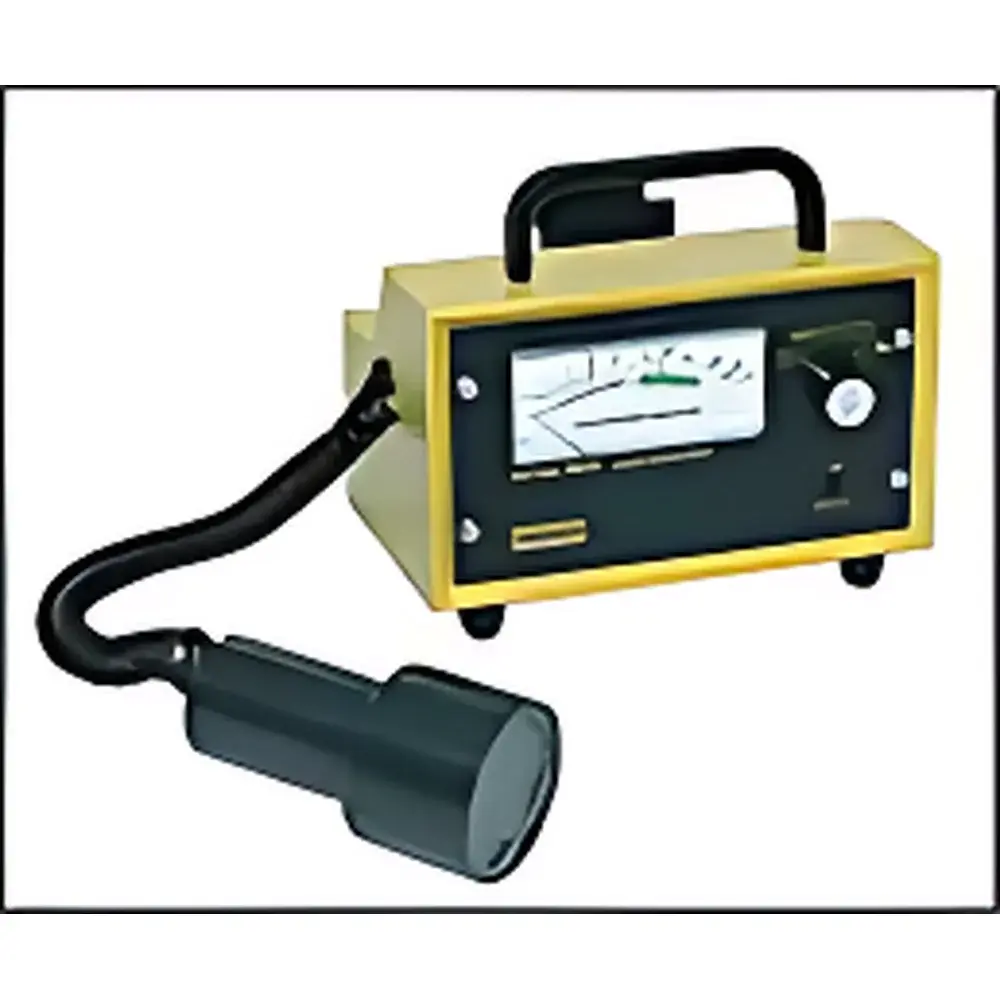
Thermo Fisher Mini 900 Series Multifunction Radiation Survey Meter
| Brand | Thermo Fisher |
|---|---|
| Origin | USA |
| Manufacturer Type | Original Equipment Manufacturer (OEM) |
| Product Origin | Imported |
| Model | Mini 900 Series |
| Instrument Category | Dose Rate Meter / Radiation Survey Meter |
| Form Factor | Portable / Benchtop Configurable |
| Radiation Types Detected | X-ray and Gamma (γ) Radiation |
| Detector Options | Geiger-Müller (GM) Tube or Scintillation Detector |
| Measurement Principle | Pulse Counting / Analog Voltage Output Integration |
| Display Format | Logarithmic Scale with Simultaneous Background and Net Count Rate Readout |
| Alarm Function | User-Adjustable Threshold with Proportional Audio Feedback |
| Variants | R-Type (General Purpose), G-Type (Gamma-Optimized), D-Type (Dose Rate Calibrated), X-Type (X-Ray Enhanced) |
| Dimensions | 180 mm (W) × 110 mm (D) × 165 mm (H) |
| Weight | 1.0 kg |
| Power Supply | 6 × AA Alkaline or Rechargeable Batteries (Typical Runtime: ~300 hours at 4 hrs/day usage) |
| GM Tube Bias Voltage Range | 300–700 V DC |
| External Power Input | 12–18 V DC |
| High-Voltage Generator Output | 600–1500 V DC |
| Sensitivity | –100 mV negative polarity analog voltage input (for external detector interfacing) |
| Energy Response | Detector-dependent |
Overview
The Thermo Fisher Mini 900 Series Multifunction Radiation Survey Meter is a field-deployable, dual-mode (portable or benchtop) radiation detection platform engineered for quantitative measurement of X-ray and gamma (γ) photon fields in low-to-moderate intensity environments. Its core architecture employs pulse counting methodology—either via integrated Geiger-Müller (GM) tubes or externally coupled scintillation detectors—delivering real-time dose rate estimation based on count rate-to-dose conversion algorithms traceable to NIST-calibrated reference sources. Designed for operational flexibility, the Mini 900 supports interchangeable probe configurations and accommodates both analog voltage input (–100 mV negative polarity) and digital pulse output interfaces, enabling seamless integration with third-party spectrometers or data acquisition systems. The instrument’s logarithmic display engine simultaneously renders background-subtracted net count rate and ambient background level, providing immediate context for interpretation—a critical feature during rapid environmental screening or emergency response scenarios.
Key Features
- Dual operating mode: Handheld portability (1.0 kg) with ergonomic grip and ruggedized housing, or stable benchtop deployment using optional mounting kit.
- Configurable detector support: Factory-integrated GM tube (R/G/D variants) or plug-and-play compatibility with NaI(Tl), CsI(Tl), or plastic scintillators (X-type optimized for low-energy X-rays).
- Dynamic audio alarm system: Threshold-triggered audible alert with volume modulated proportionally to measured count rate—enhancing situational awareness without requiring visual monitoring.
- High-voltage generator with adjustable bias (600–1500 V DC) ensures optimal detector gain stability across temperature and humidity gradients typical in field use.
- Extended battery life: Up to 300 hours of continuous operation on six AA alkaline cells; also supports rechargeable NiMH or Li-ion packs with onboard charge management.
- IEC 60529 IP54-rated enclosure provides dust resistance and protection against water splashes during outdoor surveys or industrial site inspections.
Sample Compatibility & Compliance
The Mini 900 Series is validated for use with sealed radioactive sources (e.g., 137Cs, 60Co, 241Am), X-ray generating equipment (diagnostic and industrial), and naturally occurring radioactive material (NORM) environments. Each variant undergoes type testing per IEC 60846-1:2014 (Radiation protection instrumentation — Dose rate meters and area monitors for X, gamma, neutron and beta radiations) and complies with ANSI N42.17A-2003 (Performance Criteria for Health Physics Instrumentation). Calibration certificates are issued with NIST-traceable uncertainty budgets (<±5% at 662 keV, k=2). The device meets electromagnetic compatibility (EMC) requirements per EN 61326-1:2013 and is suitable for GLP-compliant laboratories conducting routine environmental monitoring or radiation safety audits.
Software & Data Management
Data logging is supported via USB-C interface and Thermo Fisher’s proprietary RadLink™ PC software (v3.2+), enabling time-stamped export of dose rate profiles, alarm event logs, and calibration history. All stored measurements include metadata: GPS coordinates (when paired with optional Bluetooth GNSS module), operator ID, detector serial number, and ambient temperature/humidity (via integrated sensors). Audit trails comply with FDA 21 CFR Part 11 requirements for electronic records and signatures when configured with user authentication and role-based access control. Raw pulse data can be exported in CSV or binary formats for spectral analysis in third-party tools such as ORTEC GammaVision® or Canberra Genie™.
Applications
- Radiation safety programs: Routine area monitoring in nuclear medicine departments, radiotherapy bunkers, and PET cyclotron facilities.
- Environmental health physics: Baseline surveys near legacy uranium processing sites, NORM-contaminated oilfield equipment, or post-incident fallout mapping.
- Academic instruction: Hands-on laboratory exercises in nuclear physics, health physics, and radiation biology curricula.
- Industrial QA/QC: Verification of shielding integrity in non-destructive testing (NDT) bays and verification of source encapsulation integrity.
- Regulatory compliance: Support for ISO 20553:2021 (Sampling for radiological characterization of waste) and EURATOM Basic Safety Standards Directive 2013/59.
FAQ
What radiation energies does the Mini 900 Series accurately measure?
The effective energy response depends on detector configuration: G-Type achieves ±20% deviation from reference response between 50 keV and 1.3 MeV; X-Type extends lower limit to 15 keV with beryllium-window GM tube.
Can the Mini 900 interface with external spectroscopy systems?
Yes—via its –100 mV analog input port or TTL-compatible pulse output, supporting connection to multichannel analyzers (MCAs) for energy-resolved coincidence counting or spectral unfolding.
Is firmware update capability available in the field?
Yes—over-the-air updates are delivered via RadLink™ software; no hardware modification required.
Does the instrument support dose rate averaging over configurable time windows?
Yes—user-selectable integration periods from 1 second to 60 minutes, with exponential moving average (EMA) and arithmetic mean options.
How is traceability maintained during recalibration?
Each recalibration includes full metrological documentation referencing NIST SRM 2262 or equivalent certified reference materials, with uncertainty budgets reported per ISO/IEC 17025:2017 Annex A.







