
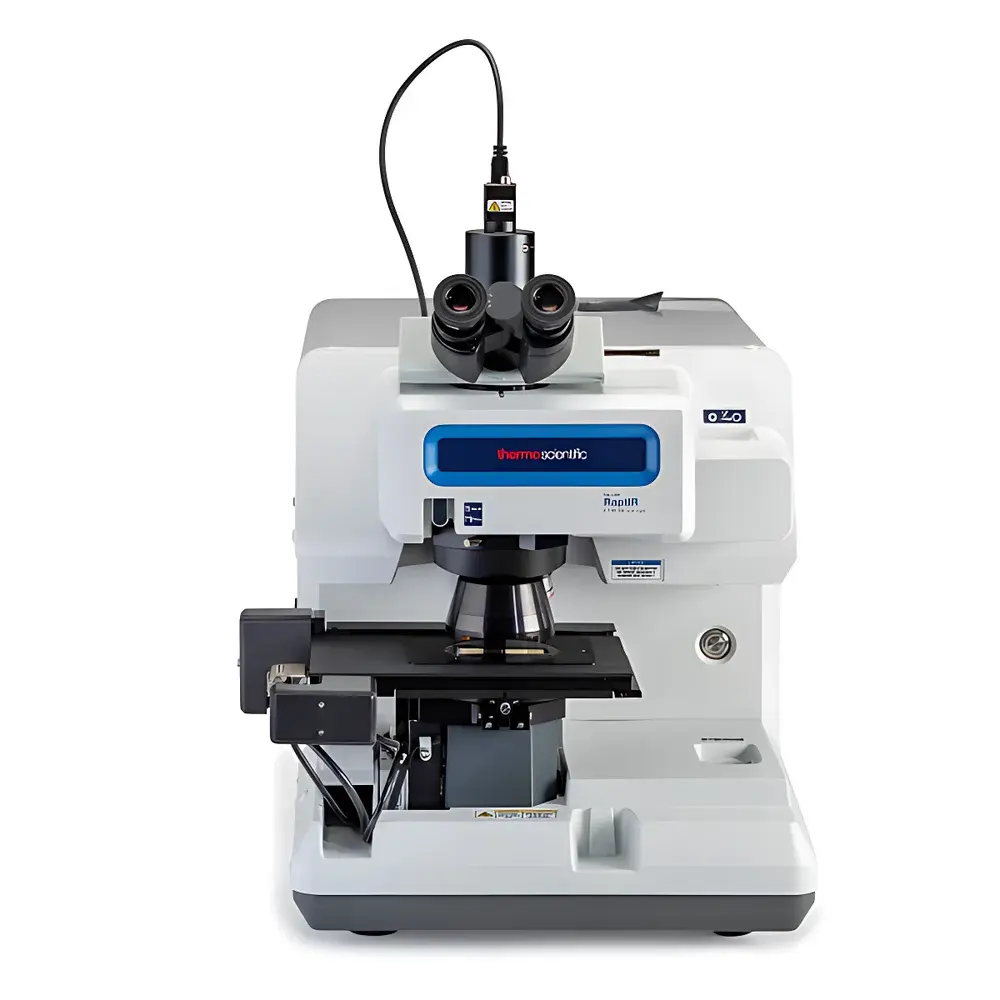
Thermo Fisher Nicolet RaptIR Fourier Transform Infrared Microscope
| Brand | Thermo Fisher |
|---|---|
| Origin | USA |
| Manufacturer | Thermo Fisher Scientific |
| Type | Imported Instrument |
| Model | RaptIR |
| Price Range | USD 42,000 – 70,000 |
Overview
The Thermo Fisher Nicolet RaptIR Fourier Transform Infrared (FT-IR) Microscope is an integrated benchtop analytical platform engineered for high-spatial-resolution chemical imaging and microspectroscopic analysis of solid, thin-film, and heterogeneous samples. Leveraging a patented optical architecture that mitigates classical diffraction limitations in mid-infrared microscopy, the RaptIR achieves effective spatial resolution down to ~3–5 µm (at 1500 cm⁻¹), surpassing conventional FT-IR microscopes without synchrotron or near-field enhancement. Its core measurement principle combines interferometric spectral acquisition (via Michelson interferometer with KBr beam splitter and liquid-nitrogen-cooled MCT detector) with precision reflective Cassegrain optics and motorized alignment—enabling quantitative absorbance, transmittance, and reflectance mapping across spectral ranges from 7500 to 600 cm⁻¹ (1.3–16.7 µm). Designed for routine use in regulated QC labs, materials research facilities, and forensic laboratories, the RaptIR delivers reproducible molecular fingerprinting at the micron scale while maintaining full compliance with ASTM E1252, ISO 18380, and USP guidelines for IR microspectroscopy.
Key Features
- Patented diffraction-limit-bypassing optical path: Incorporates adaptive mirror alignment and optimized pupil conjugation to maximize throughput and spatial fidelity without attenuated signal-to-noise ratio.
- Motorized objective turret with up to five positions: Enables seamless switching between visible-light observation (10×, 20×, 50×, 100× long-working-distance objectives) and IR transmission/reflection modes—all calibrated and registered within a single coordinate system.
- Configurable polarization optics: Optional wire-grid polarizers (visible and IR bands) support anisotropy studies, crystallinity assessment, and stress-induced birefringence analysis in polymers and pharmaceuticals.
- High-load, large-travel XYZ stage: 100 mm × 100 mm travel range with 0.1 µm closed-loop encoder resolution; supports specimens up to 5 kg and thicknesses exceeding 30 mm—ideal for cross-sectioned composites, geological thin sections, and packaged electronic components.
- Workflow-driven software interface (OMNIC Picta): Guides users through standardized acquisition protocols—including auto-focus, auto-aperture, spectral background correction, and region-of-interest (ROI) definition—minimizing operator dependency and training time.
- Dedicated particle analysis module: Performs automated detection, morphological classification (size, aspect ratio, convexity), and hierarchical cluster-based spectral identification across mm²-scale maps—validated for microplastic characterization per ASTM D8338 and EU ECHA microplastics monitoring frameworks.
Sample Compatibility & Compliance
The RaptIR accommodates a broad spectrum of sample types: polished metal cross-sections, polymer laminates, biological tissue sections (FFPE or cryo-mounted), semiconductor wafers, forensic trace evidence (fibers, paint chips, gunshot residue), and environmental filter substrates. Transmission, reflection (including ATR-microscopy via optional diamond anvil accessory), and photoacoustic modes are supported. All hardware and firmware comply with IEC 61000-6-3 (EMC) and UL 61010-1 safety standards. Data acquisition and processing meet FDA 21 CFR Part 11 requirements when deployed with OMNIC Enterprise Edition, including electronic signatures, audit trails, and role-based access control—fully auditable for GLP and GMP environments.
Software & Data Management
Controlled exclusively by Thermo Fisher’s OMNIC software suite (v12.5+), the RaptIR integrates spectral library searching (Spectral Libraries: Polymer, Pharmaceutical, Forensic, Environmental), multivariate analysis (PCA, CLS, PLS), and hyperspectral image processing (false-color mapping, spectral unmixing, threshold segmentation). Raw interferograms and processed spectra are stored in vendor-neutral .spa/.spc formats compliant with ASTM E1655; project metadata adheres to ISA-Tab conventions. Network deployment supports centralized instrument management, remote diagnostics, and secure data export to LIMS via ODBC or RESTful API integration.
Applications
- Pharmaceutical: Active pharmaceutical ingredient (API) distribution mapping in tablets, excipient compatibility screening, and counterfeit drug identification.
- Materials Science: Phase segregation in polymer blends, oxidation state analysis in battery cathode materials, and interfacial chemistry in adhesive joints.
- Environmental: Identification and quantification of microplastics (>10 µm) in water filtration membranes and sediment cores.
- Electronics: Contamination analysis on PCB surfaces, delamination detection in underfill encapsulants, and solder flux residue characterization.
- Forensics: Discrimination of automotive paint layers, fiber dye profiling, and explosive residue differentiation via spectral similarity indexing.
FAQ
What spectral resolution options are available on the RaptIR?
Standard resolution is 4 cm⁻¹; optional 2 cm⁻¹ and 1 cm⁻¹ configurations are supported via adjustable interferometer scan velocity and apodization settings.
Can the RaptIR perform step-scan time-resolved measurements?
No—the RaptIR is optimized for rapid-scan FT-IR microspectroscopy and does not support step-scan or dynamic modulation modes.
Is external ATR capability included or optional?
A motorized ATR objective (diamond crystal, 100× magnification) is available as a factory-installed option, enabling contact-mode micro-ATR analysis of non-transmissive samples.
Does the system support hyphenated techniques such as IR-GC or IR-LC?
The RaptIR is a standalone microscope; it does not integrate with gas chromatography or liquid chromatography systems.
What maintenance intervals are recommended for the interferometer and detector?
The sealed interferometer requires no routine alignment; the MCT detector should be refilled with liquid nitrogen prior to each 8-hour operational session, and vacuum integrity is monitored automatically via onboard pressure sensors.





