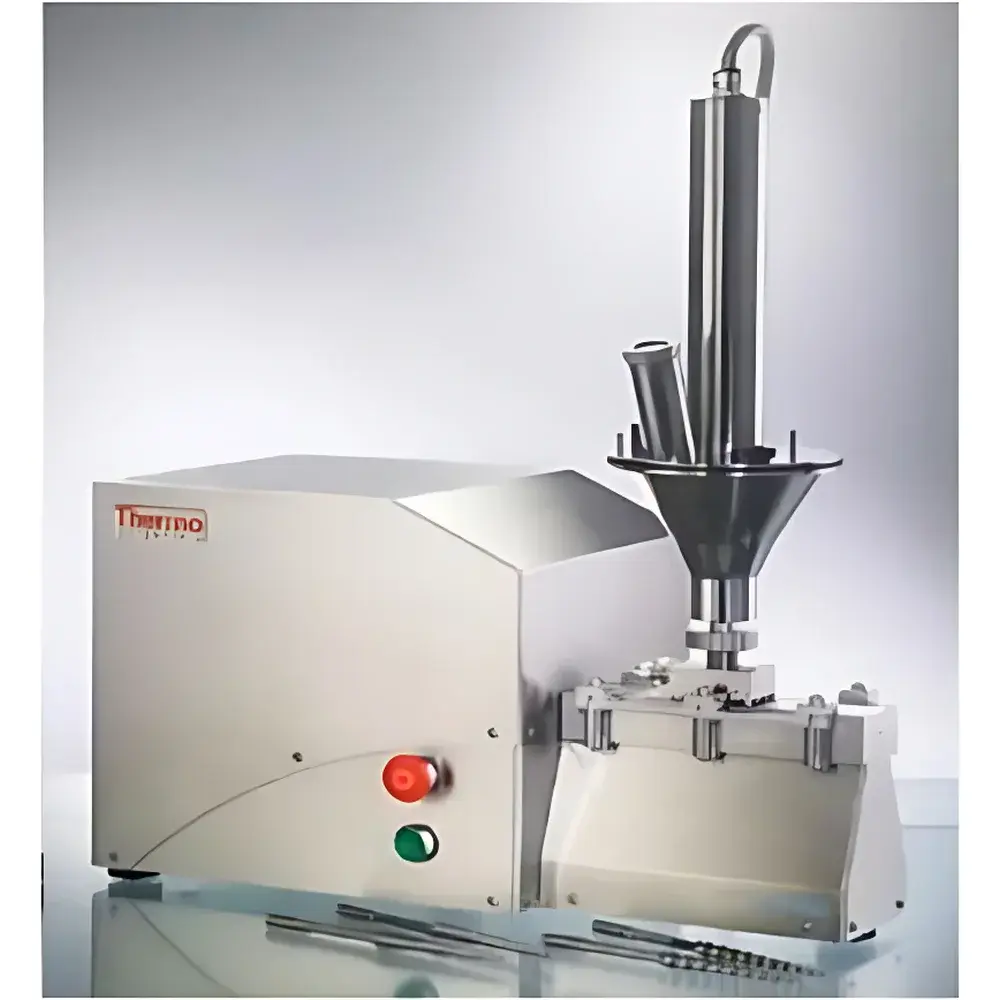
Thermo Fisher Pharma Mini HME Laboratory-Scale Hot Melt Extruder
| Brand | Thermo Fisher |
|---|---|
| Origin | Germany |
| Manufacturer | Thermo Fisher Scientific |
| Country of Origin | Imported |
| Model | Pharma Mini |
| Motor Power | 400 W |
| Speed Range | 10–360 rpm |
| Screw Configuration | Conical Co-rotating or Counter-rotating |
| Max Operating Temperature | 280 °C |
| Heating Time (22–170 °C) | < 10 min |
| Free Volume | 3 g (4 mL) |
| Screw Material | Medical-Grade Stainless Steel 1.4112 (AISI 440B) |
| Barrel Material | High-Performance Pharmaceutical-Grade Stainless Steel M340 |
| IP Rating | IP54 |
| Production Capacity | Up to 100 g/h |
| Controller | Touchscreen with User-Level Access Control and Password Protection |
Overview
The Thermo Fisher Pharma Mini HME is a laboratory-scale, conical twin-screw hot melt extruder engineered specifically for pharmaceutical formulation development under GMP-aligned conditions. It operates on the principle of continuous thermomechanical processing—combining controlled heating, shear-induced mixing, and pressure-driven conveying—to enable solid dispersion preparation, amorphous stabilization of poorly soluble APIs, and polymer-based matrix development. Unlike conventional batch mixers or larger-scale extruders, the Pharma Mini HME delivers process-relevant data at microscale, supporting Quality-by-Design (QbD) workflows and enabling direct scale-up correlation to pilot and commercial extrusion lines. Its compact conical geometry ensures high shear intensity with low residence time variability—critical for thermally sensitive actives—and facilitates rapid material screening with minimal API consumption (as low as 3 g per experiment).
Key Features
- Microscale Process Relevance: Designed with a 3 g (4 mL) internal free volume, the system enables early-stage formulation assessment using clinically relevant excipients and low-cost API quantities—reducing material waste and accelerating decision gates in preformulation.
- GMP-Ready Architecture: Constructed from pharmaceutical-grade stainless steels—including 1.4112 (AISI 440B) screws and M340 barrel material—the unit meets material compatibility requirements for USP Class VI and ISO 10993-5 compliance. All product-contact surfaces are fully demountable for cleaning validation and changeover between formulations.
- IP54-Rated Enclosure: Enables safe, compliant wet cleaning via spray rinse without disassembly—supporting routine maintenance in shared lab environments and adherence to cleaning validation protocols per EU Annex 15 and FDA Guidance on Cleaning Validation.
- Modular Thermal & Mechanical Control: Independent zone heating (up to 280 °C), real-time torque monitoring, and precise screw speed control (10–360 rpm) allow systematic DoE studies across temperature, shear rate, and residence time parameters.
- Flexible Operational Modes: Configurable as either a continuous extruder (up to 100 g/h) or a batch-mode mini-mixer via optional batch conversion kit—supporting both continuous manufacturing development and traditional batch process simulation.
- Integrated Human-Machine Interface: Standalone touchscreen controller with multi-level user authentication (admin/operator/restricted), audit trail logging, and password-protected parameter locking—aligned with 21 CFR Part 11 requirements for electronic records and signatures.
Sample Compatibility & Compliance
The Pharma Mini HME accommodates a broad range of thermoplastic polymers (e.g., HPMCAS, PVP-VA, EUDRAGIT® grades), plasticizers (e.g., triethyl citrate, PEG), and APIs—including low-melting-point compounds, hygroscopic substances, and high-potency actives—when operated within defined thermal and mechanical limits. Its design supports ASTM F2924-14 (standard guide for hot melt extrusion process development) and ICH Q5A(R2)/Q5C guidelines for biopharmaceutical excipient qualification. All wetted parts comply with USP and cytotoxicity testing standards. The system’s modular construction allows integration into ISO Class 5/7 cleanroom environments when installed inside ventilated enclosures or gloveboxes—validated for use with OEL Band 3–4 compounds per ISPE Guide: Handling Highly Potent Compounds.
Software & Data Management
Data acquisition is supported via optional HAAKE RheoWin software, which logs time-stamped records of barrel zone temperatures, motor torque, screw speed, and power consumption—exportable in CSV or PDF formats for regulatory submission (e.g., IND/NDA modules). The controller maintains an immutable audit trail of all parameter changes, user logins, and alarm events, satisfying ALCOA+ principles (Attributable, Legible, Contemporaneous, Original, Accurate, Complete, Consistent, Enduring, Available). Raw datasets can be linked to LIMS or ELN platforms via OPC UA or Modbus TCP interfaces, facilitating automated data aggregation in enterprise quality systems.
Applications
- Early-phase solubility enhancement of BCS Class II/IV APIs via amorphous solid dispersion development
- Rapid screening of polymer-API miscibility and physical stability under accelerated storage conditions
- Process parameter mapping for continuous manufacturing technology transfer (e.g., from lab to KinetiSol® or twin-screw extrusion platforms)
- Development of taste-masked oral films, implantable matrices, and transdermal polymer blends
- Supporting regulatory filings with mechanistic understanding of melt viscosity, degradation kinetics, and phase behavior
FAQ
Is the Pharma Mini HME suitable for GLP-compliant studies?
Yes—the system supports full traceability, electronic signature capability, and audit-ready data export, meeting core GLP requirements for nonclinical laboratory studies as defined by OECD Principles of GLP and FDA 21 CFR Part 58.
Can it be used with highly potent compounds (HPAPIs)?
When operated inside a certified containment glovebox (ISO Class 3–5) and coupled with the optional forced feeder and closed-loop venting, the unit complies with occupational exposure limits down to 10 ng/m³ for OEB4 compounds.
What validation documentation is provided?
Thermo Fisher supplies Factory Acceptance Test (FAT) reports, Installation Qualification (IQ) templates, and Operational Qualification (OQ) protocols aligned with ASTM E2500-13 and ISPE Baseline Guide Vol. 5.
Is remote monitoring supported?
Via Ethernet-enabled controller firmware, users may configure SNMP traps, email alerts for critical alarms, and secure web-based read-only access for supervisory review—without compromising local data integrity.