
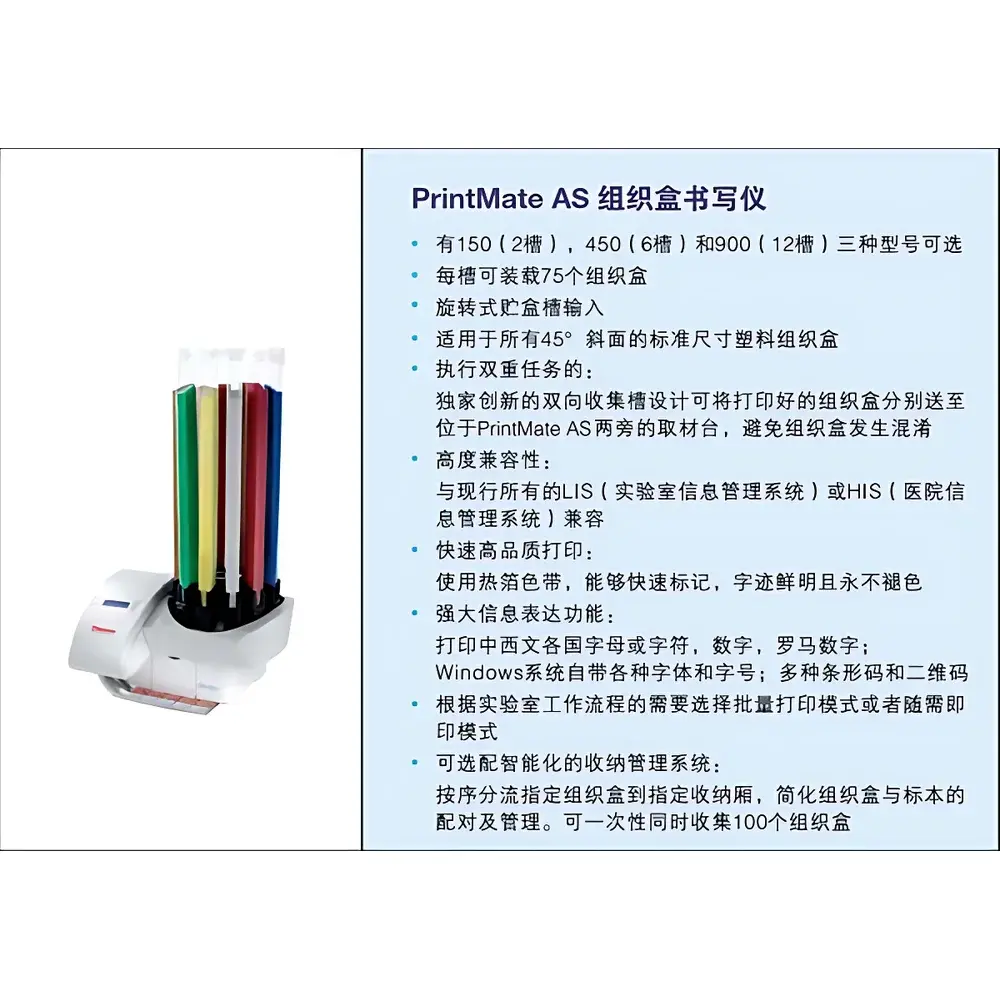
Thermo Fisher PrintMate AS Automated Tissue Cassette Printer
| Brand | Thermo Fisher Scientific |
|---|---|
| Origin | Germany |
| Model | PrintMate AS |
| Capacity Options | 150 (2-slot), 450 (6-slot), 900 (12-slot) |
| Cassette Load per Slot | 75 |
| Input Mechanism | Rotary Magazine Feeding |
| Compatible Cassette Type | Standard 45°-angled plastic tissue cassettes |
| Printing Technology | Thermal Foil Transfer with High-Durability Ribbons |
| Barcode/QR Support | Code 128, Code 39, Data Matrix, QR Code |
| Character Set | Unicode-compliant (Latin, Cyrillic, Greek, CJK Unified Ideographs), Windows TrueType Fonts |
| Interface | HL7, ASTM LIS/HIS Integration |
| Compliance | ISO 15189, CLIA, CAP, FDA 21 CFR Part 11 (audit trail & electronic signature ready) |
| Optional Module | Smart Sorting Drawer System (100-cassette simultaneous collection) |
Overview
The Thermo Fisher PrintMate AS is an automated, high-integrity tissue cassette labeling system engineered for pathology laboratories requiring traceability, regulatory compliance, and workflow scalability. Operating on thermal foil transfer printing technology, it delivers permanent, smudge-resistant, and chemically stable identification directly onto standard 45°-angled plastic tissue cassettes—without solvent-based inks or post-print drying delays. Unlike legacy dot-matrix or inkjet solutions, the PrintMate AS eliminates label adhesion failure, barcode misreads, and manual transcription errors by integrating directly with laboratory information systems (LIS) and hospital information systems (HIS) via ASTM and HL7 protocols. Its core architecture supports dual-path cassette ejection—directing printed cassettes to left- and right-side grossing stations—to enforce spatial separation of specimen streams and reduce cross-contamination risk during tissue processing.
Key Features
- Three throughput configurations: 150-cassette (2-slot), 450-cassette (6-slot), and 900-cassette (12-slot) models—each scalable via modular rotary magazine design.
- Thermal foil transfer engine ensures archival-grade print permanence: resistant to xylene, ethanol, formalin, and paraffin embedding solvents.
- Dual-output cassette routing enables concurrent distribution to two grossing workstations—eliminating manual re-sorting and supporting parallel tissue intake workflows.
- Full Unicode support—including Latin, Cyrillic, Greek, and CJK character sets—enables multilingual lab reporting and international specimen tracking without font substitution failures.
- Native integration with Windows-based print drivers allows use of system-installed TrueType fonts, variable font sizing, and dynamic field mapping (e.g., accession number, block ID, date/time stamp, operator ID).
- FDA 21 CFR Part 11–ready firmware includes user authentication, electronic signature capture, and immutable audit trails for all print jobs and configuration changes.
Sample Compatibility & Compliance
The PrintMate AS accepts only standardized 45°-angled plastic tissue cassettes conforming to ANSI/CLSI GP35-A4 and ISO 15189 Annex B specifications. It does not support non-standard angles, metal cassettes, or custom-molded geometries. All printed identifiers meet ISO/IEC 15416 and 15415 standards for linear and 2D symbology decodeability under clinical-grade scanning conditions (e.g., Zebra DS4600, Honeywell Xenon XP). The system is validated for use in CAP-accredited, CLIA-certified, and ISO 15189–compliant pathology labs. Its data exchange layer complies with ASTM E1384 (LIS interface standard) and HL7 v2.5.1 message structures for order acknowledgment, result acknowledgment, and status update transactions.
Software & Data Management
The PrintMate AS operates via Thermo Fisher’s PathPrint Control Suite—a Windows 10/11–based application supporting both batch-mode preloading (from CSV or LIS export files) and real-time “print-on-demand” execution triggered by LIS order arrival. All print jobs are logged with timestamp, user ID, cassette position, and embedded metadata (e.g., specimen type, staining protocol flag). Optional audit modules generate PDF reports compliant with GLP/GMP documentation requirements. When deployed with the Smart Sorting Drawer System, the software assigns destination drawers using configurable rules (e.g., by accession prefix, tissue origin, or processing priority), enabling fully traceable cassette-to-drawer mapping without manual intervention.
Applications
- Primary specimen labeling in surgical pathology labs handling >500 cases/week.
- High-volume biopsy processing centers requiring unambiguous differentiation between multi-block submissions from single patients.
- Research biobanks implementing FAIR (Findable, Accessible, Interoperable, Reusable) data principles through machine-readable cassette IDs linked to LIMS specimen records.
- Reference labs performing inter-laboratory validation studies where cassette-level traceability must survive full histological processing—including decalcification, microwave-assisted fixation, and automated stainer integration.
- Teaching hospitals deploying dual grossing stations to separate routine vs. urgent specimens while maintaining synchronized LIS synchronization.
FAQ
Does the PrintMate AS support direct connection to my existing LIS?
Yes—via standard ASTM E1384 or HL7 v2.5.1 interfaces. Configuration requires LIS-side message mapping and Thermo Fisher’s certified integration toolkit.
Can I print barcodes that comply with CAP checklist ANP.22800?
Yes—the system generates Code 128 and Data Matrix symbols meeting ANSI/ISO print quality Grade B or higher under clinical scanning conditions.
Is thermal foil ribbon supply included with the instrument?
No—ribbons are consumables ordered separately; Thermo Fisher offers black, red, and blue ribbons qualified for >10,000 prints per roll under ISO 15189 environmental storage conditions.
What maintenance is required beyond ribbon replacement?
Annual calibration verification by Thermo Fisher Field Service Engineers is recommended; no user-serviceable optics or printhead adjustments are permitted.
How does the Smart Sorting Drawer System integrate with specimen tracking software?
It exports drawer assignment logs as CSV or HL7 ORM messages, enabling bidirectional sync with LIMS for real-time cassette location visibility across the tissue processing chain.





