
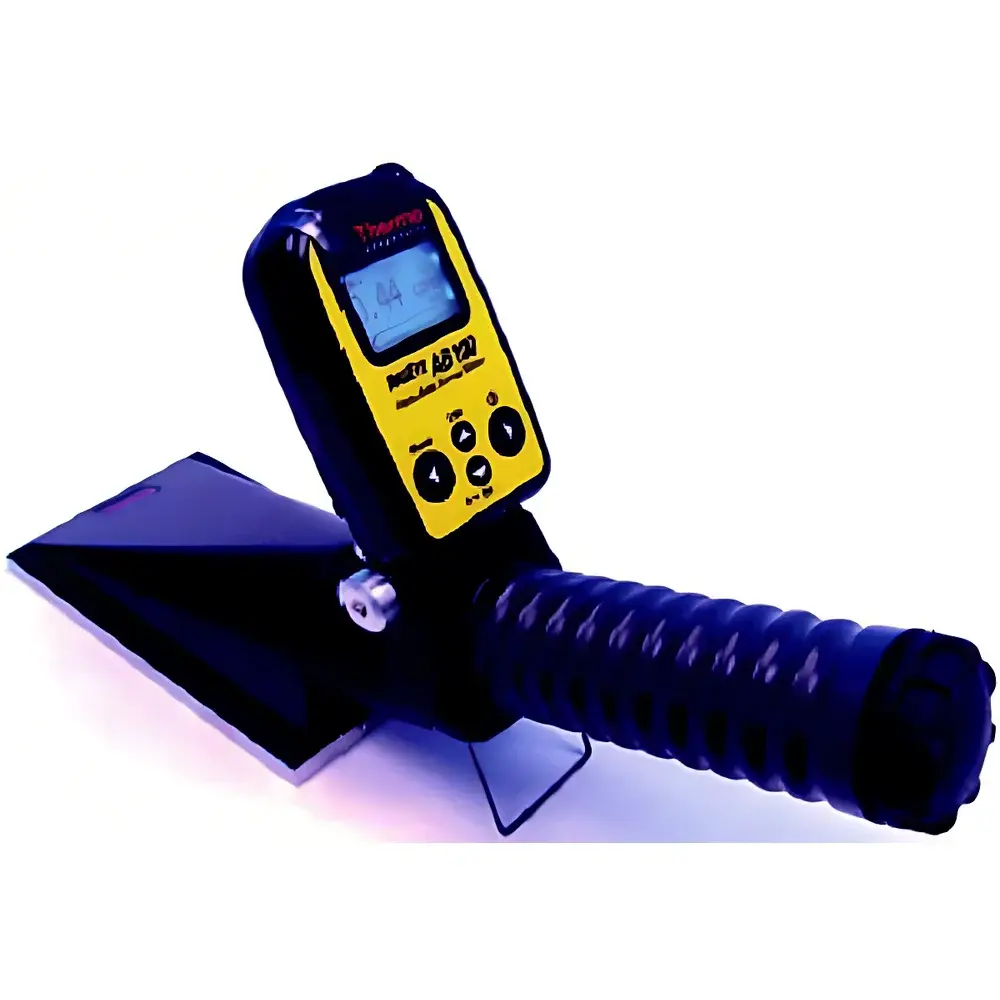
Thermo Fisher RadEye AB100 Portable Alpha/Beta Surface Contamination Monitor
| Brand | Thermo Fisher |
|---|---|
| Origin | USA |
| Manufacturer | Thermo Fisher Scientific |
| Product Type | Imported |
| Model | RadEye AB100 |
| Instrument Category | Dose Rate / Contamination Meter |
| Form Factor | Portable |
| Detector Type | Zinc-Loaded Plastic Scintillator |
| Active Detection Area | 69 mm × 145 mm (10,005 mm²) |
| Effective Sensitivity Area | 2500 px² (≈ 100 cm² equivalent in operational context) |
| Window Thickness | 0.87 mg/cm² aluminum-coated polymer foil |
| Alpha Efficiency (²⁴¹Am) | 36% |
| Beta Efficiency (⁶⁰Co) | 25% |
| Beta Efficiency (⁹⁰Sr/⁹⁰Y) | 49% |
| Gamma Response (¹³⁷Cs) | ~40 cps per µSv/h |
| Battery Life | Up to 1000 hours on NiMH rechargeable pack |
| Compliance | Meets ANSI N42.33, IEC 60846-1, and ISO 7503-1 for surface contamination monitoring |
Overview
The Thermo Fisher RadEye AB100 is a field-deployable, battery-operated alpha/beta surface contamination monitor engineered for rapid, quantitative assessment of radioactive particulate deposition on floors, walls, equipment surfaces, protective clothing, and laboratory workspaces. It employs a large-area zinc-loaded plastic scintillator detector coupled with pulse-shape discrimination (PSD) electronics to differentiate alpha and beta emissions in real time—without requiring separate probe configurations or manual energy window adjustments. The instrument operates on the principle of light emission from ionizing radiation interactions within the scintillating medium, where alpha particles produce higher light yield and slower decay components than beta particles, enabling robust spectral separation under ambient conditions. Designed for nuclear medicine departments, decommissioning sites, radiopharmaceutical manufacturing facilities, and emergency response teams, the RadEye AB100 delivers high reproducibility in low-background environments while maintaining immunity to moderate gamma fields typical of mixed-radiation workplaces.
Key Features
- Large active detection area (69 mm × 145 mm = 10,005 mm²), optimized for rapid survey coverage without compromising counting statistics
- Zinc-loaded plastic scintillator with thin aluminized entrance window (0.87 mg/cm²) ensuring high transmission for low-energy alpha emitters (e.g., ²³⁸Pu, ²⁴¹Am) and medium-energy beta emitters (e.g., ¹⁴C, ³⁵S, ⁹⁰Sr/⁹⁰Y)
- Real-time alpha/beta discrimination via digital pulse-shape analysis—no external bias voltage or cryogenic cooling required
- Low-power architecture supporting >1000 hours of continuous operation on standard NiMH rechargeable battery packs; hot-swappable battery design minimizes downtime during extended surveys
- Integrated audible and visual alarm thresholds configurable per radionuclide group (alpha-only, beta-only, or combined), with programmable background subtraction and dead-time correction
- Ruggedized IP65-rated enclosure with ergonomic handle and anti-slip grip, certified for operation across –10 °C to +50 °C ambient temperatures and up to 95% relative humidity (non-condensing)
Sample Compatibility & Compliance
The RadEye AB100 is validated for direct measurement of fixed and removable surface contamination on stainless steel, concrete, vinyl flooring, Tyvek®, and nitrile gloves—materials commonly encountered in radiological control zones. It conforms to ISO 7503-1:2019 (Measurement of radioactivity — Measurement of surface contamination — Part 1: Techniques for measuring surface contamination by alpha- and beta-emitting radionuclides), ANSI N42.33-2022 (Portable Radiation Detection Instrumentation for Homeland Security), and IEC 60846-1:2014 (Radiation protection instrumentation — Ambient and/or directional dose equivalent (rate) meters and/or monitors for beta, X and gamma radiation). Its calibration traceability is maintained to NIST SRM 4351B (alpha) and NIST SRM 4352B (beta), with documented uncertainty budgets available upon request. The device supports audit-ready data logging compliant with ALARA program requirements and integrates seamlessly into facility-wide radiation safety management systems.
Software & Data Management
Data acquisition and reporting are managed via Thermo Fisher’s proprietary RadEye Connect software (Windows-compatible), which enables secure configuration, firmware updates, spectral review, and regulatory-compliant report generation (PDF/CSV). All measurements include embedded timestamps, GPS coordinates (when paired with optional Bluetooth GNSS module), operator ID, and instrument serial number. Audit trails record every parameter change, calibration event, and alarm activation—fully satisfying 21 CFR Part 11 requirements for electronic records and signatures when deployed in GMP-regulated environments. Raw count data—including alpha-specific and beta-specific channel histograms—is exportable for secondary analysis using third-party tools such as ORTEC GammaVision or Canberra Genie 2000.
Applications
- Routine wipe test verification and direct scanning of controlled areas in nuclear pharmacies and cyclotron facilities
- Post-decontamination verification following radiological incident response or facility decommissioning activities
- Personnel exit monitoring for alpha-emitting nuclides (e.g., uranium, plutonium isotopes) in fuel fabrication or reprocessing plants
- Quality assurance audits of glovebox integrity and fume hood containment performance
- Educational use in health physics training programs requiring hands-on alpha/beta discrimination principles
- Regulatory inspections by national radiation protection authorities (e.g., NRC, CNSC, ASN, BfS)
FAQ
What radionuclides can the RadEye AB100 detect with reliable efficiency?
It is optimized for common alpha emitters including ²³⁸U, ²³⁹Pu, ²⁴¹Am, and ²¹⁰Po, and beta emitters such as ¹⁴C, ³H (via bremsstrahlung-assisted detection), ³⁵S, ⁹⁰Sr/⁹⁰Y, and ¹³¹I. Efficiency values are provided per ANSI N42.33 reference sources.
Does the instrument require annual recalibration?
Yes—Thermo Fisher recommends traceable recalibration every 12 months or after any physical impact, major firmware update, or exposure to extreme environmental conditions exceeding specification limits.
Can it be used in high-humidity or outdoor environments?
Yes—the IP65 ingress protection rating ensures reliable operation at up to 95% RH and in light rain; however, prolonged submersion or condensation inside the detector window must be avoided to preserve optical coupling integrity.
Is the RadEye AB100 suitable for measuring loose vs. fixed contamination?
It measures total surface activity per unit area (Bq/cm²); differentiation between loose and fixed contamination requires complementary wipe testing per ISO 7503-2.
How does gamma background affect alpha/beta measurement accuracy?
The PSD algorithm suppresses gamma-induced events effectively; at ≤10 µSv/h Cs-137 field strength, alpha/beta counting efficiency remains within ±5% of baseline, as verified per IEC 60846-1 Annex E.







