
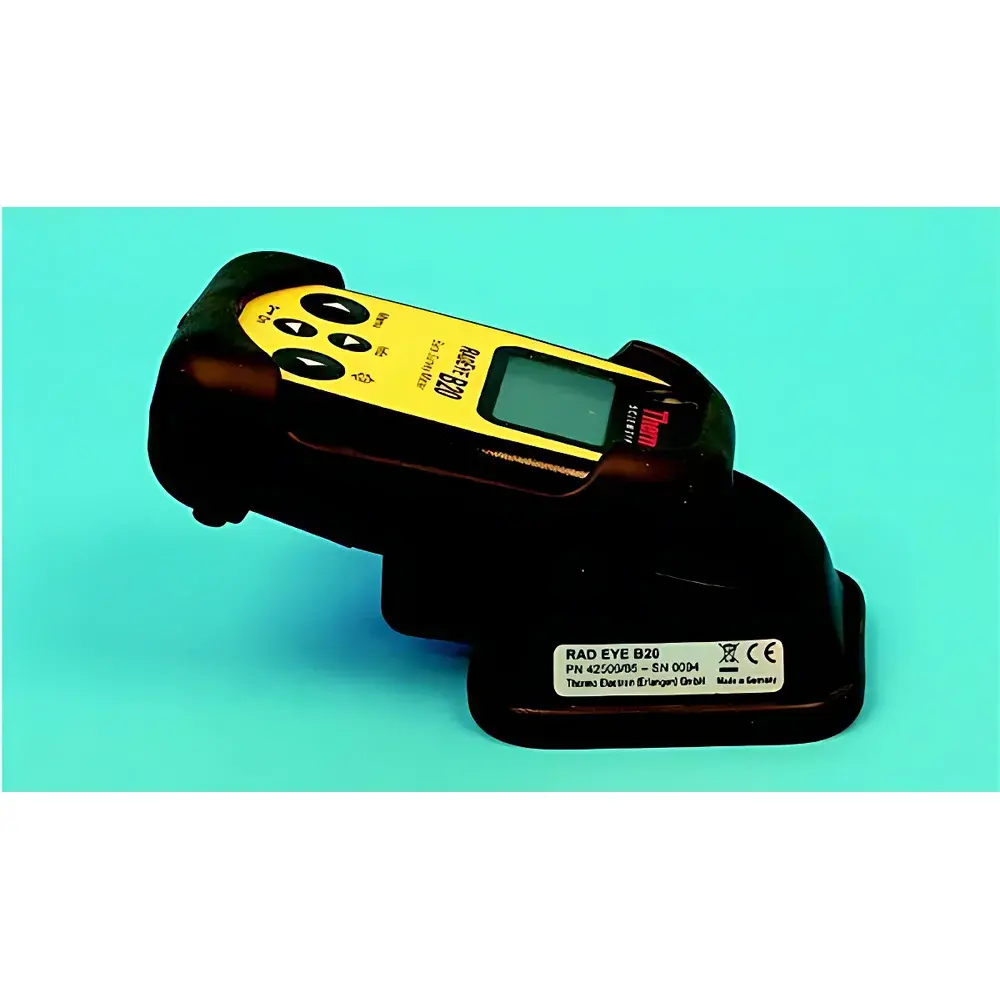
Thermo Fisher RadEye B20 Portable Alpha/Beta Surface Contamination Monitor
| Brand | Thermo Fisher |
|---|---|
| Origin | USA |
| Manufacturer Type | Original Equipment Manufacturer (OEM) |
| Product Category | Imported Instrument |
| Model | RadEye B20 |
| Instrument Type | Portable Radiation Survey Meter |
| Radiation Types Detected | Alpha, Beta, Gamma, and X-ray |
| Detector Type | Thin-window Geiger-Müller (GM) Tube with 44 mm Active Diameter and Adjustable Window Thickness (1.8–20 mg/cm²) |
| Dose Rate Range (γ) | 0–2 mSv/h (RadEye B20) |
| Count Rate Range (Contamination) | 0–10 kcps (B20) |
| Energy Response (with γ energy window) | 17 keV – 3 MeV |
| 2π Detection Efficiency | ²⁴¹Am: 28%, ⁶⁰Co: 25%, ⁹⁰Sr/⁹⁰Y: 36%, ¹⁴C: 19% |
| Calibration Source | 9 g Lutetium Oxide (Lu₂O₃) reference source, activity density 50 Bq/g (1.4 nCi/g) |
| Alarm Modes | Audible, Visual (LED), and Vibratory |
Overview
The Thermo Fisher RadEye B20 is a rugged, handheld alpha/beta surface contamination monitor engineered for rapid, reliable detection and quantification of radioactive surface contamination in nuclear facilities, decommissioning sites, medical isotope handling labs, and environmental remediation operations. It operates on the principle of gas-filled proportional counting using a thin-window Geiger-Müller detector optimized for low-energy photon and charged-particle detection. The instrument’s 44 mm active-area GM tube—paired with an adjustable mylar/polyimide window (1.8–20 mg/cm² thickness)—enables selective discrimination between alpha, beta, and gamma/X-ray emissions through pulse-height analysis and energy windowing. Unlike general-purpose dose rate meters, the RadEye B20 is specifically designed to meet ISO 7503-1 (surface contamination measurement) and IEC 60846-2 (radiation protection instrumentation) requirements for direct smear assay and in-situ scanning applications.
Key Features
- Real-time alpha/beta/gamma/X-ray discrimination via dual-threshold pulse processing and configurable energy windows
- High-sensitivity thin-window GM detector with 44 mm diameter and user-selectable window thickness for optimized alpha efficiency and background rejection
- Integrated 9 g lutetium oxide (Lu₂O₃) calibration source (50 Bq/g, 1.4 nCi/g) enabling on-site verification and traceable field calibration without external reference sources
- Three operational modes: Survey (dose rate), Contamination (count rate), and Identification (alpha/beta ratio analysis)
- Rugged IP67-rated enclosure with shock-absorbing rubber overmold, operating temperature range −10 °C to +50 °C
- Multi-modal alarm system with programmable thresholds: audible tone (85 dB at 30 cm), high-intensity LED strobe, and tactile vibration feedback
- Battery life up to 200 hours on standard AA alkaline cells; supports hot-swap battery replacement during operation
Sample Compatibility & Compliance
The RadEye B20 is validated for use with common radionuclides encountered in nuclear medicine (e.g., ⁹⁹mTc, ¹⁸F), reactor operations (¹³⁷Cs, ⁶⁰Co), and legacy contamination scenarios (²³⁹Pu, ²⁴¹Am, ⁹⁰Sr/⁹⁰Y). Its 2π geometry and documented efficiencies—28% for ²⁴¹Am (5.6 MeV α), 36% for ⁹⁰Sr/⁹⁰Y (β⁻ max 2.28 MeV), and 25% for ⁶⁰Co (1.17/1.33 MeV γ)—are traceable to NIST SRM 4351B and certified by Thermo Fisher’s ISO/IEC 17025-accredited metrology laboratory. The device complies with ANSI N42.33 (portable radiation detection instrumentation), IEC 62327 (hand-held instruments for radionuclide identification), and meets performance criteria outlined in USNRC Regulatory Guide 4.15 and DOE Order 458.1 for radiological control programs. It supports GLP-compliant data capture when used with optional audit-trail-enabled firmware.
Software & Data Management
Data acquisition and reporting are managed via Thermo Fisher’s RadEye Connect desktop application (Windows 10/11), which supports encrypted USB transfer, time-stamped event logging, and customizable report generation (PDF/CSV). Each measurement record includes GPS coordinates (when paired with optional Bluetooth GNSS module), operator ID, instrument serial number, calibration date, and full spectral metadata. Firmware version 3.2+ implements FDA 21 CFR Part 11-compliant electronic signatures, audit trails, and role-based access control—ensuring regulatory readiness for pharmaceutical cleanroom monitoring or nuclear site license compliance audits. Raw count data and dose rate profiles can be exported for third-party analysis in MATLAB, Python (NumPy/Pandas), or ORTEC GammaVision environments.
Applications
- Post-decontamination verification of nuclear facility work surfaces and PPE
- In-situ scanning of soil, concrete, and metal substrates during site remediation
- Quality assurance of radiopharmaceutical synthesis modules and hot cells
- Emergency response screening following transportation incidents involving radioactive materials
- Regulatory inspections under EPA 40 CFR Part 61 and IAEA Safety Standards Series No. RS-G-1.7
- Training and proficiency testing in radiation safety officer (RSO) certification courses
FAQ
What is the minimum detectable activity (MDA) for alpha contamination on stainless steel?
The MDA for ²⁴¹Am on a 304 SS surface is ≤0.04 Bq/cm² (1σ, 60 s counting time), per ISO 7503-1 Annex B validation protocols.
Can the RadEye B20 perform isotope identification?
No—it does not incorporate spectrometry capability; it provides gross alpha/beta ratio analysis and energy-windowed gamma screening, but not nuclide-specific identification.
Is the Lu₂O₃ calibration source replaceable in the field?
No—the source is hermetically sealed within the instrument housing and certified for 10-year stability; replacement requires factory recalibration and NIST-traceable re-certification.
Does the instrument support wireless data transmission?
Yes—via optional Bluetooth 5.0 module (RadEye BT-Kit), enabling real-time telemetry to Thermo Fisher’s RadNet cloud platform for fleet-wide dose mapping and trend analytics.
How often must the instrument be calibrated?
Annual calibration is recommended per ISO/IEC 17025 and ANSI N42.20; however, daily user checks using the internal Lu₂O₃ source satisfy routine operational verification requirements.







