
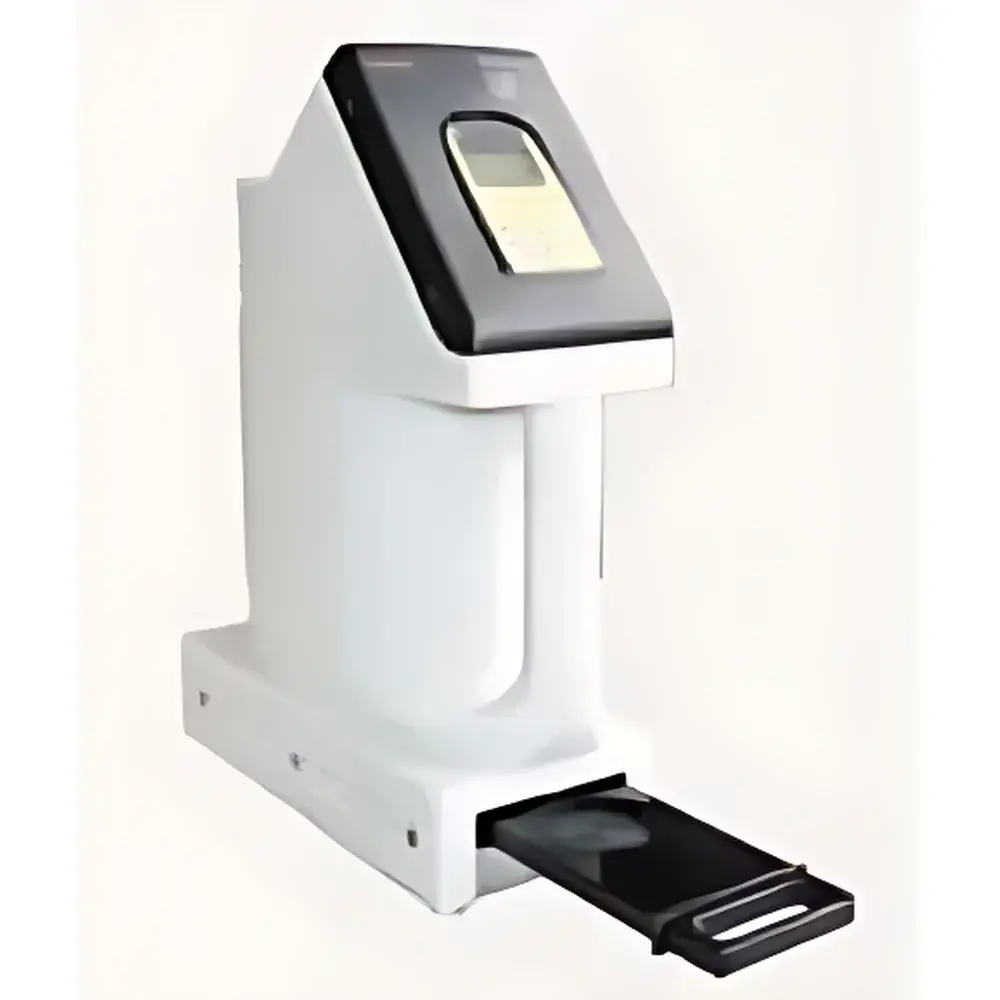
Thermo Fisher RadEye HEC Portable Field Alpha/Beta Counter
| Brand | Thermo Fisher |
|---|---|
| Origin | USA |
| Manufacturer | Thermo Fisher Scientific |
| Product Type | Imported |
| Model | RadEye HEC |
| Instrument Category | Dose Rate / Activity Meter |
| Form Factor | Portable |
| Measured Radiation Types | Alpha and Beta Emitters |
| Detector Type | Scintillation Detector (Lu₂O₃-based) |
| Counting Range | Alpha: 1–10,000 cps |
| Beta | 1–100,000 cps |
| Background | Alpha <2 cpm, Beta <70 cpm (under 0.25 µSv/h gamma background) |
| Detector Diameter | 5 cm |
| Detection Efficiency (2π geometry, 50 mm source) | Pu-239 >85%, Am-241 >75%, Tc-99 >45%, Sr/Y-90 >70%, C-14 >20% |
| Sample Chamber Dimensions | 51.6 mm × 9.6 mm |
| Adjustable Sample Height | 3.2–7.9 mm |
| Data Storage | 250 system events (alarms/errors/parameter changes), 4500 full sample records |
| Calibration & Decay Correction | Built-in automated routines |
| Interface | Serial and USB |
| Regulatory Compliance | CE Marked |
| Internal Check Source | 9 g lutetium oxide (¹⁷⁶Lu) |
Overview
The Thermo Fisher RadEye HEC is a field-deployable, dual-channel alpha/beta scintillation counter engineered for rapid, on-site quantitative assessment of surface contamination from radionuclides emitting alpha and beta particles. It operates on the principle of pulse-height discrimination in a solid-state lutetium oxide (Lu₂O₃)-doped scintillator, enabling simultaneous yet spectrally resolved detection of alpha and beta emissions without mechanical separation or gas-flow requirements. Unlike proportional counters or ZnS-based systems, the Lu₂O₃ detector provides enhanced light yield and improved alpha/beta pulse shape differentiation—critical for reliable discrimination in mixed-field environments. Designed for environmental monitoring, nuclear decommissioning, waste characterization, and regulatory compliance verification, the RadEye HEC delivers laboratory-grade counting performance in a ruggedized, battery-operated platform certified to CE standards for electromagnetic compatibility and safety.
Key Features
- Rugged portable design with integrated palm-sized controller for real-time operation in uncontrolled field environments—including outdoor sites, gloveboxes, and interim storage facilities.
- Lutetium oxide (Lu₂O₃) scintillation detector (5 cm diameter) optimized for high-efficiency alpha detection (>85% for Pu-239 at 2π geometry) and robust beta sensitivity (>70% for Sr/Y-90).
- Adjustable sample chamber accommodating variable thicknesses (3.2–7.9 mm) and fixed footprint (51.6 mm × 9.6 mm), enabling reproducible geometry for swipe, filter, or direct-surface measurements.
- Automated decay correction and calibration management—retains up to 4500 complete sample records with timestamp, geometry, efficiency factor, background subtraction, and user-defined metadata.
- Comprehensive event logging: stores the last 250 system-level events (e.g., alarm triggers, configuration changes, error codes) with ISO 8601 timestamps for audit trail integrity.
- Dual-interface connectivity (RS-232 serial and USB 2.0) compliant with Windows-based data acquisition software; supports export to CSV, XML, and ASTM E2855-compliant reporting formats.
Sample Compatibility & Compliance
The RadEye HEC accepts standard alpha/beta sampling media including smears (filter paper, cellulose acetate), air filters (glass fiber, PVC), and planar surfaces with defined geometry. Its adjustable sample height ensures consistent source-to-detector distance across varying substrate thicknesses—minimizing geometric uncertainty per ISO 7503-1 and ANSI N13.12. The instrument meets CE marking requirements under Directive 2014/30/EU (EMC) and 2014/35/EU (LVD). While not intrinsically rated for ATEX or IECEx Zone 0/1, it is routinely deployed under ALARA protocols in controlled radiological areas. Background performance (<2 cpm alpha, <70 cpm beta at 0.25 µSv/h ambient gamma) satisfies EPA Method 900 for low-level surface contamination screening and aligns with IAEA Safety Standards Series No. RS-G-1.8 for field instrumentation used in environmental surveillance.
Software & Data Management
Data acquisition and analysis are managed via Thermo Fisher’s RadEye Control Suite—a validated Windows application supporting configurable measurement protocols, multi-user access control, and electronic signature workflows. All raw counts, efficiency-corrected activity values (Bq, Bq/cm², dpm), and statistical uncertainties are stored with embedded traceability to calibration certificates and detector response curves. Audit logs comply with FDA 21 CFR Part 11 requirements when configured with digital signature enforcement and role-based permissions. Export functions support integration into LIMS platforms via HL7 or ASTM E1384 interfaces. Firmware updates preserve backward compatibility with historical datasets and maintain full GLP/GMP alignment for regulated laboratories.
Applications
- Environmental site assessments: rapid mapping of alpha-emitting transuranics (e.g., Pu, Am) and beta-emitting fission products (e.g., Sr-90, Cs-137) on soil, sediment, and vegetation samples.
- Nuclear facility decommissioning: verification of clearance levels per IAEA RS-G-1.7 and national regulations (e.g., NRC 10 CFR 20 Subpart E, UK EA RPS 10).
- Radioactive waste characterization: classification of LLW/ILW drums and containers using swipe assays prior to disposal or transport.
- Emergency response: first-responder screening of personnel, equipment, and infrastructure following radiological incidents or illicit material interdiction.
- Regulatory compliance monitoring: routine checks for licensees operating under ISO/IEC 17025-accredited QA programs or DOE Order 458.1 radiation protection requirements.
FAQ
What types of radioactive isotopes can the RadEye HEC reliably detect?
It is optimized for common alpha emitters (²³⁹Pu, ²⁴¹Am, ²³⁸U) and beta emitters (⁹⁰Sr/⁹⁰Y, ¹⁴C, ⁹⁹Tc, ¹³⁷Cs) with documented efficiencies per ISO 8769 reference geometries.
Does the instrument require external calibration sources during routine use?
No—built-in calibration routines leverage the internal 9 g lutetium oxide (¹⁷⁶Lu) check source for daily stability verification; traceable primary calibrations are performed annually per ISO/IEC 17025 requirements.
Can measurement results be exported directly to laboratory information management systems (LIMS)?
Yes—via standardized CSV or ASTM E1384-compliant XML exports; optional API integration supports HL7 v2.x and RESTful endpoints for enterprise LIMS synchronization.
Is the RadEye HEC suitable for use in high-humidity or dusty field conditions?
The IP54-rated enclosure provides protection against dust ingress and water splashing; operational temperature range is –10 °C to +50 °C, verified per MIL-STD-810G environmental testing protocols.
How is background variability accounted for in low-activity measurements?
Real-time background subtraction uses rolling 10-minute background estimates updated during idle periods; statistical uncertainty propagation follows ISO 11929 for decision threshold and detection limit calculations.







