
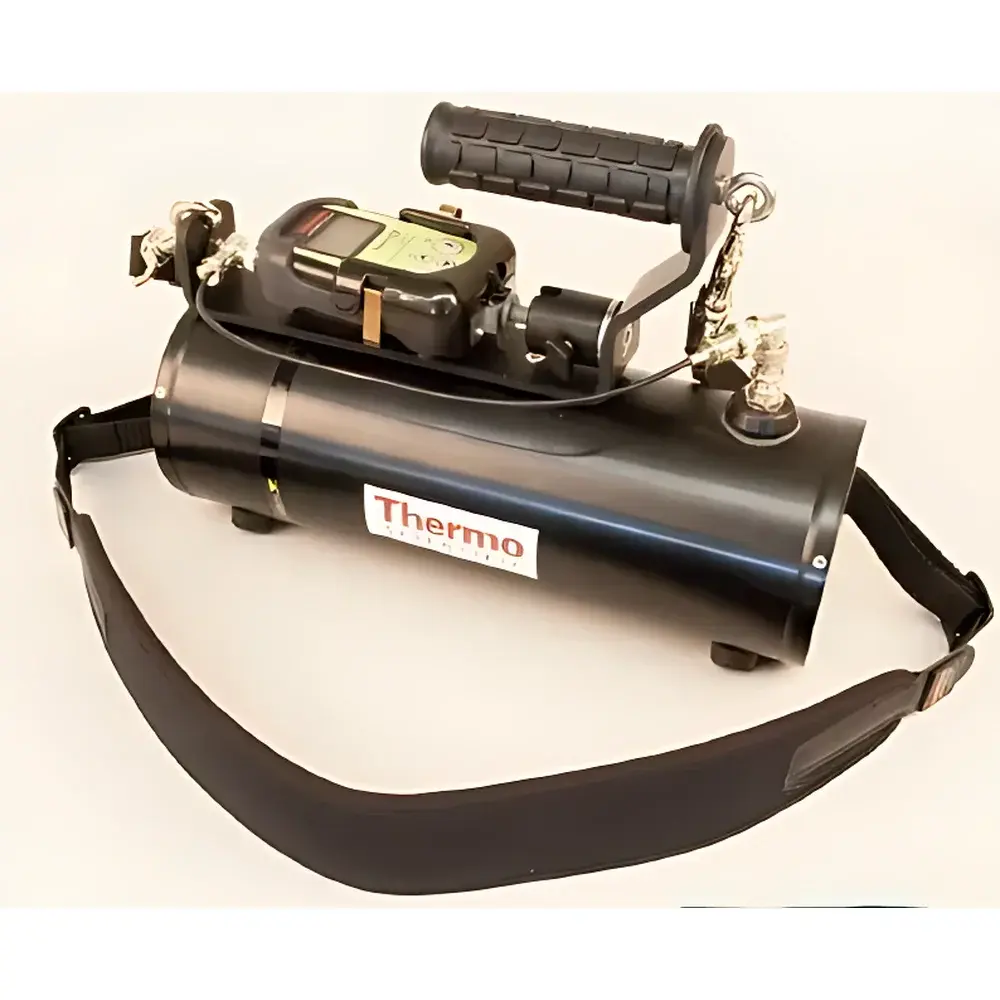
Thermo Fisher RadEye NBR Portable High-Sensitivity Gamma Contamination Detector
| Brand | Thermo Fisher |
|---|---|
| Origin | USA |
| Manufacturer | Thermo Fisher Scientific |
| Product Type | Imported |
| Model | RadEye NBR |
| Instrument Category | Radiation Survey Meter / Dose Rate Meter |
| Form Factor | Portable |
| Detection Target | Trace Artificial Gamma Emitters |
| Detector Type | Multi-Function NBR Probe (FHZ 674) |
| Measurement Range | 0.01 µSv/h – 100 µSv/h |
| Sensitivity | >1500 cps per µSv/h (at 30 keV) |
| Operating Temperature | −20 °C to +50 °C |
| Dimensions (RadEye SX) | 110 mm × 67 mm × 62 mm |
| Weight (RadEye SX only) | ~160 g (with 2×AA batteries and rubber boot) |
| Weight (FHZ 674 probe + SX) | ~2.8 kg (excluding shoulder strap) |
| Battery Life | ~150 h (with FHZ 674 probe, part #4250693) |
| Data Storage | 1500 measurement records + 250 operation logs |
| Alarm | Dual configurable thresholds (count rate / dose rate), audible alarm ≥80 dB at 30 cm |
| Probe Cable | RG58, up to 1.5 m, MHV connector |
| High Voltage Output | 100–1400 V, 2 MΩ load |
| Compatible Probes | 16 selectable probe types (configurable via HV, calibration factor, dead-time correction, overload threshold, and range) |
Overview
The Thermo Fisher RadEye NBR is a purpose-engineered portable radiation survey instrument designed for the rapid, reliable detection of trace artificial gamma-emitting radionuclides in complex environmental and operational settings. Unlike conventional dose rate meters optimized for broad-field exposure assessment, the RadEye NBR integrates advanced Net Background Rejection (NBR) signal processing with a high-sensitivity NaI(Tl)-based scintillation detector (FHZ 674) to isolate weak gamma signatures from elevated or fluctuating natural background radiation. Its core principle relies on real-time spectral comparison between live acquisition and dynamically updated background reference spectra—enabling statistically significant identification of low-activity sources even when masked by terrestrial (e.g., K-40, U/Ra-series) or cosmic contributions. This makes it particularly effective for nuclear security applications, orphan source recovery, post-incident contamination mapping, and regulatory compliance screening where detection of shielded or low-yield gamma emitters (e.g., Cs-137, Co-60, Am-241) is mission-critical.
Key Features
- Net Background Rejection (NBR) Algorithm: Continuously adapts to local background variations, suppressing false positives while preserving detection sensitivity for artificial gamma lines—even under dynamic field conditions such as moving vehicles or changing soil composition.
- High Sensitivity Scintillation Detection: FHZ 674 probe delivers >1500 counts per second per µSv/h at 30 keV, exceeding IEC 62533 requirements for energy response uniformity across 60 keV–4 MeV (−30% to +90%).
- Modular Architecture: Combines the lightweight RadEye SX main unit (160 g) with the ruggedized FHZ 674 probe (2.8 kg total system weight), enabling single-hand operation during prolonged search missions.
- Extended Operational Endurance: Delivers ~150 hours of continuous use per battery set—five times longer than legacy FHT 40 NBR systems—without compromising detection performance or thermal stability.
- Dual-Threshold Alarm System: Configurable independent alarms for count rate and dose rate parameters; audible output ≥80 dB at 30 cm ensures operability in noisy industrial or outdoor environments.
- Ruggedized Field Design: IP67-rated enclosure (RadEye SX), rubberized impact protection, and operating temperature range of −20 °C to +50 °C support deployment in extreme climates and demanding infrastructure inspections.
Sample Compatibility & Compliance
The RadEye NBR is validated for quantitative and qualitative detection of gamma-emitting isotopes commonly associated with medical, industrial, and nuclear fuel cycle activities—including but not limited to 137Cs, 60Co, 241Am, 192Ir, and 152Eu. It meets IEC 62533:2010 for portable radiation protection instrumentation and conforms to ANSI N42.33-2021 standards for radionuclide identification and alarm functionality. While not a spectroscopic identifier, its NBR-enhanced response enables reliable discrimination between natural background fluctuations and anthropogenic gamma emissions—a capability routinely referenced in IAEA Nuclear Security Guidance (NSS No. 23) and US NRC Regulatory Guide 8.39 for radiological search operations. The device supports GLP-compliant data integrity through timestamped logging, audit-trail-capable firmware, and secure PC-based data export via Thermo Fisher’s proprietary RadEye PC software.
Software & Data Management
Data acquisition and configuration are managed through RadEye PC software (Windows-compatible), which provides full access to internal memory registers including 1500 measurement records (each storing time-stamped count rate, dose rate, and statistical uncertainty), 250 operation logs (power-on/off, alarm triggers, calibration events), and user-defined measurement intervals (default: 120 s). All stored values retain traceable metadata—including probe ID, HV setting, calibration factor, and dead-time correction parameters—ensuring full chain-of-custody documentation for regulatory reporting. The software supports batch export to CSV and XML formats compatible with LIMS integration and includes built-in tools for trend analysis, dose accumulation tracking, and geotagging (when paired with optional GPS module). Firmware updates preserve configuration integrity and comply with FDA 21 CFR Part 11 requirements for electronic records and signatures when deployed in regulated pharmaceutical or healthcare environments.
Applications
- Nuclear security and border monitoring for illicit radioactive materials
- Decommissioning and decontamination (D&D) site characterization
- Emergency response to radiological dispersal device (RDD) incidents
- Verification of scrap metal and recycled material shipments
- Environmental surveillance around nuclear facilities and waste repositories
- Regulatory compliance audits per ISO 20553:2016 (radiation protection in the nuclear industry)
- Training and education in radiation safety protocols and detection methodology
FAQ
What distinguishes the RadEye NBR from standard gamma survey meters?
The RadEye NBR employs real-time Net Background Rejection (NBR) signal processing—not just simple background subtraction—to detect statistically significant deviations from ambient radiation levels, making it uniquely capable of identifying shielded or low-activity artificial gamma sources in high-background environments.
Can the RadEye NBR identify specific radionuclides?
No—it is not a gamma spectrometer. It detects anomalous gamma activity above background and quantifies dose rate; nuclide identification requires energy-resolved spectroscopy (e.g., with RadEye B20 or identiFINDER series instruments).
Is the FHZ 674 probe interchangeable with other Thermo Fisher survey meters?
Yes—the FHZ 674 is compatible with all RadEye SX-compatible platforms and selected FHT-series controllers, provided firmware version supports NBR mode and HV configuration for this probe type.
Does the RadEye NBR meet international radiation safety standards for field use?
Yes—it complies with IEC 62533:2010, ANSI N42.33-2021, and EU Directive 2013/59/Euratom requirements for portable radiation protection devices used in occupational and public exposure monitoring.
How is calibration maintained across extended deployments?
The system supports field calibration using certified check sources (e.g., 137Cs or 60Co); all calibration parameters—including energy-dependent efficiency curves and dead-time corrections—are stored in non-volatile memory and applied automatically during measurement.
Related Products







