
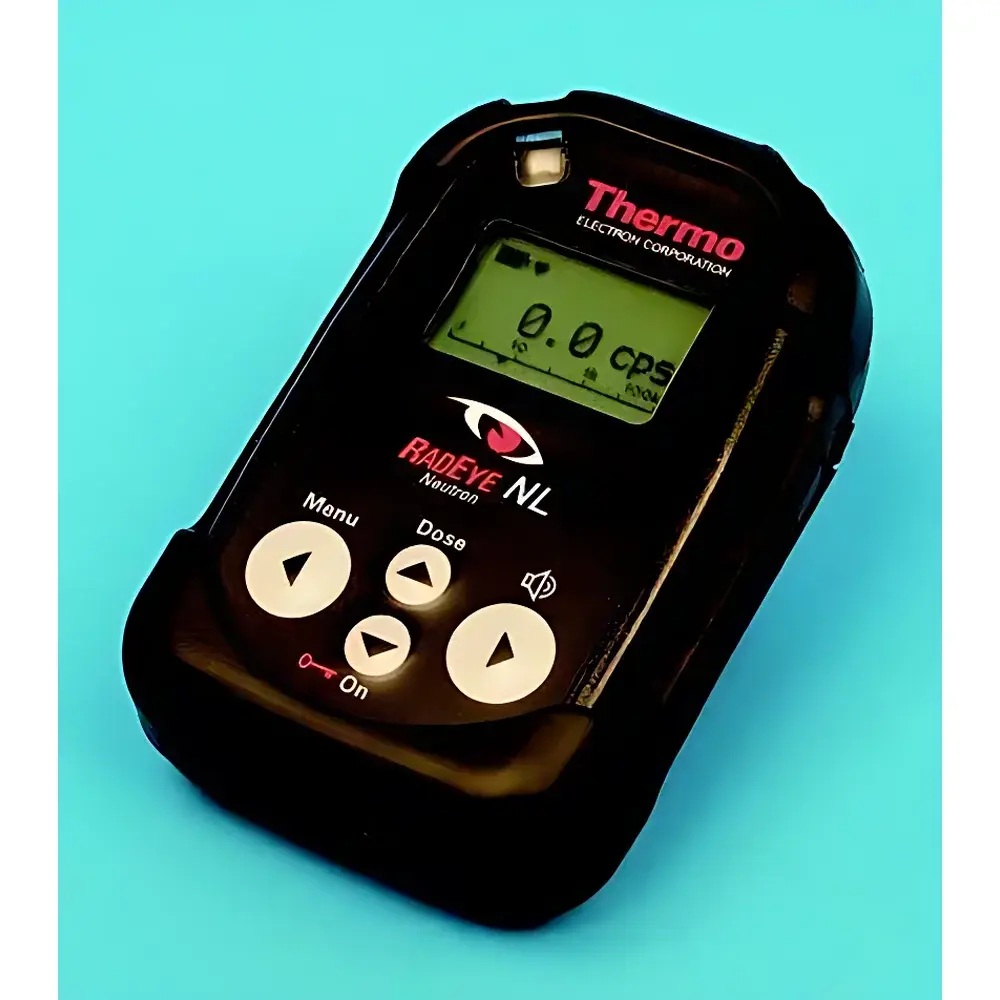
Thermo Fisher RadEye NL Portable Neutron Survey Meter
| Brand | Thermo Fisher |
|---|---|
| Origin | USA |
| Manufacturer Type | Original Equipment Manufacturer (OEM) |
| Product Origin | Imported |
| Model | RadEye NL |
| Instrument Category | Neutron Dose Rate Meter |
| Form Factor | Portable |
| Detector Type | Pressurized He-3 Proportional Counter (2.5 bar) |
| Measurement Range | <0.2 cps (in presence of 10 mSv/h Cs-137 gamma field) |
| Neutron Sensitivity | −0.15 cps per μSv/h (calibrated to Cf-252 neutron source) |
| Background Count Rate | 0.0025 cps (at 300 m elevation) |
| Gamma Rejection Ratio | <0.2 cps for 10 mSv/h Cs-137 |
| Units Displayed | Counts per second (cps) |
Overview
The Thermo Fisher RadEye NL is a purpose-engineered portable neutron survey meter designed for reliable, real-time detection and quantification of neutron radiation in mixed-field environments. Operating on the principle of thermal neutron capture via the 3He(n,p)3H nuclear reaction, the instrument utilizes a pressurized (2.5 bar) 3He proportional counter housed within an optimized polyethylene moderator assembly. This architecture enables high intrinsic neutron sensitivity while maintaining exceptional gamma discrimination—critical for accurate neutron dose rate assessment where gamma fields exceed 10 mSv/h (e.g., near spent fuel handling areas, reactor maintenance zones, or accelerator-based facilities). Unlike scintillation-based alternatives, the RadEye NL delivers stable, low-drift count-rate output directly traceable to neutron fluence-to-dose conversion coefficients defined in ICRP Publication 74 and ISO 8529-1. Its compact, battery-powered form factor supports field deployment for radiological protection surveys, emergency response, regulatory compliance checks, and routine area monitoring in nuclear power plants, research reactors, medical isotope production facilities, and decommissioning sites.
Key Features
- Pressurized 3He proportional detector (2.5 bar) with integrated thermal neutron moderation for enhanced sensitivity to fast and epithermal neutrons.
- Gamma-insensitive design: <0.2 cps response under 10 mSv/h Cs-137 gamma exposure—ensuring minimal interference in high-background gamma fields.
- Calibrated neutron sensitivity of −0.15 cps per μSv/h referenced to a 252Cf isotopic neutron source, traceable to NIST standards.
- Low intrinsic background of 0.0025 cps at 300 m elevation, enabling reliable detection of weak neutron fields.
- Real-time cps readout with configurable alarm thresholds and audible/visual alerting for rapid hazard identification.
- Optional neutron dose-rate conversion module and extended-range polyethylene slow-down collars for improved energy response uniformity across 0.025 eV–14 MeV.
- Ruggedized IP67-rated enclosure with ergonomic grip, integrated belt clip, and 20-hour battery life using standard AA alkaline cells.
Sample Compatibility & Compliance
The RadEye NL is validated for use in heterogeneous radiation fields containing both neutron and gamma components, including moderated fission spectra (e.g., from 252Cf, 241Am–Be), reactor leakage fields, and accelerator-generated neutron beams. It complies with ISO 22188:2012 (“Radiation protection — Monitoring of workers exposed to neutron radiation”) for personal and area monitoring applications. Its performance meets the requirements of ANSI N42.33-2022 (Portable Radiation Detection Instrumentation for Homeland Security) and satisfies key functional criteria outlined in IEC 60846-2:2014 (Radiation protection instrumentation — Ambient and/or directional dose equivalent (rate) meters and/or monitors for beta, X and gamma radiation — Part 2: High range beta and photon dose and dose rate meters and/or monitors). The device supports GLP-compliant operation through timestamped event logging and optional external data download via USB interface.
Software & Data Management
Data acquisition and configuration are managed via Thermo Fisher’s RadEye Configuration Utility (Windows-compatible), enabling user-defined alarm setpoints, measurement averaging intervals, and unit preferences (cps, µSv/h, mrem/h). All measurements—including timestamps, detector status flags, and battery voltage—are stored internally with non-volatile memory capable of retaining ≥10,000 records. Exported CSV files include metadata required for audit trails under 21 CFR Part 11 when used in regulated environments. Firmware updates maintain alignment with evolving ICRU and ICRP recommendations for neutron dosimetry weighting factors.
Applications
- Area monitoring around nuclear reactor containment structures, spent fuel pools, and dry cask storage facilities.
- Radiological survey support during maintenance outages and refueling operations.
- Emergency response screening for neutron-emitting sources following transportation incidents or security breaches.
- Verification of neutron shielding integrity in hot cells and gloveboxes housing alpha–neutron emitters (e.g., 241Am–Be).
- Commissioning and periodic testing of neutron generators and pulsed neutron sources in industrial and academic laboratories.
- Training and demonstration of neutron detection principles in health physics education programs.
FAQ
Does the RadEye NL provide direct neutron dose equivalent (H*(10)) readings?
No—it outputs raw count rate (cps) calibrated to neutron fluence; optional firmware modules or post-processing tools apply fluence-to-dose conversion coefficients per ICRP 74.
Can it distinguish between fast and thermal neutrons?
Not spectrally; its polyethylene moderator provides broad-energy response optimized for H*(10) estimation across the 0.025 eV–14 MeV range.
Is calibration traceable to national standards?
Yes—factory calibration uses NIST-traceable 252Cf neutron sources and accredited gamma reference fields.
What is the recommended recalibration interval?
Annual calibration is advised per ISO/IEC 17025 guidelines, with interim functional checks using check sources prior to each deployment.
Does it support wireless data transfer?
No—data export is conducted via USB cable; no Bluetooth or Wi-Fi interfaces are implemented to preserve electromagnetic compatibility in sensitive nuclear environments.
Related Products







