
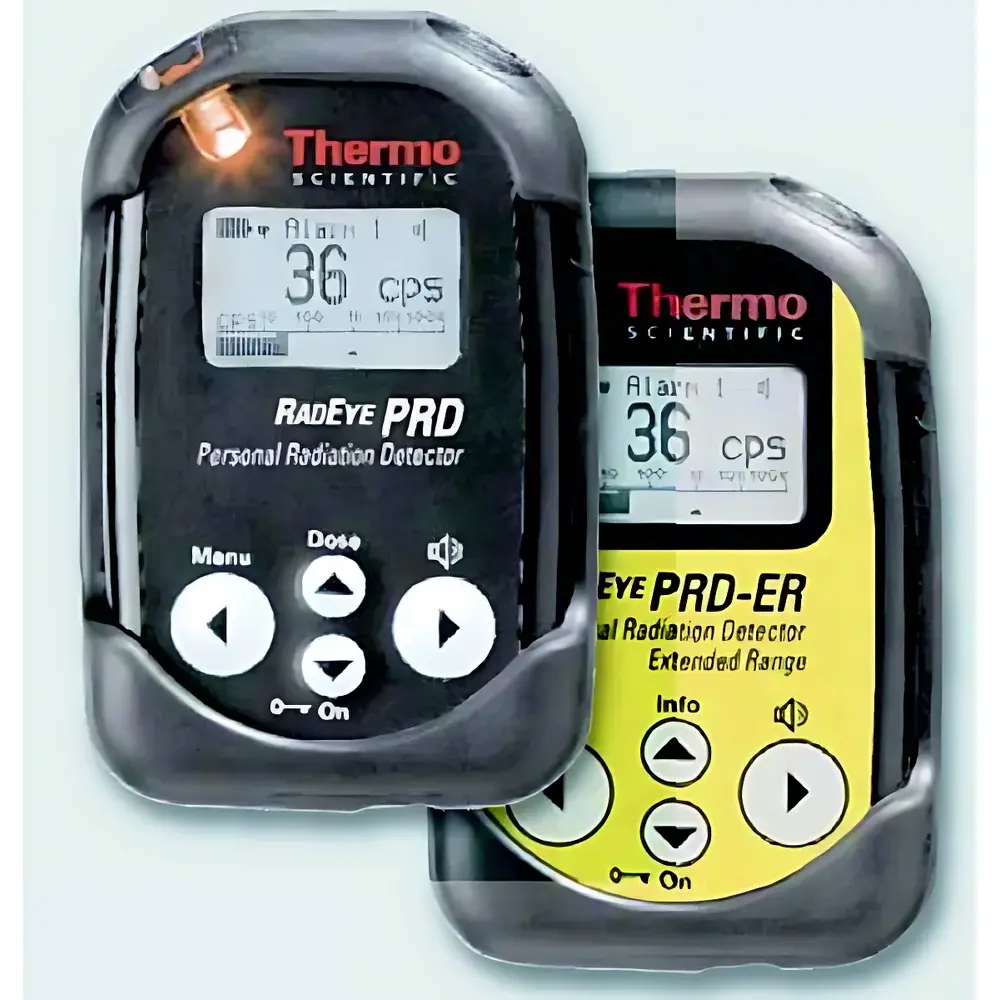
Thermo Fisher RadEye PRD Portable Gamma Radiation Detector
| Brand | Thermo Fisher |
|---|---|
| Origin | USA |
| Manufacturer | Thermo Fisher Scientific |
| Product Type | Portable Personal Radiation Detector (PRD) |
| Detector Type | NaI(Tl) Scintillation Crystal |
| Measurement Principle | Gamma Photon Detection via Scintillation & Pulse Height Analysis |
| Dose Rate Range | 0.01 µSv/h – 250 µSv/h (PRD mode) |
| Extended Range (PRD-ER) | 0.01 µSv/h – 100 mSv/h |
| Energy Response Range | 60 keV – 1.3 MeV |
| Sensitivity | 150 cps/(µSv/h) for ¹³⁷Cs |
| Data Storage Capacity | 1600 dose rate readings with timestamps |
| Ingress Protection Rating | IP65 |
| Operating Temperature | –10 °C to +50 °C |
| Battery Life | Up to 1,000 hours (typical alkaline battery operation) |
Overview
The Thermo Fisher RadEye PRD is a compact, rugged, and high-sensitivity portable gamma radiation detector engineered for real-time personal dose rate monitoring in field-based radiological protection applications. It operates on the principle of scintillation detection: incident gamma photons interact with a thallium-doped sodium iodide [NaI(Tl)] crystal, generating light pulses proportional to photon energy. These pulses are converted to electrical signals via a photomultiplier tube (PMT) or solid-state photodetector, then processed using digital pulse height analysis to discriminate background radiation and deliver accurate ambient dose equivalent rate (H*(10)) measurements in µSv/h. Its core innovation—Thermo Scientific’s patented Natural Background Rejection (NBR) algorithm—dynamically distinguishes anthropogenic gamma emissions from naturally occurring background (e.g., ⁴⁰K, ²³⁸U, ²³²Th series), significantly enhancing detection confidence in low-dose environments without compromising response time or energy resolution.
Key Features
- NaI(Tl) scintillation detector optimized for gamma sensitivity across 60 keV–1.3 MeV, enabling reliable identification of common isotopes including ¹³⁷Cs, ⁶⁰Co, ²⁴¹Am, and ¹⁹²Ir
- Dual-range operational modes: standard PRD mode (0.01–250 µSv/h) and extended-range PRD-ER mode (0.01 µSv/h–100 mSv/h), supporting both routine surveillance and emergency response scenarios
- Natural Background Rejection (NBR) technology—real-time spectral subtraction that suppresses statistical fluctuations from terrestrial and cosmic background, reducing false alarms and improving minimum detectable activity (MDA)
- IP65-rated enclosure ensuring dust-tight integrity and resistance to low-pressure water jets, validated for use in outdoor, industrial, and first-responder environments
- Onboard memory stores up to 1,600 timestamped dose rate readings with user-configurable logging intervals (1 s to 60 min), supporting retrospective exposure assessment and ALARA compliance documentation
- Low-power design with >1,000-hour battery life using standard AA alkaline cells; no proprietary battery packs required for logistics simplicity in global deployments
Sample Compatibility & Compliance
The RadEye PRD is designed for direct measurement of ambient gamma dose rate in air—not intended for alpha, beta, or neutron radiation. It complies with IEC 60846-1:2014 (Radiation protection instrumentation — Ambient and/or directional dose equivalent (rate) meters and/or monitors for beta, X and gamma radiation) and meets ANSI N42.33-2022 (American National Standard for Portable Radiation Detection Instrumentation for Homeland Security). Its energy response is calibrated per ISO 4037-3:2019 reference radiation fields, and dose rate reporting adheres to ICRP 60/103 tissue weighting factors for H*(10). The device supports GLP-aligned data integrity through immutable timestamping and non-volatile memory; optional firmware upgrades enable audit-trail functionality compatible with 21 CFR Part 11–governed workflows when integrated with Thermo Fisher’s RadEye Connect software platform.
Software & Data Management
Data export is performed via USB interface or Bluetooth (optional module) to Thermo Fisher’s RadEye Connect desktop application—a secure, Windows-based tool supporting CSV and XML export, dose history visualization, geotagging (when paired with GPS-enabled accessories), and automated report generation compliant with ISO/IEC 17025 documentation requirements. All stored measurements include acquisition time, dose rate value, accumulated dose, battery status, and detector temperature. Firmware updates are digitally signed and delivered through Thermo Fisher’s authorized service portal, ensuring traceability and cybersecurity alignment with NIST SP 800-193 guidelines for embedded system integrity.
Applications
- Radiological emergency response (e.g., RDD, IND, or nuclear facility incidents) by HAZMAT teams and civil defense units
- Border security and customs screening for illicit radioactive material interdiction
- Decommissioning and decontamination (D&D) site surveys, including legacy nuclear facilities and scrap metal recycling yards
- Environmental monitoring programs near NORM/TENORM sites (e.g., oil & gas production, phosphate mining)
- Occupational health & safety programs for nuclear medicine departments, radiotherapy clinics, and industrial radiography crews
- Academic and regulatory training exercises requiring traceable, field-deployable dosimetry references
FAQ
Does the RadEye PRD require annual calibration to maintain traceability?
Yes. Per ISO/IEC 17025 and national metrology institute (NMI) recommendations, annual calibration against accredited gamma reference sources (e.g., ¹³⁷Cs, ⁶⁰Co) is required. Thermo Fisher offers certified calibration services with NIST-traceable certificates.
Can the device distinguish between different radionuclides?
No. As a dose rate instrument—not a spectrometer—the RadEye PRD reports H*(10) without isotope identification. For nuclide-specific analysis, pairing with a RadEye G handheld gamma spectrometer is recommended.
Is the NBR algorithm configurable or user-adjustable?
No. NBR is embedded firmware logic optimized for typical terrestrial background spectra; it operates autonomously and cannot be disabled or tuned by the end user to preserve measurement integrity and regulatory acceptance.
What environmental conditions limit operational reliability?
The unit is rated IP65 and functional from –10 °C to +50 °C. Continuous operation above 50 °C may degrade PMT gain stability; prolonged exposure below –10 °C requires thermal stabilization prior to critical measurements.
Does the RadEye PRD support wireless data transmission for networked monitoring systems?
Standard models support Bluetooth 4.2 (BLE) for short-range telemetry; integration into centralized radiation monitoring networks (e.g., Thermo Fisher’s RadNet™) requires gateway hardware and licensed middleware configuration.
Related Products







