
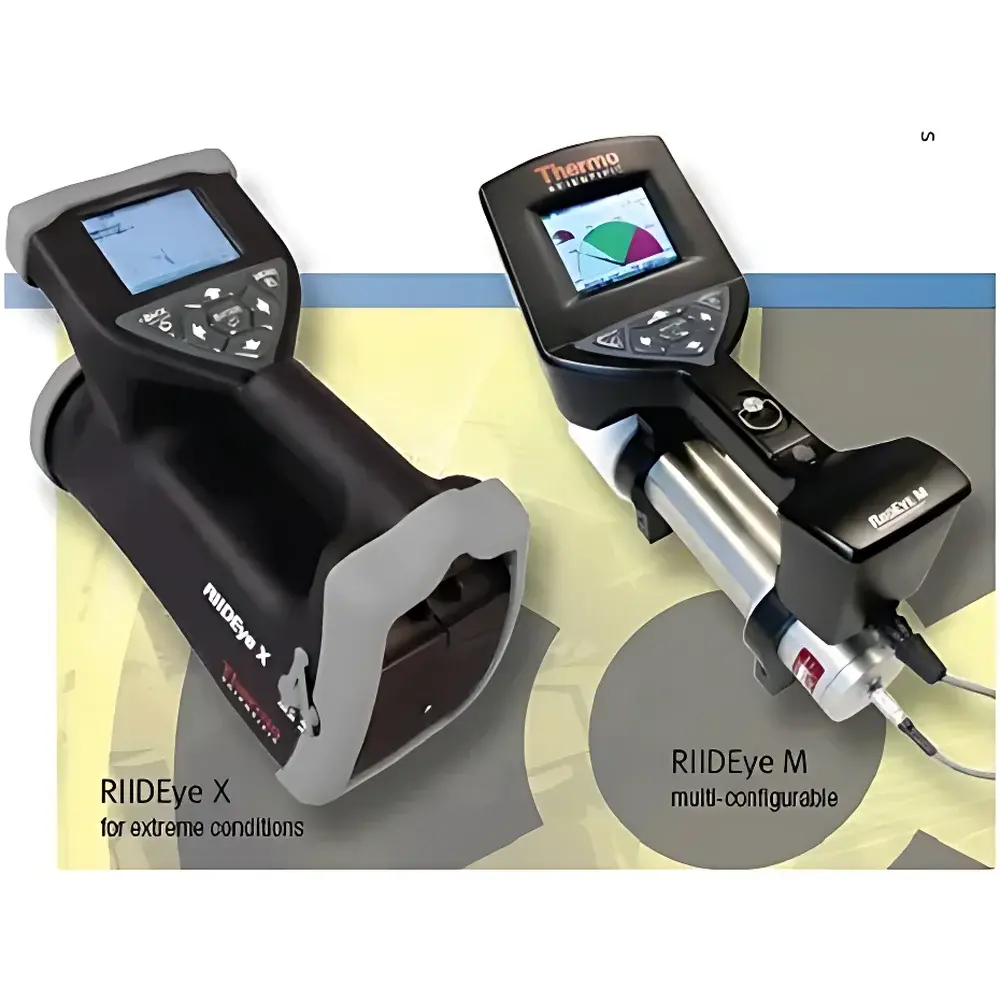
Thermo Fisher RIIDEye Portable Gamma and Neutron Spectrometer
| Brand | Thermo Fisher |
|---|---|
| Origin | USA |
| Manufacturer | Thermo Fisher Scientific |
| Product Type | Portable Radiation Spectrometer |
| Model | RIIDEye |
| Detector Types | NaI(Tl), LaBr₃(Ce), LiI(Eu), CLYC (Cs₂LiYCl₆:Ce) |
| Energy Range | 20 keV – 3 MeV |
| Dose Rate Range | 10 nSv/h – 0.1 Sv/h |
| Total Dose Range | 100 nSv – 1 Sv |
| Sensitivity | 3000 cps/μSv/h |
| ADC Resolution | 14-bit fast baseline restoration |
| Spectral Stabilization | K-40-based automatic temperature-compensated stabilization |
| Nuclide Library | ANSI N42.34-compliant library of 88 isotopes (expandable to 125), including ITRAP/IAEA, medical, industrial, SNM, and user-defined nuclides |
| Identification Algorithms | QCC™ Quantitative Composite Comparison and Hysteresis™ pattern-matching technologies |
| Display | 3.5″ color LCD (320×240, 32k colors) |
| Interface | 7-key single-finger keypad, Ethernet or RS-232 |
| Data Storage | ≥10,000 spectra with timestamp, GPS (optional), and full metadata |
| Power | Rechargeable battery or AA cells |
| Environmental Rating | IP67-rated ruggedized enclosure (RIIDEyeX) |
| Compliance | ANSI N42.34, IEC 62327, IEEE 309, MIL-STD-810G |
Overview
The Thermo Fisher RIIDEye is a field-deployable, dual-mode gamma and neutron spectrometer engineered for rapid, quantitative radionuclide identification and dose assessment in complex radiological environments. Operating on the principle of scintillation spectroscopy, it utilizes high-light-yield detectors—including NaI(Tl), LaBr₃(Ce), and advanced elpasolite crystals (CLYC)—to resolve gamma-ray and thermal/fast neutron interactions across a broad energy range (20 keV to 3 MeV). Its real-time spectral acquisition architecture supports simultaneous measurement of photon energy deposition and neutron capture signatures, enabling unambiguous discrimination between naturally occurring radioactive material (NORM), medical isotopes (e.g., Tc-99m, I-131), industrial sources (e.g., Co-60, Cs-137), and special nuclear materials (SNM) such as weapons-grade plutonium or highly enriched uranium. Designed for first responders, health physics technicians, border security personnel, and environmental monitoring teams, the RIIDEye delivers laboratory-grade spectral fidelity in a handheld platform certified to MIL-STD-810G for shock, vibration, dust, and immersion.
Key Features
- QCC™ (Quantitative Composite Comparison) spectral analysis engine: Delivers nuclide identification within 1 second for single- and multi-isotope mixtures by correlating measured spectra against reference libraries using weighted chi-square minimization and peak-area normalization.
- Hysteresis™ adaptive recognition algorithm: Achieves ≥97% confidence in nuclide assignment within 2 seconds by dynamically weighting prior spectral context—critical for evolving scenarios such as plume dispersion or shielded source detection.
- Multi-detector modularity (RIIDEyeM): Supports hot-swappable detector heads—including 2″×2″ NaI, 1.5″×1.5″ LaBr₃, and 3″×3″ NaI with optional neutron-sensitive LiI(Eu) or CLYC—enabling mission-specific optimization without hardware replacement.
- Temperature-stable auto-calibration: Real-time K-40 (1461 keV) tracking compensates for detector gain drift across −20 °C to +50 °C, eliminating manual recalibration during extended deployments.
- Ruggedized IP67 enclosure (RIIDEyeX): Fully sealed against dust and submersion to 1 m for 30 minutes; tested per MIL-STD-810G for drop, shock, and extreme thermal cycling.
- Intuitive 7-key interface and high-contrast 3.5″ color display: Enables glove-compatible, single-finger operation under low-light or hazardous conditions; all critical parameters—including dose rate, accumulated dose, nuclide ID confidence, and spectral SNR—are visible at a glance.
Sample Compatibility & Compliance
The RIIDEye is validated for direct measurement of gamma-emitting and neutron-emitting radionuclides in air, soil, water (via sample vials), surface contamination, and shielded configurations. It meets ANSI N42.34–2021 for portable radiation detection instrumentation, ensuring traceable performance against standardized test sources (e.g., Co-60, Cs-137, Am-241, Cf-252). Its nuclide library conforms to ITRAP/IAEA Category I–IV threat definitions and includes full support for USP , ISO 4037, and IEC 62327 regulatory frameworks. The system supports audit-ready data logging compliant with GLP/GMP principles, including immutable timestamps, operator ID, GPS coordinates (when enabled), detector configuration, and full spectral raw data—facilitating FDA 21 CFR Part 11–compliant reporting when integrated with Thermo Fisher’s Quantum software suite.
Software & Data Management
Data acquisition, analysis, and reporting are managed via Thermo Fisher’s Quantum Spectral Analysis Software—a Windows-based application supporting spectral deconvolution, isotope quantification, background subtraction, and uncertainty propagation per ISO/IEC 17025 guidelines. Spectra are transferred via Ethernet or CompactFlash card; each stored record contains full metadata (detector type, HV setting, live time, real time, temperature, GPS fix, and alarm status). Quantum enables batch processing of field-collected spectra, generation of customizable PDF reports (including dose maps and nuclide heatmaps), and export to CSV, XML, or N42.42 formats for integration into national radiation monitoring networks (e.g., EPA RadNet, IAEA USIE). Firmware updates and library expansions are delivered through secure, digitally signed packages validated via SHA-256 checksums.
Applications
- Radiological emergency response: Rapid triage of incident sites, characterization of fallout composition, and real-time dose-rate mapping for evacuation corridor planning.
- Border and port security: Detection and identification of illicit SNM, orphan sources, or shielding-adapted threats using combined gamma-neutron interrogation capability.
- Environmental site assessment: In-situ screening of legacy nuclear facilities, uranium mill tailings, or NORM-contaminated industrial sites per ASTM D3648 and EPA Method 901.1.
- Decommissioning and waste characterization: Verification of radionuclide inventory in drums, concrete, or piping prior to disposal—supporting ALARA compliance and waste classification per 10 CFR 61.
- Health physics surveys: Routine area monitoring in hospitals, research reactors, and cyclotron facilities, with automated reporting aligned with NCRP Report No. 160 dose limits.
FAQ
What neutron detection technologies are supported?
The RIIDEyeM platform accepts LiI(Eu) scintillators for thermal neutron detection and CLYC (Cs₂LiYCl₆:Ce) crystals for simultaneous gamma/neutron discrimination with pulse shape analysis.
Can the nuclide library be customized for site-specific isotopes?
Yes—users may import custom energy peaks, branching ratios, and half-lives via Quantum software to extend the library beyond the standard 125 isotopes.
Is spectral data export compatible with third-party analysis tools?
All spectra are stored in industry-standard N42.42 format and can be imported into MATLAB, Python (using PyMCA or radpy), or Canberra Genie 2000 without proprietary conversion.
How does the system maintain energy calibration during prolonged field use?
Automatic K-40 peak tracking provides continuous gain correction; no external reference source is required, and calibration stability is verified every 30 seconds.
What power options ensure operational continuity in remote locations?
The unit operates on eight AA alkaline cells (≥8 h) or a rechargeable Li-ion pack (≥10 h); both support hot-swap capability with zero downtime during battery replacement.
Related Products







