
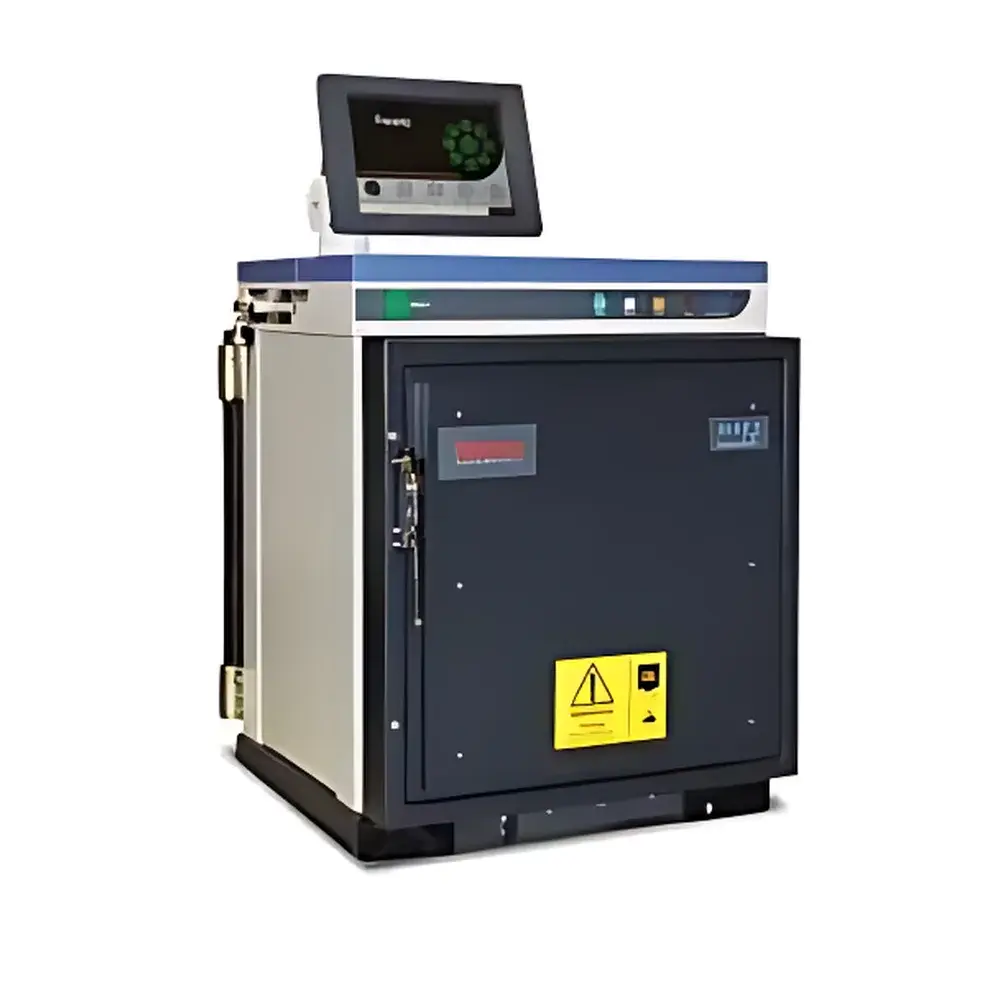
Thermo Fisher SAM12 Small-Item Radiation Monitoring System
| Brand | Thermo Fisher |
|---|---|
| Origin | USA |
| Manufacturer Type | Original Equipment Manufacturer (OEM) |
| Product Origin | Imported |
| Model | SAM12 |
| Instrument Category | Dose Rate / Contamination Meter |
| Instrument Form Factor | Portable |
| Detection Target | Gamma-emitting Radionuclides |
| Detector Technology | Co-60–Optimized Scintillation Detection with NBR (Natural Background Rejection) Algorithm |
| Measurement Scope | Discrimination of Artificial vs. Natural Gamma Radioactivity |
| Performance Context | High-reliability detection under elevated natural background radiation conditions |
| Sensitivity | Enhanced for low-level gamma contamination screening |
Overview
The Thermo Fisher SAM12 Small-Item Radiation Monitoring System is a purpose-engineered portable gamma contamination monitor designed for rapid, reliable screening of tools, personal protective equipment (PPE), laboratory ware, and other small objects in nuclear medicine facilities, radiopharmaceutical production suites, decommissioning sites, and radioactive waste handling environments. It operates on the principle of scintillation-based gamma spectroscopy coupled with real-time spectral analysis using Thermo Fisher’s proprietary Natural Background Rejection (NBR) algorithm. Unlike conventional gross-count gamma monitors, the SAM12 performs continuous spectral deconvolution to distinguish anthropogenic radionuclides—such as 60Co, 137Cs, and 99mTc—from naturally occurring radioactive material (NORM), including 40K, 232Th, and 238U decay chain isotopes. This capability ensures high specificity in regulatory-compliant release monitoring, especially where elevated terrestrial or cosmic background contributes significant spectral interference.
Key Features
- Co-60–optimized scintillation detector with energy resolution sufficient for peak identification in the 1.17–1.33 MeV range, enabling selective sensitivity to common industrial and medical gamma emitters.
- Real-time NBR algorithm that dynamically models and subtracts natural background spectra during measurement—no pre-scan calibration required.
- Large-area capacitive touchscreen display (≥7″) with intuitive icon-driven interface, supporting multilingual operation and context-sensitive help overlays.
- Onboard battery status monitoring, sensor health diagnostics, and automatic voltage regulation to maintain detector gain stability across temperature gradients (–10 °C to +50 °C operational range).
- Integrated quality control (QC) scheduler: executes automated background stability checks, energy calibration verification, and detector efficiency validation at user-defined intervals.
- USB 2.0 interface compliant with CDC ACM (Abstract Control Model) for seamless host communication; supports firmware updates and configuration synchronization without proprietary drivers.
Sample Compatibility & Compliance
The SAM12 accommodates objects up to 30 cm × 30 cm × 15 cm in dimension and ≤5 kg mass, including gloves, tongs, syringes, vials, and small instrumentation components. Its open geometry design permits both surface wipe assay correlation and direct object scanning. The system meets IEC 62327:2017 requirements for handheld radiation protection instruments and conforms to ANSI N42.33-2021 for performance criteria of radionuclide identification devices. Data acquisition and storage comply with ALARA documentation practices and support audit-ready reporting per ISO/IEC 17025:2017 clause 7.11 (Reporting of Results). While not FDA 21 CFR Part 11–certified out-of-the-box, its SQL-based database architecture allows integration with validated LIMS platforms supporting electronic signatures and audit trails.
Software & Data Management
The embedded firmware runs a deterministic real-time OS with dual-mode data handling: (1) local storage of raw spectra (1024-channel MCA format), processed counts, NBR-subtracted net peaks, and QC logs in an encrypted SQLite database; (2) structured export via USB to CSV, XML, or vendor-neutral .RAD files for traceable archiving. Reporting modules generate customizable PDF certificates—including background reference metadata, measurement duration, statistical uncertainty (±2σ), and nuclide-specific activity estimates referenced to ISO 11929:2019. All timestamps are synchronized to internal RTC with NTP-capable optional Ethernet module (SAM12-E variant).
Applications
- Release monitoring of non-radioactive waste from PET radiopharmacy labs prior to disposal.
- Post-decontamination verification of tools used in reactor maintenance or fuel handling.
- Field screening of scrap metal or recovered instrumentation suspected of orphan source contamination.
- Periodic surveillance of gloveboxes, hot cells, and fume hoods in radiochemical synthesis facilities.
- Training and procedural validation in radiation safety officer (RSO) certification programs.
FAQ
Does the SAM12 require annual factory recalibration?
No—its NBR algorithm and internal reference source enable field verification of spectral stability. However, biannual energy calibration using a 137Cs check source is recommended per ISO 4037-3:2019.
Can it detect alpha or beta emitters?
No—the SAM12 is optimized exclusively for gamma/X-ray photons ≥50 keV. Alpha and beta contamination requires dedicated proportional counters or ZnS scintillators.
Is the SQLite database schema documented for third-party integration?
Yes—Thermo Fisher provides a public schema definition document (SAM12-DB-SPEC Rev. 2.1) under NDA, detailing table structures, foreign key relationships, and timestamp conventions.
What is the typical minimum detectable activity (MDA) for 60Co on stainless steel?
Under standard 30-second scan at 5 cm distance, MDA is ≤1.2 Bq/cm² (1σ, ISO 11929:2019 methodology), assuming 0.2 µSv/h ambient background.
Does the system support remote firmware updates over Wi-Fi?
Not natively—the base SAM12 model relies on USB-based updates. The optional SAM12-WiFi add-on module enables secure OTA updates via WPA2-Enterprise networks.
Related Products







