
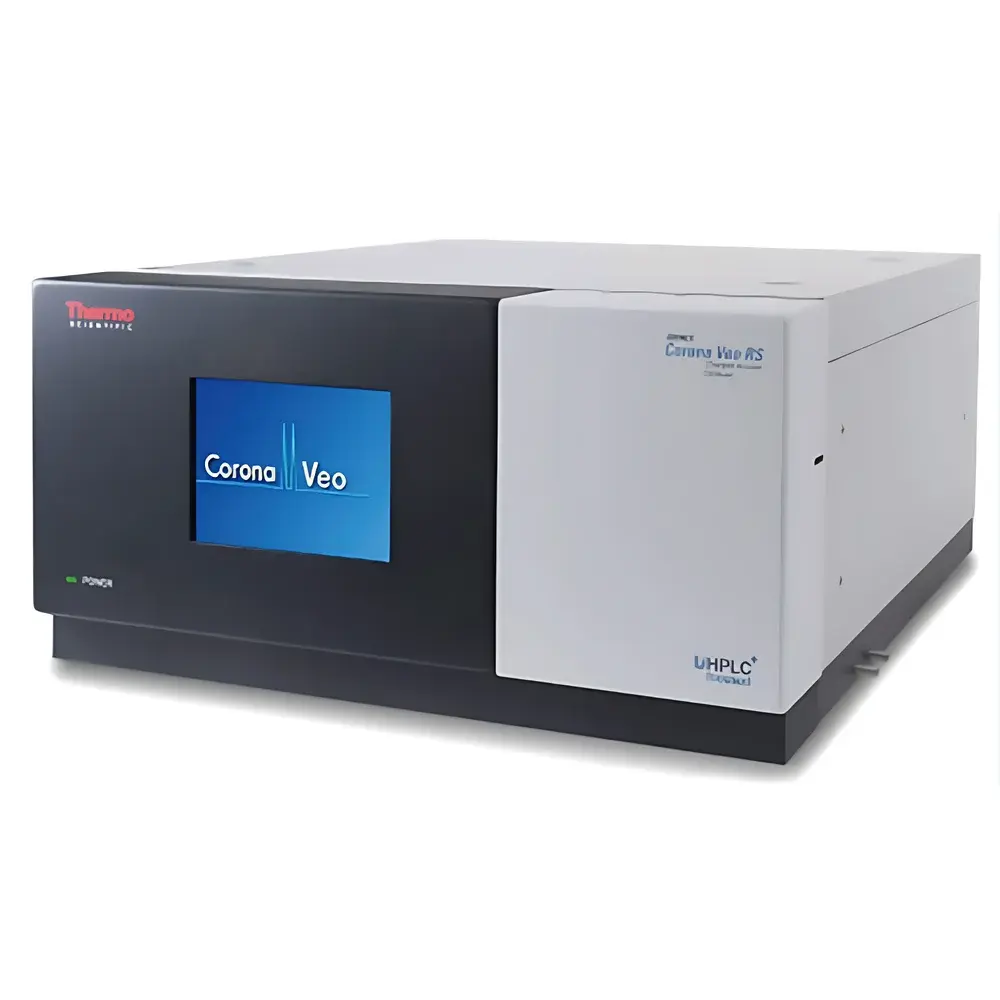
Thermo Fisher Scientific Corona Veo Charged Aerosol Detector
| Brand | Thermo Fisher Scientific |
|---|---|
| Origin | USA |
| Manufacturer Type | Original Equipment Manufacturer (OEM) |
| Product Category | Imported Instrument |
| Model | Corona Veo |
| Instrument Type | Universal Chromatographic Detector |
| Flow Rate Range | 0.01–2.0 mL/min |
| Detection Principle | Charged Aerosol Detection (CAD) |
| Sensitivity | Sub-nanogram |
| Linear Dynamic Range | >4 orders of magnitude |
| Compatibility | HPLC, UHPLC, microLC, capillary LC |
| Software Drivers | Chromeleon CDS, ChemStation, EZChrom, OpenLab, Empower 2/3 |
| Regulatory Compliance | Supports 21 CFR Part 11 audit trails, GLP/GMP-compliant data integrity workflows |
Overview
The Thermo Fisher Scientific Corona Veo Charged Aerosol Detector (CAD) is a universal, mass-sensitive detection platform engineered for high-reproducibility quantification of non-volatile and semi-volatile analytes across liquid chromatography (LC) modalities—including HPLC, UHPLC, microLC, and capillary LC. Unlike UV-Vis, fluorescence, or ELSD detectors, CAD operates on a fundamentally distinct physical principle: it aerosolizes the LC effluent, dries the droplets to form analyte particles, charges them uniformly via controlled nitrogen ionization, and measures the resultant particle-bound charge using a highly sensitive electrometer. This mechanism yields near-uniform response factors across chemically diverse compounds—regardless of chromophore presence, ionizability, or structural class—enabling accurate area-percent quantitation without compound-specific calibration standards.
Key Features
- Universal Response Profile: Delivers consistent, structure-independent signal generation for lipids, polymers, carbohydrates, surfactants, APIs, excipients, and other non-chromophoric or poorly ionizing species.
- Extended Flow Flexibility: Optimized for flow rates from 0.01 to 2.0 mL/min—enabling seamless integration with conventional analytical columns, sub-2-µm UHPLC systems, and micro/nano-LC configurations.
- Enhanced Sensitivity & Dynamic Range: Achieves sub-nanogram detection limits with >4-decade linear dynamic range—critical for trace-level impurity profiling and broad-concentration mixture analysis.
- Coaxial Nebulizer Architecture: Features an advanced coaxial nebulizer design that minimizes clogging, accommodates high-organic and high-salt mobile phases, and supports extended uptime in routine QC environments.
- Zero-Dead-Volume Integration: Compatible with Thermo Scientific Dionex Viper fittings (1/32″ capillary), rated to 1250 bar—ensuring minimal band broadening and optimal resolution transfer from column to detector.
- Regulatory-Ready Operation: Fully compatible with 21 CFR Part 11-compliant chromatography data systems (CDS), including Chromeleon, Empower 2/3, OpenLab, and third-party platforms—supporting electronic signatures, audit trails, and secure data archiving.
Sample Compatibility & Compliance
The Corona Veo CAD detects any non-volatile or semi-volatile analyte that forms stable particles upon solvent evaporation—including small-molecule pharmaceuticals, peptides, oligonucleotides, glycans, phospholipids, polymeric additives, surfactants, and industrial organic acids. It excludes only highly volatile compounds (e.g., solvents, low-MW organic acids below ~100 Da) and thermally labile species prone to decomposition during drying. Method development requires no analyte-specific optimization; mobile phase selection follows standard LC compatibility guidelines (e.g., volatility, volatility-compatible modifiers). The system complies with ISO/IEC 17025 method validation requirements and supports ICH Q2(R2) parameters—linearity, LOD/LOQ, precision, accuracy, and robustness—when deployed in GxP-regulated laboratories.
Software & Data Management
The Corona Veo integrates natively with Thermo Fisher Chromeleon CDS and provides certified drivers for Waters Empower 2/3, Agilent ChemStation, PerkinElmer EZChrom, and Agilent OpenLab CDS. All supported platforms enable full instrument control, real-time signal monitoring, and automated post-run processing—including built-in Power Function linearization. This proprietary algorithm applies a mathematical transformation to raw CAD response data, correcting inherent nonlinearity and enabling accurate quantitation of co-eluting peaks and mass-balance calculations without reference standards. Raw data files are stored in vendor-neutral formats (e.g., .cdf, .raw) and support metadata tagging, version-controlled method storage, and role-based access control—fulfilling ALCOA+ (Attributable, Legible, Contemporaneous, Original, Accurate, Complete, Consistent, Enduring, Available) data integrity principles.
Applications
- Pharmaceutical Development: Simultaneous quantitation of active pharmaceutical ingredients (APIs) and counterions in HILIC separations; excipient profiling in formulated products; residual solvent and polymer impurity screening.
- Lipidomics & Biologics Characterization: Quantitative analysis of triglycerides, phospholipids, and glycolipids without derivatization; aggregate and fragment detection in mAb formulations.
- Food & Beverage Quality Control: Sucrose, lactose, and maltodextrin profiling in gradient RP-LC; detection of non-UV-absorbing preservatives and emulsifiers.
- Industrial Polymer & Specialty Chemical Analysis: Molecular weight distribution estimation of polyacrylic acid inhibitors; quantification of surfactant blends in agrochemical formulations.
- Alternative Fuel & Biofuel Research: Fatty acid methyl ester (FAME) and hydroprocessed esters and fatty acids (HEFA) analysis where UV response varies significantly across chain lengths and saturation states.
FAQ
How does CAD differ from ELSD?
CAD uses controlled nitrogen ionization to impart uniform charge to dried analyte particles, yielding superior sensitivity, wider linear dynamic range, and improved reproducibility compared to evaporative light scattering detection (ELSD), which relies on optical scattering intensity.
Can CAD replace UV detection in regulated QC labs?
Yes—when validated per ICH Q2(R2) and aligned with 21 CFR Part 11 data governance protocols, CAD serves as a primary quantitative detector for non-UV-active compounds in release testing and stability studies.
Is CAD compatible with gradient elution methods?
Yes—the Corona Veo maintains baseline stability and quantitative accuracy across steep organic gradients (e.g., 5–95% acetonitrile), unlike ELSD or RI detectors that suffer from mobile-phase-induced drift.
What maintenance is required for long-term reliability?
Routine maintenance includes weekly nebulizer cleaning with methanol/water, quarterly replacement of the drying gas filter, and annual electrometer calibration—documented in the instrument’s preventive maintenance log within Chromeleon or Empower.
Does CAD require special mobile phase additives?
No—standard LC-grade solvents and volatile buffers (e.g., ammonium acetate, ammonium formate) are fully compatible; non-volatile salts (e.g., phosphate buffers) must be avoided to prevent nebulizer fouling.






