
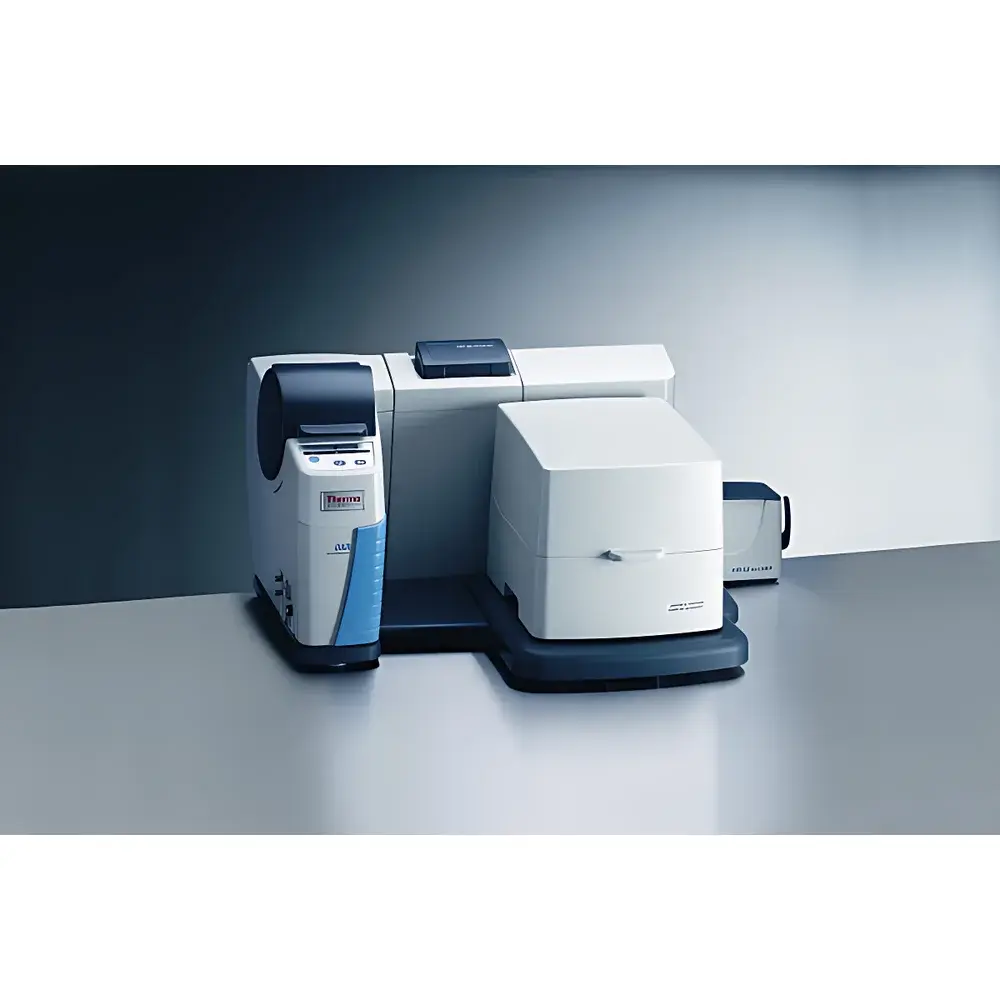
Thermo Fisher Scientific DXR Smart Raman Spectrometer
| Brand | Thermo Fisher Scientific |
|---|---|
| Origin | USA |
| Manufacturer Type | Original Equipment Manufacturer (OEM) |
| Instrument Type | Dispersive Raman Spectrometer (not FT-Raman) |
| Spectral Range | 50–6000 cm⁻¹ |
| Spectral Resolution | <2 cm⁻¹ |
| Spatial Resolution | Micron-level |
| Minimum Wavenumber | 50 cm⁻¹ |
| Spectral Reproducibility | ±0.2 cm⁻¹ |
Overview
The Thermo Fisher Scientific DXR Smart Raman Spectrometer is a high-performance, research-grade dispersive Raman spectrometer engineered for precision, robustness, and operational efficiency in regulated and high-throughput laboratory environments. Unlike Fourier-transform (FT) Raman systems—which rely on interferometry and near-infrared excitation—the DXR employs a high-efficiency holographic grating monochromator coupled with a thermoelectrically cooled CCD detector, enabling rapid, high-sensitivity acquisition across the full 50–6000 cm⁻¹ spectral range. Its optical architecture is optimized for visible and near-UV excitation (with selectable laser wavelengths), delivering strong signal-to-noise ratios even for weak scatterers and fluorescence-prone samples. Designed explicitly for quality control (QC), raw material identification (RMID), polymorph screening, and failure analysis, the DXR integrates hardware-level automation with chemometric-ready software to minimize operator dependency while maintaining metrological traceability.
Key Features
- Patented Auto-Alignment & Self-Calibration: Eliminates routine optical realignment; maintains wavelength accuracy within ±0.2 cm⁻¹ over extended operation without scheduled downtime.
- Intelligent Acquisition Suite: Includes Auto-Focus (maximizes Raman signal intensity at sample surface), Auto-Exposure (dynamically calculates optimal integration time per spectrum), and Smart Background (acquires dark/ambient background during instrument idle periods, decoupling background collection from active measurement).
- Variable Dynamic Point Sampling (VDPS): Enables spatially resolved mapping of heterogeneous samples—e.g., tablets, emulsions, or composite films—by dynamically adjusting laser spot position and dwell time across user-defined regions.
- Laser Flexibility: Three interchangeable solid-state lasers (e.g., 532 nm, 633 nm, 785 nm) allow optimization of resonance enhancement, fluorescence suppression, and penetration depth per sample class.
- Cosmic Ray Rejection Algorithm: Embedded real-time spectral correction removes transient high-energy particle artifacts without user intervention or post-processing delay.
- Smart Accessory Recognition: All sampling interfaces—including array autosamplers, vial holders, tablet chucks, 180° reflection probes, and universal stages—feature electronic ID chips. OMNIC software auto-detects configuration, applies correct calibration files, and logs accessory usage for audit trails.
Sample Compatibility & Compliance
The DXR accepts diverse physical forms without destructive preparation: intact pharmaceutical blister packs, amber glass vials containing liquids or suspensions, multi-well plates (96-/384-well), polymer films, powders in polyethylene bags, and coated tablets. Its non-contact, through-container capability satisfies ASTM E1840 and USP guidelines for non-invasive identity testing. System validation supports IQ/OQ/PQ protocols compliant with FDA 21 CFR Part 11, EU Annex 11, and ISO/IEC 17025 requirements. Full electronic audit trail—covering instrument parameters, accessory swaps, spectral acquisition history, and user actions—is natively generated and exportable in CSV or PDF format.
Software & Data Management
Powered by OMNIC Specta software, the DXR delivers end-to-end workflow integration—from automated batch acquisition to library-driven identification and multivariate analysis. The platform includes InterpretIR™ for peak assignment and functional group correlation, integrated spectral libraries (>35,000 reference spectra), and customizable search algorithms (e.g., correlation thresholding, derivative matching). Array automation modules support unattended analysis of multi-well plates and carousel-based sample sets, with result aggregation into Excel-compatible reports. All spectral data are stored in vendor-neutral .spa format, ensuring long-term readability and third-party tool compatibility (e.g., MATLAB, Python SciPy). Raw and processed data, metadata, and method files are encrypted and version-controlled on local storage or network-attached drives.
Applications
- Pharmaceutical: Polymorph identification, counterfeit detection, blend uniformity assessment, coating thickness estimation via depth-profiling.
- Materials Science: Carbon nanotube chirality analysis, graphene layer counting, stress/strain mapping in composites.
- Forensics: Trace evidence characterization (e.g., pigments, explosives residues, illicit drugs) through opaque packaging.
- Academia & R&D: In situ reaction monitoring, catalyst surface speciation, battery electrode degradation studies.
- Quality Assurance: Incoming raw material verification against pharmacopeial monographs (USP, EP, JP), release testing of final dosage forms.
FAQ
Is the DXR a Fourier-transform Raman spectrometer?
No. The DXR is a dispersive Raman spectrometer utilizing a holographic grating and CCD detector. It does not employ an interferometer or require FT mathematical transformation.
Can the DXR analyze samples inside plastic or glass containers?
Yes. Its high-throughput optics and optimized excitation/detection geometry enable reliable analysis through common primary packaging materials—including polyethylene, polypropylene, and borosilicate glass—without opening or reformatting.
How does the system ensure long-term spectral reproducibility?
Through continuous internal wavelength calibration using built-in neon and argon emission lines, combined with real-time thermal stabilization of optical components and detector cooling to –50°C.
What regulatory documentation is provided for GxP environments?
Thermo Fisher supplies comprehensive validation documentation packages—including Design Qualification (DQ), Installation Qualification (IQ), Operational Qualification (OQ), and Performance Qualification (PQ) templates—as well as 21 CFR Part 11 compliance configuration guides and electronic signature implementation notes.
Is remote monitoring or networked deployment supported?
Yes. OMNIC Specta supports centralized license management, role-based access control, and secure remote access via HTTPS-enabled web interface for instrument status, queue monitoring, and diagnostic reporting.





