
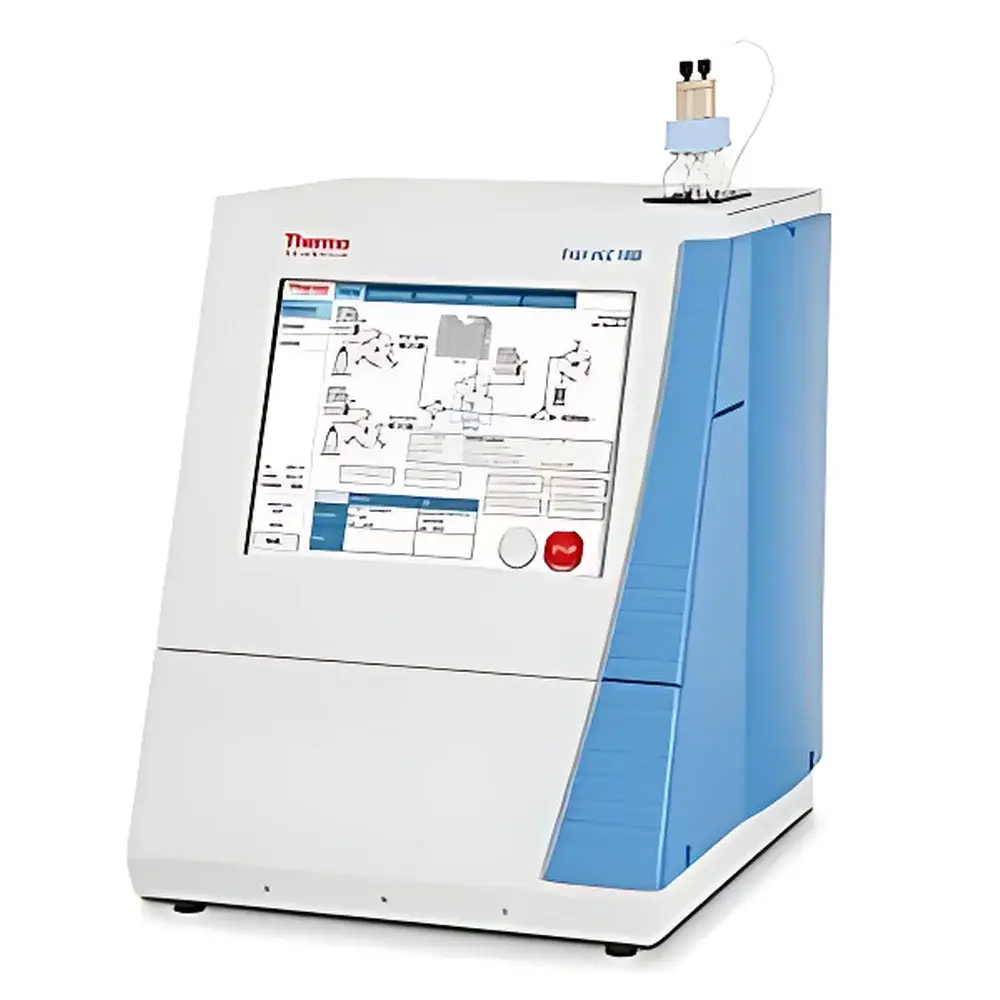
Thermo Fisher Scientific EASY-nLC 1000 Nano-UHPLC System
| Brand | Thermo Fisher Scientific |
|---|---|
| Origin | USA |
| Manufacturer Type | Original Equipment Manufacturer (OEM) |
| Product Origin | Imported |
| Model | EASY-nLC 1000 |
| Instrument Type | Nanoflow Liquid Chromatography System |
| Column ID | 50 µm |
| Packing Particle Size | 1.9 µm |
| Maximum Operating Pressure | Up to 1000 bar |
| Gradient Precision | <0.2% RSD |
| Flow Rate Range | 50–1000 nL/min |
| Injection Volume Precision | <1% RSD |
| System Dead Volume | <100 nL |
| Software Platform | Thermo Scientific Xcalibur |
Overview
The Thermo Fisher Scientific EASY-nLC 1000 is a purpose-engineered nanoflow ultra-high-performance liquid chromatography (nano-UHPLC) system designed for high-sensitivity, high-reproducibility separation of low-abundance biomolecules—particularly peptides and intact proteins—in bottom-up and top-down proteomics workflows. Operating on the principle of pressure-driven laminar flow through microbore capillary columns, the EASY-nLC 1000 delivers precise gradient elution at flow rates between 50 and 1000 nL/min, enabling optimal coupling with electrospray ionization (ESI) sources of high-resolution mass spectrometers—including Orbitrap, Q-Exactive, and TSQ series instruments. Its architecture supports pressures up to 1000 bar, facilitating the use of sub-2-µm particle-packed columns (e.g., 50 µm i.d. × 15–50 cm length, 1.9 µm particles) to achieve enhanced peak capacity, reduced analysis time, and improved peptide identification rates—demonstrated in peer-reviewed studies to increase sequence coverage and protein identifications by up to 30% compared to conventional microflow LC systems.
Key Features
- Intelligent Flow Control (IFC): Dynamically modulates flow during loading and column equilibration to prevent over-pressurization, minimize column clogging, and extend column lifetime.
- Advanced Flow Control (AFC): Delivers sub-microliter gradient precision (<0.2% RSD) across sequential injections, ensuring robust inter-run reproducibility essential for label-free quantitative proteomics.
- Pulse-free dual-syringe pumping: Eliminates mechanical pulsation via synchronized syringe actuation, reducing wear on seals, valves, and ferrules while improving baseline stability and retention time reproducibility.
- Integrated diagnostics suite: Real-time leak detection with spatial localization, automated system backpressure profiling, event-logged fault tracing, and remote web-based system monitoring via Ethernet or LAN.
- Minimal dead-volume fluidic path: Factory-optimized capillary routing (<100 nL total system volume) ensures rapid gradient response, negligible band broadening, and full exploitation of nano-column resolving power.
- True splitless gradient mixing: No post-mixing dilution or flow splitting; gradients are formed and delivered directly to the column using dual independent syringe pumps and real-time flow-rate sensing.
Sample Compatibility & Compliance
The EASY-nLC 1000 is compatible with standard 360 µm o.d. fused-silica capillaries, packed or self-packed nano-columns (50–75 µm i.d.), and commercial nano-LC cartridges (e.g., EASY-Spray, PepMap). It supports aqueous/organic mobile phases (e.g., water/acetonitrile with 0.1% formic acid), including volatile buffers required for MS compatibility. The system meets core regulatory expectations for analytical instrument qualification under GLP and GMP environments: it supports audit-trail-enabled operation within Thermo Scientific Xcalibur software (compliant with FDA 21 CFR Part 11 when configured with appropriate IT controls), and its performance specifications align with ISO/IEC 17025 method validation requirements for chromatographic resolution, retention time stability, and injection precision. Routine operation adheres to ASTM E2914-13 (Standard Guide for Validation of LC-MS Methods in Proteomics) and USP guidelines for chromatographic system suitability.
Software & Data Management
Controlled exclusively through Thermo Scientific Xcalibur software (v4.5 or later), the EASY-nLC 1000 integrates natively into LC-MS method development, acquisition scheduling, and post-run data review workflows. Xcalibur provides full instrument configuration, gradient programming, real-time pressure/flow monitoring, automated maintenance logging, and synchronized MS acquisition triggering. All method parameters—including flow rate ramps, gradient profiles, valve switching sequences, and column temperature settings—are stored as encrypted, version-controlled method files. Audit trails record user actions, parameter changes, and system events with timestamps and operator IDs. Raw data files (.raw) embed complete chromatographic metadata (pressure traces, flow logs, error codes), enabling retrospective troubleshooting and full traceability per ALCOA+ principles.
Applications
- High-depth bottom-up proteomics: Enables identification and quantification of >10,000 proteins from single-shot HeLa lysate analyses using 2–4 h gradients on 50 µm × 50 cm columns.
- Post-translational modification (PTM) mapping: Supports enrichment-compatible nano-LC workflows for phosphopeptides, glycopeptides, and acetylated histones with minimal sample loss.
- Single-cell proteomics: Delivers sufficient sensitivity and retention time stability for sub-nanogram-level digests with reproducible peak shapes across technical replicates.
- Top-down proteomics: Compatible with intact protein separations using specialized stationary phases (e.g., C4, BEH C4) under denaturing conditions.
- Targeted proteomics (SRM/PRM): Provides exceptional retention time precision (<0.02 min RSD) and peak shape fidelity required for multiplexed assay development.
FAQ
What is the maximum recommended operating pressure for the EASY-nLC 1000?
The system is rated for continuous operation up to 1000 bar, with safety cutoffs and real-time pressure monitoring to protect columns and fluidic components.
Can the EASY-nLC 1000 be used with non-Thermo mass spectrometers?
Yes—its standard ESI interface and analog/digital trigger outputs support integration with third-party MS platforms, provided they accept external start signals and operate within standard nano-ESI voltage and gas flow ranges.
Does the system require external gas supply or cooling?
No—no compressed gas, chiller, or external solvent degassing unit is needed; all functions are self-contained, including integrated solvent degassing and ambient-temperature operation.
How is column priming and system equilibration automated?
Xcalibur’s built-in method editor includes dedicated “Column Conditioning” and “System Equilibration” steps with programmable flow ramping, dwell time, and pressure hold sequences.
Is preventive maintenance documentation included?
Yes—Thermo provides a comprehensive Maintenance Guide (P/N 08 021152) covering syringe calibration, seal replacement intervals, valve actuation testing, and pressure sensor verification protocols aligned with ISO/IEC 17025 preventive maintenance criteria.
Related Products




