
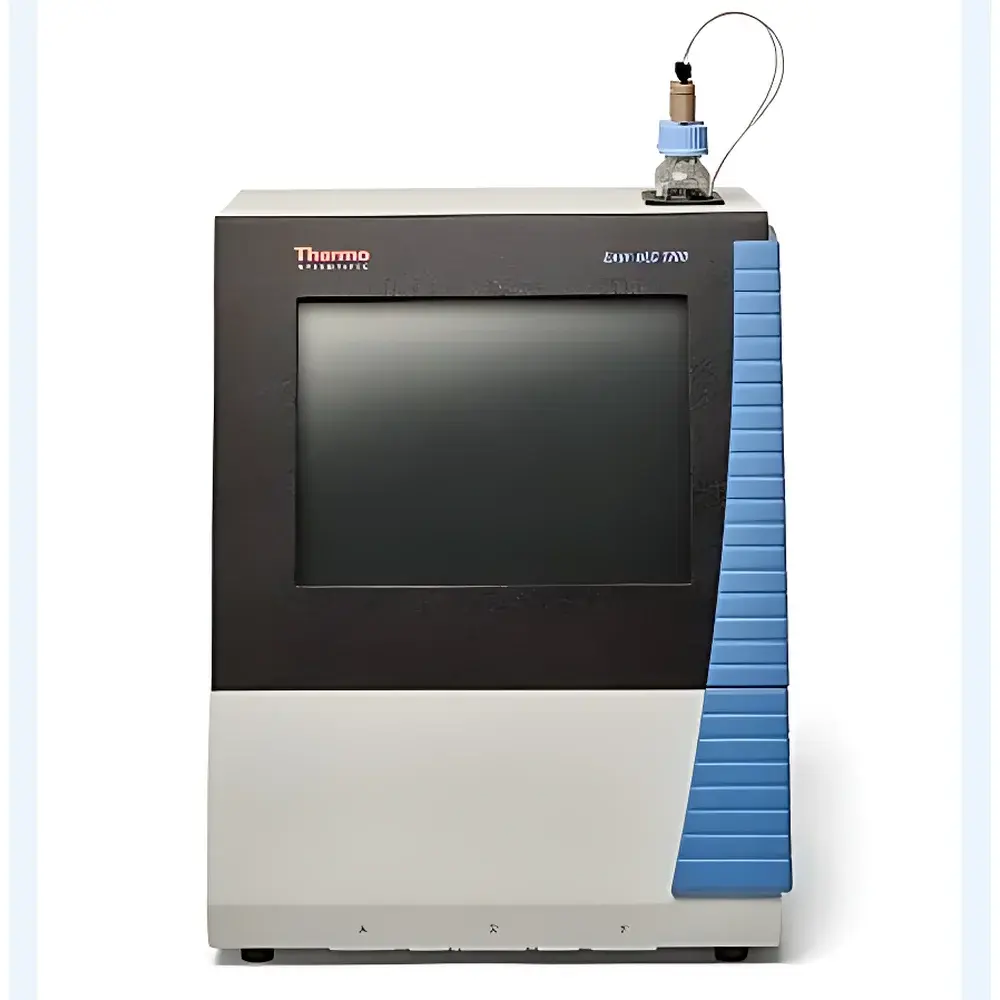
Thermo Fisher Scientific EASY-nLC 1200 Nano-UHPLC System
| Brand | Thermo Fisher |
|---|---|
| Origin | USA |
| Manufacturer Type | Original Equipment Manufacturer (OEM) |
| Product Origin | Imported |
| Model | EASY-nLC 1200 |
| Instrument Type | Nanoflow Liquid Chromatography System |
| Maximum Operating Pressure | 1200 bar |
| Column Compatibility | 75 cm columns packed with 1.9 µm particles |
Overview
The Thermo Fisher Scientific EASY-nLC 1200 Nano-UHPLC System is a purpose-built nanoflow liquid chromatography platform engineered for high-sensitivity, high-resolution separation of low-abundance biomolecules—particularly peptides and intact proteins—in bottom-up and top-down proteomics workflows. Based on robust microfluidic architecture and dual-pump gradient generation, the system operates at up to 1200 bar to enable optimal utilization of sub-2-µm particle-packed capillary columns (e.g., 75 µm × 75 cm). Its core principle relies on precise, pulse-free solvent delivery and nanoliter-scale flow control (50–1000 nL/min), minimizing band broadening and maximizing peak capacity, signal-to-noise ratio, and identification confidence in LC-MS coupling. Designed as a dedicated front-end for Thermo Scientific Orbitrap and triple quadrupole mass spectrometers, the EASY-nLC 1200 integrates seamlessly into regulated and discovery-oriented proteomics laboratories where reproducibility, uptime, and method transferability are critical.
Key Features
- Intelligent Flow Control (IFC): Dynamically adjusts flow rates during sample loading and column equilibration to reduce cycle time by up to 30%, while preventing column overloading and frit clogging.
- Advanced Flow Control (AFC): Maintains flow accuracy within ±1.5% RSD across the full nanoflow range (50–1000 nL/min), ensuring inter-run retention time stability < 0.5% RSD and quantitative repeatability suitable for label-free and TMT-based quantitation.
- Pulse-Free Dual-Syringe Pump Architecture: Eliminates mechanical pulsation via synchronized syringe actuation and active backpressure regulation—reducing seal wear, valve maintenance frequency, and baseline noise in MS detection.
- Integrated Diagnostics Suite: Real-time leak localization, pre-injection air bubble detection, automated system backpressure profiling, and self-calibrating flow sensor validation—all accessible via embedded web interface.
- Maintenance-Aware Design: Tool-free module replacement, maintenance event logging with timestamped error codes, scheduled service alerts, and remote troubleshooting support via secure HTTPS connection.
- Optimized Fluidic Pathway: Factory-tuned, low-dead-volume flow path (< 200 nL from injector to column outlet) ensures minimal dispersion and enables true nanoflow gradient fidelity without splitting or post-column dilution.
Sample Compatibility & Compliance
The EASY-nLC 1200 supports standard nanobore column formats (25–150 µm i.d.) and is validated for use with reversed-phase C18, C8, and hydrophilic interaction (HILIC) stationary phases. It accommodates both trap-elute and one-dimensional nano-LC configurations. The system complies with ISO 9001-certified manufacturing standards and supports audit-ready operation under GLP and GMP environments when paired with Thermo Scientific Chromeleon CDS or Xcalibur software configured for 21 CFR Part 11 compliance—including electronic signatures, audit trails, and user-access controls. Method parameters and run logs are stored with immutable timestamps and checksum-verified integrity.
Software & Data Management
Controlled exclusively through Thermo Scientific Xcalibur 4.x or later, the EASY-nLC 1200 leverages native instrument drivers for synchronized method execution, real-time pressure/flow monitoring, and automatic recovery from common faults (e.g., air ingress, pressure spikes). All sequence methods, calibration data, and diagnostic reports are stored in a relational database schema compatible with LIMS integration. Raw chromatographic data (including pressure, flow, and gradient profiles) are embedded in .raw files alongside MS acquisitions, enabling retrospective correlation of LC performance with spectral quality metrics (e.g., peak width, S/N, precursor intensity). Remote system status checks and firmware updates are performed over standard Ethernet without requiring local workstation access.
Applications
- High-depth bottom-up proteomics (single-shot analysis of >10,000 proteins from mammalian cell lysates)
- Post-translational modification (PTM) mapping requiring extended gradient linearity and low carryover
- Single-cell and limited-sample proteomics (e.g., laser-capture microdissected tissues, circulating tumor cells)
- Peptide retention time prediction model training and retention time alignment across multi-lab studies
- Method development for clinical biomarker verification using SRM/MRM on triple quadrupole platforms
- Top-down proteomics with intact protein separations on long monolithic or packed capillary columns
FAQ
What is the maximum recommended operating pressure for the EASY-nLC 1200?
The system is rated for continuous operation up to 1200 bar, with hardware components (pumps, injectors, fittings) qualified per ASME B31.3 process piping standards.
Can the EASY-nLC 1200 be used with non-Thermo mass spectrometers?
Yes—its analog/digital I/O ports and open API allow third-party MS synchronization via TTL triggers and voltage-controlled start/stop signals, though full vendor-supported integration is limited to Thermo Scientific mass spectrometers.
Does the system support gradient delay volume compensation?
Yes—Xcalibur software includes built-in gradient delay calibration routines that measure and correct for dwell volume using step-gradient profiling, ensuring accurate retention time alignment across column lengths and flow rates.
Is method transfer possible between EASY-nLC 1000 and EASY-nLC 1200?
Methods developed on the EASY-nLC 1000 can be ported directly; however, pressure-dependent parameters (e.g., flow rate limits, gradient steepness) must be re-validated due to the expanded 1200 bar operational envelope and improved pump linearity.
How frequently does the system require preventive maintenance?
Under typical usage (8 h/day, 5 days/week), the recommended maintenance interval is every 6 months—primarily involving syringe seal inspection, waste line flush, and flow sensor recalibration—documented automatically in the service log.
Related Products






