
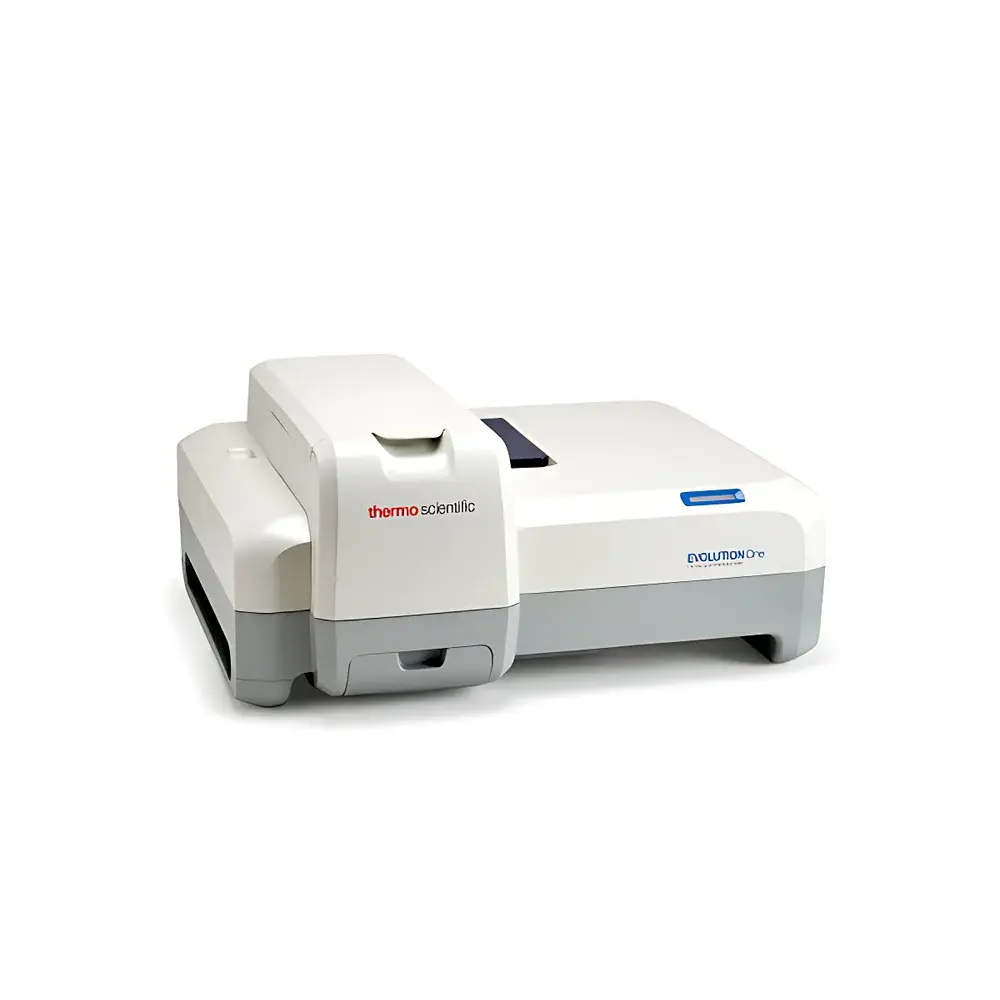
Thermo Fisher Scientific Evolution One UV-Vis Spectrophotometer
| Brand | Thermo Fisher |
|---|---|
| Origin | USA |
| Manufacturer Type | Original Equipment Manufacturer (OEM) |
| Product Origin | Imported |
| Model | Evolution One |
| Instrument Architecture | Double-beam |
| Detector Type | Photodiode Array (PDA) |
| Wavelength Range | 190–1100 nm |
| Wavelength Automation | Motorized Auto-Scanning |
| Spectral Bandwidth | 0.5–4 nm (selectable) |
| Wavelength Accuracy | ±0.5 nm (at Hg emission lines 541.9 nm and 546.1 nm), ±0.8 nm (full range) |
| Wavelength Repeatability | ≤0.05 nm (SD, 10 measurements at 546.1 nm Hg line) |
| Stray Light | <0.01% T (at 220 nm, NaI |
Overview
The Thermo Fisher Scientific Evolution One UV-Vis Spectrophotometer is a precision double-beam instrument engineered for high-fidelity quantitative and qualitative analysis across academic research, pharmaceutical development, materials science, and regulated quality control laboratories. It operates on the fundamental principle of Beer–Lambert law-based absorption spectroscopy, utilizing a xenon flash lamp as its broadband light source—eliminating warm-up delays and enabling rapid, stable spectral acquisition from 190 to 1100 nm. Its core optical architecture integrates Advanced Fixed Beam Geometry (AFBG), a proprietary double-beam design that maintains path-length stability and minimizes photometric drift during extended measurements. Unlike traditional scanning monochromators with moving gratings, the Evolution One employs a fixed grating and PDA detector, delivering simultaneous full-spectrum capture with high signal-to-noise ratio and exceptional wavelength fidelity. This architecture supports rigorous method validation, long-term instrument stability monitoring, and reproducible data generation under GLP, GMP, and ISO/IEC 17025 frameworks.
Key Features
- Double-beam optical design with Advanced Fixed Beam Geometry (AFBG) for superior baseline stability and reduced photometric noise
- Xenon flash lamp illumination: zero warm-up time, >10⁹ lifetime flashes, and consistent spectral output across UV, visible, and NIR regions
- Photodiode array (PDA) detector enabling full-spectrum acquisition in <1 second per scan, with no mechanical slit movement
- Selectably variable spectral bandwidth (0.5–4 nm) optimized for resolution/sensitivity trade-offs in complex matrices
- Wavelength accuracy certified against NIST-traceable mercury emission lines (541.9 nm, 546.1 nm) and validated across full range per ASTM E275 and ISO 9001 calibration protocols
- Robust mechanical construction with temperature-compensated optics and vibration-damped optical bench for operation in non-climate-controlled lab environments
Sample Compatibility & Compliance
The Evolution One accommodates diverse sample formats—including cuvettes (1 mm to 100 mm pathlength), microvolume stands, integrating spheres for diffuse reflectance, fiber-optic probes for in-situ monitoring, and solid-sample holders for thin films or powders. Optional Peltier-controlled single-cell or 8-position thermostatted holders support kinetic studies from 0 °C to 100 °C with ±0.1 °C stability. All accessories are mechanically registered and software-recognized to prevent misconfiguration. For regulated environments, the system supports 21 CFR Part 11-compliant user access control, electronic signatures, and full audit trail logging when deployed with Insight Pro Software v3.5+. It meets key international standards including ASTM E169 (general practices for UV-Vis), ASTM E387 (wavelength accuracy), USP (spectrophotometric analysis), and ISO 17025 clause 5.5.2 (equipment verification).
Software & Data Management
Insight Pro Software provides a role-based, workflow-driven interface compliant with ALCOA+ data integrity principles. Its Custom User Environment (CUE) allows creation of locked, version-controlled analytical methods with embedded pass/fail criteria, auto-calculations (e.g., concentration, purity ratios, molar absorptivity), and integrated uncertainty propagation. Raw spectral data are stored in vendor-neutral .spc format with embedded metadata (instrument ID, operator, timestamp, calibration status). The software supports direct export to LIMS via ASTM E1384-compliant ASCII or XML, and includes built-in tools for ICH Q2(R2)-aligned method validation reports (linearity, LOD/LOQ, robustness). Audit trails record all user actions—including parameter edits, calibration events, and report generation—with immutable timestamps and operator attribution.
Applications
The Evolution One delivers validated performance in applications requiring regulatory traceability and technical rigor: quantification of nucleic acids and proteins (A260/A280), dissolution testing per USP , colorimetric enzyme kinetics (e.g., LDH, ALP), nanoparticle size estimation via plasmon resonance, polymer degradation analysis by carbonyl index, and impurity profiling in small-molecule APIs. Its high stray-light rejection (3.5 A) eliminates need for manual attenuation in most routine assays.
FAQ
Does the Evolution One support IQ/OQ/PQ documentation packages for regulated labs?
Yes—Thermo Fisher offers factory-certified Installation Qualification (IQ), Operational Qualification (OQ), and Performance Qualification (PQ) kits aligned with ASTM E2500 and Annex 11 requirements.
Can Insight Pro Software be configured for multi-user permission levels?
Yes—administrators can define roles (e.g., Analyst, Supervisor, QA Reviewer) with granular controls over method editing, data deletion, and electronic signature authority.
Is the instrument compatible with third-party autosamplers?
It interfaces natively with Thermo’s AutoSampler Plus and supports RS-232/USB command protocols for integration with select OEM autosamplers meeting SCPI standards.
What calibration standards are recommended for routine verification?
NIST-traceable holmium oxide (Ho₂O₃) and didymium filters for wavelength verification; potassium dichromate in 0.005 M H₂SO₄ for photometric accuracy at 235, 257, 313, and 350 nm per USP .
How is photometric linearity verified across the absorbance range?
Using neutral density filters or serial dilutions of certified reference materials, with linearity assessed per ISO 10012 (R² ≥ 0.9999 over 0–3.0 A) and documented in the system suitability report.




