
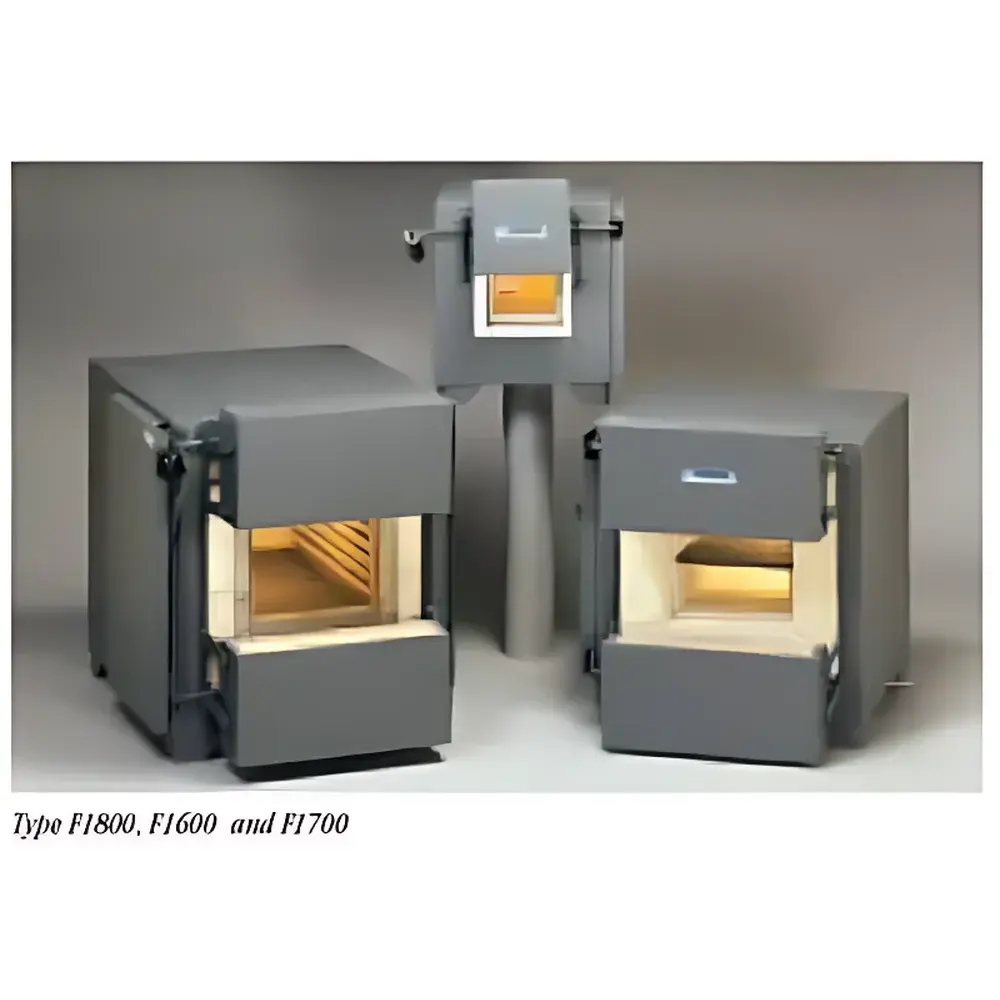
Thermo Fisher Scientific F1600/F1700/F1800 Heavy-Duty Refractory Brick Muffle Furnace
| Brand | Thermo Fisher Scientific |
|---|---|
| Origin | USA |
| Model | F1600 / F1700 / F1800 |
| Temperature Range | 150–1360 °C |
| Chamber Volume | 5.7–41.4 L |
| Construction | Heavy-duty refractory brick lining + reinforced steel cabinet |
| Heating Element Configuration | Four-wall embedded in refractory cement |
| Standard Floor Protection | Ceramic hearth plate |
| Power Supply | Requires external hardwiring |
| Controller | Sold separately |
| Safety Design | Top-hinged door with heat-shielded orientation (hot surface directed away from operator) |
Overview
The Thermo Fisher Scientific F1600, F1700, and F1800 series heavy-duty muffle furnaces are engineered for sustained high-temperature operation in demanding laboratory and industrial quality control environments. These furnaces operate on resistive heating principles, utilizing high-purity Kanthal A1 or similar alloy heating elements embedded within a monolithic refractory cement matrix—ensuring thermal stability, mechanical protection against particulate contamination, and resistance to chemical degradation from ash residues or volatile combustion byproducts. Designed for applications requiring precise thermal profiles and long-term repeatability—including organic ashing per ASTM D3174 and ISO 1171, ceramic sintering, metallurgical heat treatment, and glass annealing—the series delivers robust performance at maximum operating temperatures up to 1360 °C. The furnace chamber is fully isolated from the heating elements by dense, low-conductivity refractory brick insulation (typically alumina-silica composition), minimizing thermal loss and supporting stable setpoint maintenance under load.
Key Features
- Reinforced structural architecture: Dual-layer construction comprising a load-bearing carbon steel outer shell and a 100–150 mm thick high-density refractory brick inner lining, rated for continuous operation at 1360 °C and capable of supporting static loads up to 25 kg without deformation.
- Four-wall heating configuration: Heating elements distributed uniformly across all interior vertical surfaces and the ceiling, enabling rapid thermal equilibration and achieving ±5 °C temperature uniformity (measured per ASTM E220) across the working zone at 1000 °C.
- Integrated ceramic hearth plate: Removable 25 mm-thick alumina-based floor tile protects the bottom heating circuit from direct contact with crucibles, spillage, and thermal shock during repeated loading/unloading cycles.
- Top-hinged safety door: Mechanically balanced upward-opening mechanism positions the hottest internal surface (door inner face) away from the operator during access, reducing radiant exposure and complying with ANSI Z87.1-rated ergonomic handling protocols.
- Refractory cement-encapsulated elements: Heating wires cast directly into high-alumina refractory cement, eliminating exposed terminations and mitigating oxidation, vibration fatigue, and corrosive attack from halogenated organics or sulfur-rich samples.
Sample Compatibility & Compliance
These furnaces accommodate standard ceramic, quartz, and metal crucibles (up to 150 mm diameter), graphite boats, and sintering trays used in ASTM C114 (cement analysis), USP (heavy metals testing), and ISO 5660-1 (fire reaction calorimetry). All models meet IEC 61010-1:2010 requirements for electrical safety in laboratory equipment and are compatible with GLP/GMP workflows when paired with validated controllers supporting 21 CFR Part 11-compliant audit trails. The refractory lining composition complies with EU Directive 2002/95/EC (RoHS) and contains no asbestos or crystalline silica above threshold limits.
Software & Data Management
Controller integration is modular: compatible with Thermo Fisher’s TC-1000 programmable temperature controller (with ramp/soak profiling, USB data logging, and optional Ethernet connectivity) or third-party PID units meeting DIN 43760 standards. When configured with compliant firmware, the system supports electronic record retention, user-access-level authentication, and timestamped event logs—including door-open alerts, overtemperature faults, and power interruption recovery sequences—enabling traceability in regulated pharmaceutical and materials certification labs.
Applications
- Quantitative ash content determination in foodstuffs, polymers, and lubricants per AOAC 942.05 and ISO 2171.
- Pre-conditioning of catalyst supports and ceramic substrates prior to BET surface area analysis.
- Thermal gravimetric analysis (TGA) sample preparation under inert or oxidative atmospheres (requires optional gas purge kit).
- Calibration of thermocouples and reference materials using fixed-point metals (e.g., Ag, Au, Cu) in accordance with NIST SP 250-89.
- Residue ignition in environmental soil testing (EPA Method 9081) and wastewater sludge characterization (APHA 2540 E).
FAQ
Is a controller included with the furnace?
No. All F-series models require a separately ordered temperature controller; recommended options include the Thermo Fisher TC-1000 or equivalent DIN-compliant PID units.
What electrical supply is required?
Hardwired connection to a dedicated 208–240 V AC, 50/60 Hz circuit with appropriate overcurrent protection; exact amperage depends on model and voltage configuration (see technical datasheet).
Can these furnaces be used under inert gas?
Yes—when fitted with an optional gas inlet/outlet port kit and sealed door gasket, they support nitrogen or argon purging at flow rates up to 1 L/min for controlled-atmosphere processing.
What maintenance is required for the refractory lining?
Visual inspection every 200 operational hours; replacement recommended after 5,000 cumulative hours at ≥1200 °C or upon detection of spalling, cracking, or >5% dimensional shrinkage.
Are calibration certificates available?
Factory-installed NIST-traceable thermocouple calibration is optional; on-site IQ/OQ/PQ validation services are offered through Thermo Fisher Field Support teams.



