
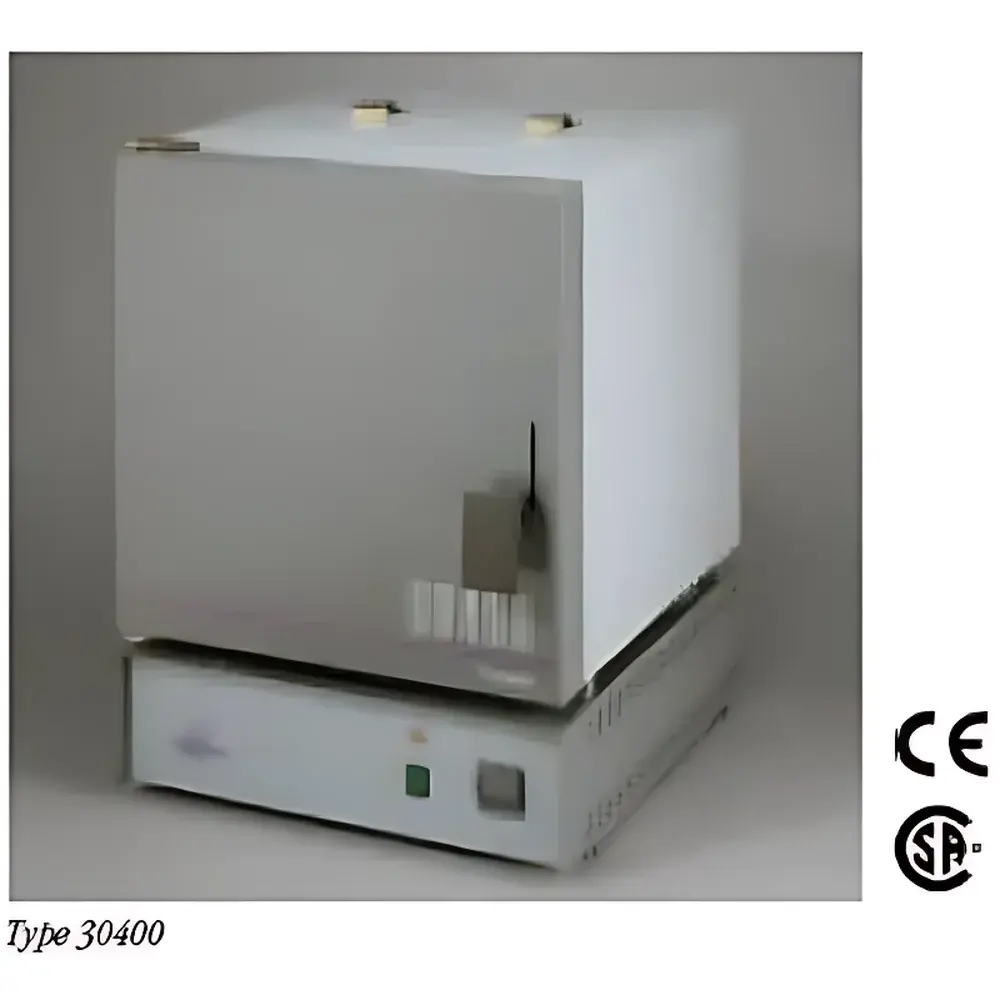
Thermo Fisher Scientific F30400 High-Capacity Muffle Furnace
| Brand | Thermo Fisher Scientific |
|---|---|
| Origin | USA |
| Model | F30400 |
| Temperature Range | 100–1093 °C (up to 1200 °C short-term) |
| Chamber Volume | 45 L |
| Heating Element Layout | Top, Bottom, Left & Right Walls |
| Safety | 35 A Circuit Breaker + Interlocked Door Switch |
| Control Options | B1 (Single-Setpoint), C1 (8-Step Single Program), D1 (16-Step × 4 Programs, RS232) |
Overview
The Thermo Fisher Scientific F30400 High-Capacity Muffle Furnace is an industrial-grade laboratory furnace engineered for precision thermal processing of large-volume samples under controlled oxidizing or inert atmospheres. Designed around a robust ceramic fiber insulation architecture and a quadrilateral heating element configuration—distributed across the top, bottom, left, and right chamber walls—the system delivers exceptional temperature uniformity (±5 °C at 1000 °C per ASTM E220) across its 45-liter working volume. Its maximum operating temperature of 1093 °C—extendable to 1200 °C for short-duration cycles—supports demanding applications including ashing of biological, pharmaceutical, and environmental matrices; catalyst calcination; glass annealing; and volatile residue determination per ISO 1171, USP , and EPA Method 2540E. The furnace complies with IEC 61010-1 safety requirements for laboratory electrical equipment and is constructed to meet GLP-compliant thermal validation protocols.
Key Features
- Quadrilateral heating element distribution ensures ±5 °C temperature uniformity across the full 45 L chamber at 1000 °C, validated per ASTM E220.
- Dual adjustable ceramic shelving system (optional) increases effective sample capacity by up to 3× compared to standard single-shelf muffle furnaces.
- Standard 9.5 mm exhaust port enables continuous venting of combustion byproducts and moisture, reducing internal condensation and protecting thermocouple integrity and heater longevity.
- Rear-mounted 9.5 mm access port allows integration of independent monitoring thermocouples or gas-sampling probes without compromising chamber seal integrity.
- Interlocked door switch immediately de-energizes all heating elements upon door opening, satisfying OSHA 1910.147 lockout/tagout prerequisites.
- Integrated 35 A circuit breaker provides coordinated overcurrent protection for control electronics, power relays, and heating circuits.
Sample Compatibility & Compliance
The F30400 accommodates crucibles, boats, and trays up to 200 mm × 200 mm × 100 mm (W × D × H) per shelf. It supports silica, alumina, platinum, and nickel-chromium alloy sample containers, making it suitable for ashing organic tissues, soil composites, polymer additives, and catalytic metal oxides. All configurations comply with ISO/IEC 17025 calibration traceability requirements when paired with NIST-traceable reference thermocouples. The furnace meets electromagnetic compatibility (EMC) standards per EN 61326-1 and is compatible with FDA 21 CFR Part 11–enabled data acquisition systems when configured with the D1 controller and validated software interfaces.
Software & Data Management
The D1 digital multi-program controller includes factory-calibrated Type K thermocouple input, real-time ramp/soak logging, and RS232 serial output for external data capture. When connected to compliant LIMS or ELN platforms, it supports audit-trail generation—including operator ID, timestamped setpoint changes, program execution logs, and thermal deviation alerts—for GMP/GLP documentation. Firmware supports user-defined alarm thresholds (e.g., deviation >±10 °C for >30 s), automatic shutdown on sensor failure, and password-protected parameter modification. Calibration records and thermal mapping reports can be exported in CSV or PDF format for regulatory submission.
Applications
- Quantitative ash content analysis of foodstuffs, feedstocks, and clinical specimens per AOAC 942.05 and ISO 5984.
- Thermal stabilization of heterogeneous catalysts (e.g., Pt/Al₂O₃, Ni/MgO) prior to BET surface area measurement.
- Controlled annealing of borosilicate and fused quartz components to relieve internal stress and improve optical homogeneity.
- Residue-on-ignition (ROI) testing of wastewater sludge and fly ash in environmental compliance laboratories.
- Pre-treatment of geological samples for XRF and ICP-MS digestion protocols requiring complete organic matrix removal.
FAQ
What is the maximum recommended continuous operating temperature?
The F30400 is rated for continuous operation up to 1093 °C. Short-term excursions to 1200 °C are permissible for ≤30 minutes per cycle, provided cooling intervals exceed 60 minutes between such events.
Can the furnace be used under inert gas purge?
Yes—the standard exhaust port and rear monitoring port support optional gas inlet fittings (not included) for nitrogen or argon purging; users must install flow regulators and oxygen monitors to maintain safe O₂ levels below 1% v/v.
Is third-party IQ/OQ/PQ validation support available?
Thermo Fisher provides documented validation templates, calibration checklists, and temperature mapping protocols aligned with ASTM E742 and EU Annex 15; certified field service engineers offer on-site qualification services.
How is temperature uniformity verified during installation?
A 9-point thermal mapping procedure using nine calibrated Type K thermocouples—positioned at center, corners, and mid-walls—is performed at three setpoints (500 °C, 800 °C, and 1000 °C) to generate a spatial uniformity report meeting ±5 °C tolerance.
Does the D1 controller support remote monitoring via Ethernet or USB?
The D1 controller features RS232 only; Ethernet or USB connectivity requires an external protocol converter (e.g., RS232-to-Ethernet bridge) validated for laboratory use under IEC 62443 cybersecurity guidelines.



