
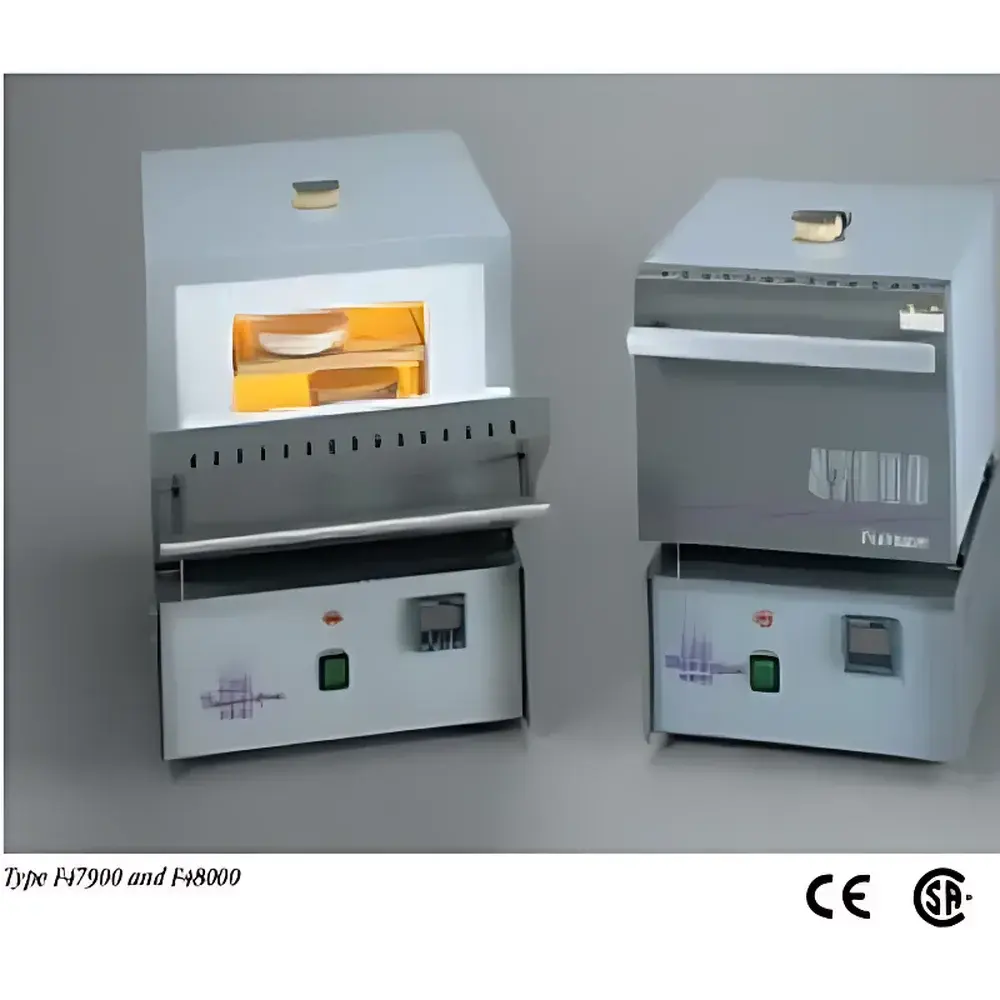
Thermo Fisher Scientific F47900 / F48000 Desktop Muffle Furnace
| Brand | Thermo Fisher Scientific |
|---|---|
| Origin | USA |
| Model | F47900 (2 L) / F48000 (5.8 L) |
| Temperature Range | 100–1200 °C |
| Chamber Volume | 2 L or 5.8 L |
| Heating Element Layout | Dual-side mounted |
| Max. Operating Temperature | 1200 °C |
| Rear Port Diameter | 9.5 mm |
| Control Options | A1 (single-setpoint), B1 (delayed ramp), C1 (8-segment single program), D1 (16-segment × 4 programs, RS232 interface) |
| Venting | Integrated exhaust port |
| Construction | Heat-treated ceramic chamber lining |
| Compliance | Designed for GLP-compliant thermal processing in analytical and materials laboratories |
Overview
The Thermo Fisher Scientific F47900 and F48000 Desktop Muffle Furnaces are precision-engineered benchtop thermal processing instruments designed for reproducible high-temperature applications in analytical, quality control, and research laboratories. Based on resistive heating principles with dual-side-mounted heating elements, these furnaces deliver uniform temperature distribution across the insulated ceramic chamber—minimizing axial and radial thermal gradients during critical procedures such as gravimetric analysis, ashing, calcination, sintering, and heat treatment of inorganic and metallic samples. The muffle design isolates the sample from combustion byproducts and heating element emissions, ensuring contamination-free thermal exposure consistent with ASTM E1530, ISO 5660, and USP <231> requirements for residue-on-ignition testing. With a maximum operating temperature of 1200 °C and two chamber volumes (2 L and 5.8 L), the platform supports scalable throughput while maintaining compact footprint and electrical safety compliance per UL 61010-1 and IEC 61010-1.
Key Features
- Dual-zone heating architecture with symmetrically arranged resistance wire elements ensures rapid ramp rates (up to 15 °C/min typical) and ±3 °C temperature uniformity at 1000 °C across the working zone.
- Heat-treated ceramic chamber lining provides low thermal mass, high emissivity, and long-term dimensional stability under repeated thermal cycling—reducing energy consumption and extending service life beyond 10,000 operational hours.
- Integrated 9.5 mm rear access port enables real-time monitoring using external thermocouples (Type K or S) without compromising chamber integrity or calibration traceability.
- Four configurable control systems (A1–D1) support progressive automation needs—from basic setpoint operation to multi-step thermal protocols compliant with FDA 21 CFR Part 11 audit trail requirements when paired with validated software.
- Built-in mechanical overtemperature protection relay (independent of electronic controller) activates at 1250 °C, providing fail-safe shutdown per IEC 60519-2 safety standards for industrial heating equipment.
- Front-access venting aperture facilitates continuous removal of volatile decomposition products, moisture vapor, and acidic gases—preserving heater longevity and minimizing cross-contamination between sequential runs.
Sample Compatibility & Compliance
These furnaces accommodate standard crucibles (alumina, platinum, silicon carbide), quartz boats, and ceramic trays up to 100 mm in diameter. The inert muffle environment is suitable for ASTM D3175 (moisture-free ash determination), ISO 1171 (ash content in coal and coke), and EPA Method 2540E (total suspended solids ignition). All models comply with CE marking directives (2014/30/EU EMC, 2014/35/EU LVD), RoHS 2011/65/EU, and are compatible with laboratory environmental management systems aligned with ISO 14001. Optional calibration certificates (NIST-traceable) and IQ/OQ documentation packages are available for regulated GMP/GLP environments.
Software & Data Management
The D1 control system includes an RS232 serial interface supporting bidirectional communication with third-party data acquisition platforms (e.g., LabVIEW, MATLAB, or custom SCADA). Logged temperature profiles—including ramp rate, dwell time, and soak stability—are timestamped and exportable in CSV format. When integrated with Thermo Fisher’s optional ThermalTrace™ software suite (sold separately), users gain full 21 CFR Part 11 compliance features: electronic signatures, role-based access control, and immutable audit trails for all parameter changes and run executions. Firmware updates maintain backward compatibility with legacy protocol libraries and support user-defined alarm thresholds for deviation detection.
Applications
- Gravimetric analysis: Quantitative determination of ash, sulfate residue, or metal oxide content following standardized ignition protocols.
- Material pre-treatment: Controlled oxidation, reduction, or annealing of catalysts, battery electrode materials, and ceramic precursors.
- Thermal stability screening: TGA-like endpoint assessment for polymers, pharmaceutical excipients, and nanocomposites prior to formal thermogravimetric analysis.
- Calibration standard preparation: Homogenization and stabilization of reference materials (e.g., NIST SRM 1978) under inert atmosphere conditions.
- Educational labs: Hands-on instruction in thermal kinetics, phase transformation, and furnace safety protocols per ANSI Z87.1 and OSHA 1910.1200 guidelines.
FAQ
What is the recommended maintenance schedule for the ceramic chamber and heating elements?
Routine visual inspection every 200 operating hours is advised; cleaning with dry, non-abrasive cloths only—no solvents. Annual calibration verification using Class I reference thermocouples is recommended for GLP/GMP workflows.
Can the furnace operate under inert or reducing atmospheres?
No—these models are air-atmosphere only. For controlled gas environments, Thermo Fisher offers the Lindberg/Blue M line of tube furnaces with gas inlet/outlet manifolds and purge capability.
Is the RS232 interface compatible with modern Windows 11 systems?
Yes, via standard USB-to-RS232 adapters with signed drivers; native COM port emulation is supported in all current versions of Thermo Fisher’s ThermalTrace™ software.
What safety certifications apply to installation in a shared laboratory space?
Units meet UL 61010-1 (2nd Ed.) and IEC 61010-1:2010 requirements for protection against electric shock, fire hazard, and mechanical instability—certified for Class II, Division 1 laboratory use.
How does the dual-side heating configuration improve temperature uniformity compared to top/bottom-only layouts?
Lateral heat injection reduces vertical thermal stratification, achieving ≤±2.5 °C uniformity (per ASTM E220) across the central 70% of chamber volume at 1100 °C—critical for multi-sample gravimetric repeatability.



