
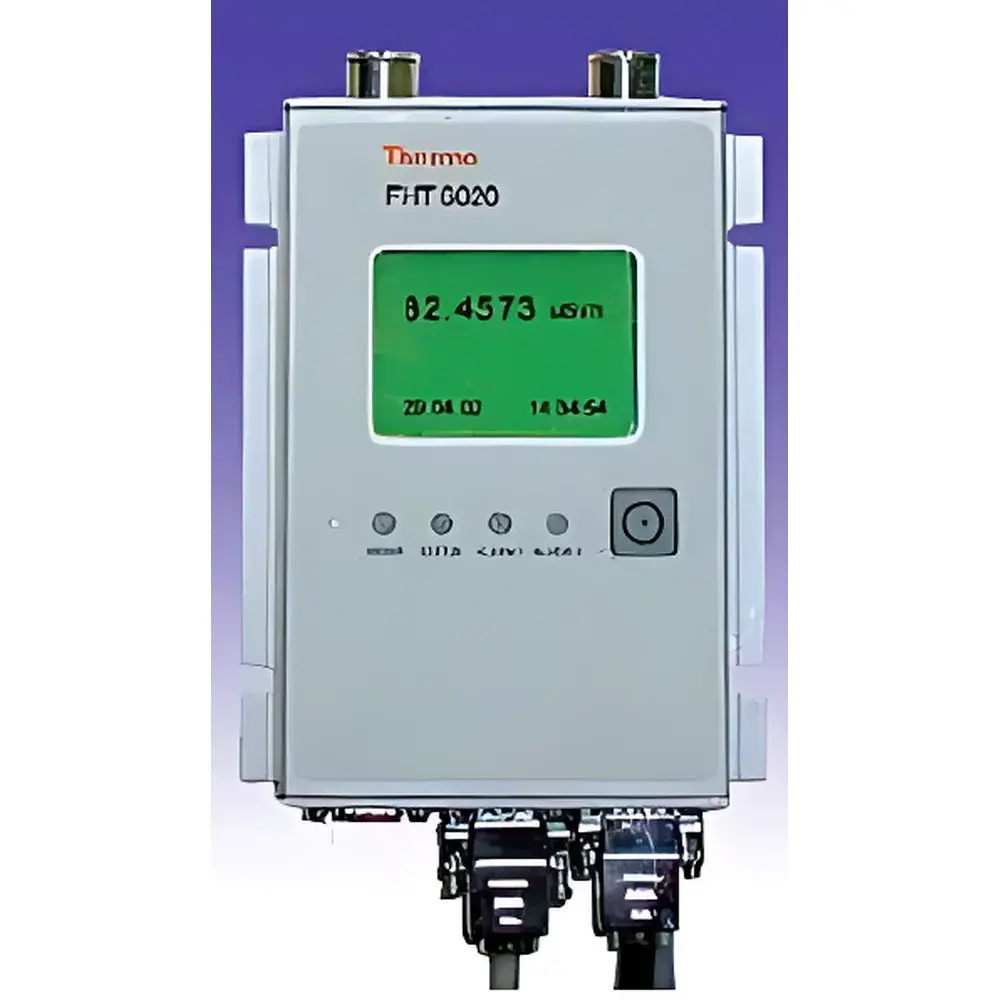
Thermo Fisher Scientific FHT 6020 Radiation Dose Rate Monitor
| Brand | Thermo Fisher Scientific |
|---|---|
| Origin | USA |
| Model | FHT 6020 |
| Instrument Type | Dose Rate Meter |
| Power Supply | 9–36 VDC |
| Operating Current | 30–102 mA (dependent on detector configuration) |
| Battery Life | Up to 10 years |
| Display | 4-digit or 6-digit LCD |
| Max. Readout | 999 M / 999,999 |
| Digital Outputs | 0–±36 VDC / 0–26.4 VAC (50/60 Hz) |
| Digital Inputs | ±3–±60 mA |
| Analog Output | 0–20 mA |
| Analog Input | 0–4.5 V |
| Communication Interfaces | RS-232, RS-485 |
| Detector Support | Up to 16 external detectors (ionization chambers, GM tubes, scintillation probes) |
| Alarm Outputs | Relay-based, configurable for local/remote audible/visual alerts and safety interlock integration |
Overview
The Thermo Fisher Scientific FHT 6020 is a modular, microprocessor-controlled radiation dose rate monitor engineered for continuous, long-term environmental and occupational radiation monitoring in nuclear facilities, research laboratories, industrial radiography sites, border security checkpoints, and emergency response operations. It operates on the principle of real-time charge collection and pulse processing from externally connected radiation detectors—including high-pressure ionization chambers, Geiger-Müller (GM) tubes, and energy-compensated scintillation probes—enabling accurate measurement of ambient dose equivalent rate H*(10) across a wide dynamic range. Its robust architecture supports uninterrupted operation for over a decade on internal battery backup, meeting stringent requirements for unattended surveillance in critical infrastructure environments. Designed in accordance with IEC 60846-1:2014 (Radiation protection instrumentation – Dose rate meters and area monitors for photon radiation), the FHT 6020 delivers metrological traceability, linearity, and angular response compliance essential for regulatory reporting and ALARA program implementation.
Key Features
- Modular expansion capability supporting up to 16 independent radiation detectors via standardized high-voltage and signal interfaces
- Dual serial communication ports (RS-232 and RS-485) enabling integration into centralized SCADA systems or distributed sensor networks
- Configurable analog and digital I/O channels for interfacing with building management systems (BMS), safety interlocks, and alarm annunciators
- High-resolution 4- or 6-digit LCD display with user-selectable units (µSv/h, mR/h, cps, etc.) and real-time trend indicators
- Onboard non-volatile memory for time-stamped dose rate logging at programmable intervals (1 second to 24 hours), retaining ≥10,000 data points
- Multi-level alarm architecture with independently adjustable thresholds for dose rate, accumulated dose, and fault conditions (e.g., detector disconnection, HV failure, temperature excursion)
- Front-panel keypad and intuitive menu navigation, complemented by Windows-based configuration software (FHT 6020.EXE) supporting script-driven measurement task sequencing
Sample Compatibility & Compliance
The FHT 6020 does not perform direct sample analysis but serves as a central readout and control unit for a broad spectrum of radiation detectors certified under ISO 4037 (X and gamma reference radiations) and ANSI N42.33 (Portable radiation detection instrumentation). Compatible probe types include energy-compensated GM detectors (e.g., FH 40 G-L, FH 40 G-L10), pressurized ionization chambers (e.g., FH 40 G-L10, FH 40 G-L15), and neutron-sensitive proportional counters (with appropriate moderator assembly). The system complies with electromagnetic compatibility (EMC) per IEC 61326-1:2021 and meets IP54 ingress protection rating for indoor and sheltered outdoor deployment. All firmware and configuration logs adhere to ALARA documentation requirements and support audit-ready record retention for GLP/GMP-aligned facilities.
Software & Data Management
FHT 6020.EXE is a Windows-native configuration and data acquisition utility that enables full parameterization—including detector calibration coefficients, alarm setpoints, sampling intervals, and I/O mapping—without requiring hardware reprogramming. Measurement data can be exported in CSV or XML format for post-processing in third-party tools (e.g., MATLAB, Python pandas, LabVIEW). The software supports batch configuration deployment across multiple units and generates automated compliance reports aligned with IAEA Safety Standards Series No. RS-G-1.9 and US NRC Regulatory Guide 4.15. Audit trails—including operator ID, timestamp, and action type—are maintained locally and exportable for FDA 21 CFR Part 11–compliant environments when paired with validated IT infrastructure.
Applications
- Continuous area monitoring in nuclear power plant auxiliary buildings, spent fuel pools, and waste handling areas
- Radiation portal monitor (RPM) integration at customs and cargo inspection facilities
- Mobile survey platforms for environmental remediation and post-incident assessment (e.g., Fukushima-type scenarios)
- Calibration laboratory reference systems for secondary standard dosimetry verification
- Research reactor perimeter surveillance and beamline interlock validation
- Decommissioning site dose mapping and worker exposure tracking via networked detector arrays
FAQ
What types of radiation detectors are compatible with the FHT 6020?
The FHT 6020 supports high-voltage ionization chambers (up to 2000 V), GM tubes (300–900 V), and scintillation-based probes with standard BNC or LEMO connectors and compatible bias voltage requirements.
Can the FHT 6020 operate autonomously without a PC connection?
Yes—it functions fully standalone with internal battery backup, onboard memory, and programmable alarms; PC connectivity is required only for initial setup, firmware updates, or data retrieval.
Is the FHT 6020 suitable for outdoor installation?
It is rated IP54 and designed for indoor or weather-protected enclosures; extended outdoor use requires supplementary thermal management and UV-resistant housing.
Does the system support remote diagnostics and firmware updates?
Remote diagnostics are enabled via RS-485 Modbus RTU or optional Ethernet gateway; firmware updates require local USB-to-serial connection using FHT 6020.EXE.
How is calibration traceability maintained?
Each detector channel retains its unique calibration factor and date stamp; users must perform periodic verification against national standards (e.g., NIST-traceable sources) per ISO/IEC 17025 requirements.
Related Products







