
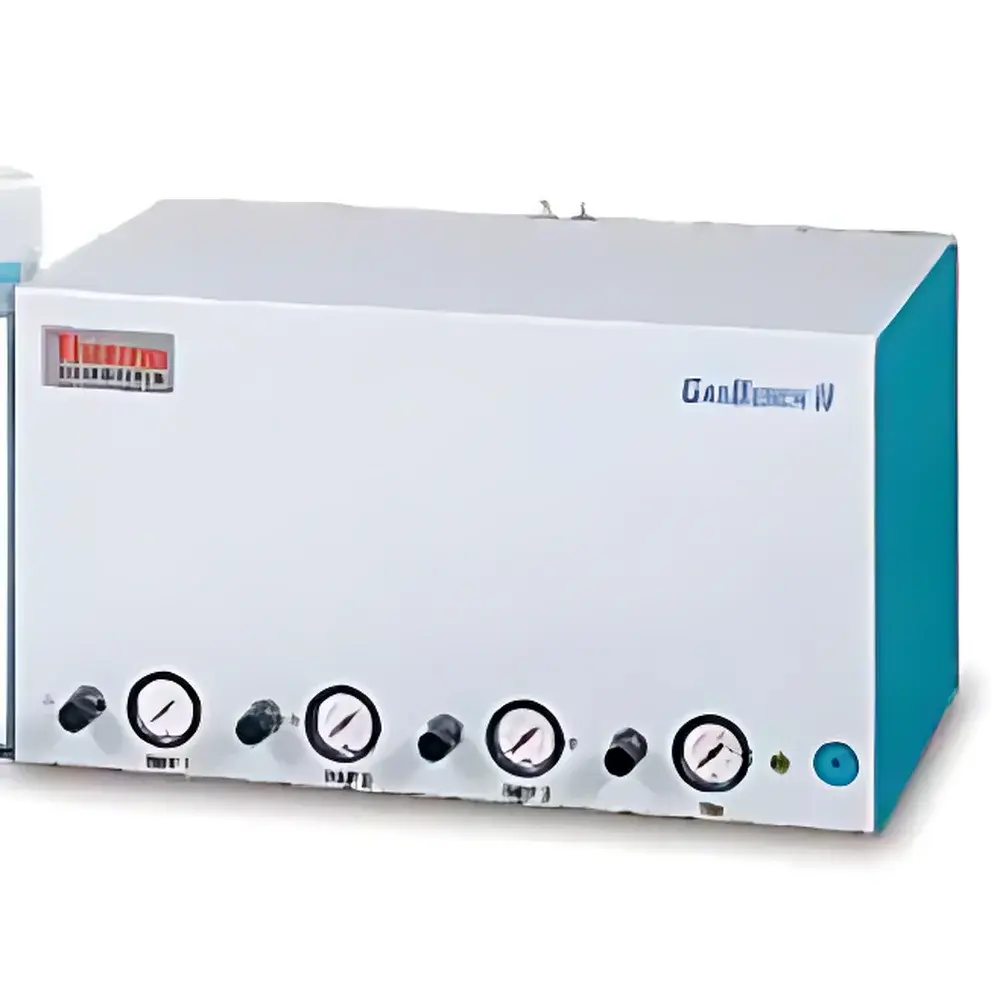
Thermo Fisher Scientific GasBench II Online Gas Preparation and Introduction System for Isotope Ratio Mass Spectrometry
| Brand | Thermo Fisher |
|---|---|
| Origin | Germany |
| Manufacturer Type | Original Equipment Manufacturer (OEM) |
| Import Status | Imported |
| Model | GasBench II |
| Instrument Category | Stable Isotope Ratio Mass Spectrometer Interface |
| Measurement Precision | High-precision isotopic ratio analysis |
Overview
The Thermo Fisher Scientific GasBench II is a fully automated, online gas preparation and introduction system engineered specifically for high-precision stable isotope ratio mass spectrometry (IRMS). It operates on the principle of continuous-flow isotope ratio mass spectrometry (CF-IRMS), interfacing seamlessly with Thermo Scientific Delta series IRMS instruments. The system prepares gaseous analytes—such as CO2, H2O vapor, N2, O2, and H2—from solid, liquid, or gaseous samples via controlled chemical reactions and cryogenic trapping, delivering them to the mass spectrometer under precisely regulated flow and pressure conditions. Its dual-inlet–compatible architecture enables rigorous correction for instrumental mass fractionation using reference gas pulses, ensuring traceable δ13C, δ18O, δ2H, δ15N, and δ17O measurements at sub-0.1‰ (1σ) long-term reproducibility.
Key Features
- Automated dual-needle acid addition module for reproducible carbonate dissolution, minimizing operator-induced variability and enabling precise stoichiometric CO2 generation from CaCO3, MgCO3, and dolomite standards.
- Programmable multi-loop injection system with temperature-stabilized quantitative loops (0.5–5 mL volume range), supporting up to 120 sequential injections per run without manual intervention.
- Dual-path viscous-flow gas handling architecture with independent helium carrier lines, allowing simultaneous conditioning and analysis cycles for enhanced throughput and reduced cross-contamination risk.
- Integrated cryo-focusing traps (−196 °C liquid N2 cooled) and molecular sieve/porous polymer columns for selective separation and purification of target gases (e.g., CO2 isolation from complex headspace matrices).
- Real-time pressure and flow monitoring via digital mass flow controllers (MFCs) and capacitance manometers, with closed-loop feedback for <±0.5% flow stability during analysis.
Sample Compatibility & Compliance
The GasBench II accommodates diverse sample types across environmental, geochemical, food authenticity, and clinical research domains: solid carbonates (for δ13C and δ18O), liquid waters (for δ2H and δ18O via H2/H2O or CO2/H2O equilibration), wine and fruit juice matrices (for origin verification), air samples (for δ13C-CO2, δ15N-N2), and organic solids requiring offline combustion. All hardware components comply with CE marking requirements and meet IEC 61000-6-3 (EMC) and IEC 61010-1 (safety) standards. The system supports GLP/GMP-aligned operation through configurable audit trails, user access levels, and electronic signature capability when integrated with Thermo Scientific Chromeleon CDS software (FDA 21 CFR Part 11 compliant).
Software & Data Management
Controlled via Thermo Scientific Qtegra ISM software, the GasBench II provides method-driven automation—including reaction timing, loop fill/flush sequences, trap temperature ramps, and valve actuation logic—with full parameter logging at 100 Hz resolution. Raw signal data (ion currents, baseline offsets, peak integrals) are exported in standardized .raw format compatible with Isodat software for offline δ-value calculation, drift correction, and two-point calibration against international reference materials (e.g., VSMOW, NBS 19, IAEA-600). Batch processing supports ISO 11095-compliant linearity verification and ASTM D7927-15–aligned uncertainty propagation reporting.
Applications
- Geochemistry: Carbonate diagenesis studies, paleoclimate reconstruction from foraminifera and speleothems, volcanic CO2 source fingerprinting.
- Food Authenticity: Detection of water adulteration in beverages, geographic origin assignment of wines and honey via δ2H–δ18O dual-isotope mapping.
- Environmental Science: Soil respiration CO2 flux isotopic characterization, nitrate source apportionment using δ15N–δ18O dual-isotope plots.
- Biomedical Research: Metabolic tracer studies using 13C-labeled substrates, breath-test diagnostics (e.g., 13C-urea for *Helicobacter pylori* detection).
- Climate Monitoring: Long-term atmospheric CO2 and CH4 isotopic monitoring networks (e.g., NOAA GML program protocols).
FAQ
What sample throughput can be achieved with the GasBench II?
Typical throughput is 60–90 samples per 24-hour unattended run, depending on reaction kinetics and required equilibration times (e.g., 2–4 h for H2O–CO2 exchange; 15–30 min for acid-carbonate digestion).
Is the system compatible with non-Thermo IRMS instruments?
Yes—via analog voltage output (0–10 V) and RS-232/USB communication, though optimal performance and full feature integration require Thermo Delta XP or Delta V Plus IRMS platforms.
How is carryover minimized between samples?
Through automated high-purity helium purge cycles (≥5× loop volume), heated transfer lines (80 °C), and cryo-trap regeneration between injections, validated to yield <0.05% residual signal for adjacent δ13C measurements.
Can the GasBench II perform simultaneous dual-isotope analysis (e.g., δ13C and δ18O) on a single sample aliquot?
Yes—by configuring sequential trapping and release of CO2 and H2O-derived species within one analytical cycle, enabling correlated isotopic data acquisition without sample splitting.
What maintenance intervals are recommended for routine operation?
Quarterly replacement of O-rings and desiccant traps; biannual recalibration of MFCs and pressure sensors using NIST-traceable references; annual full system leak check (≤1×10⁻⁸ mbar·L/s He leak rate).




