
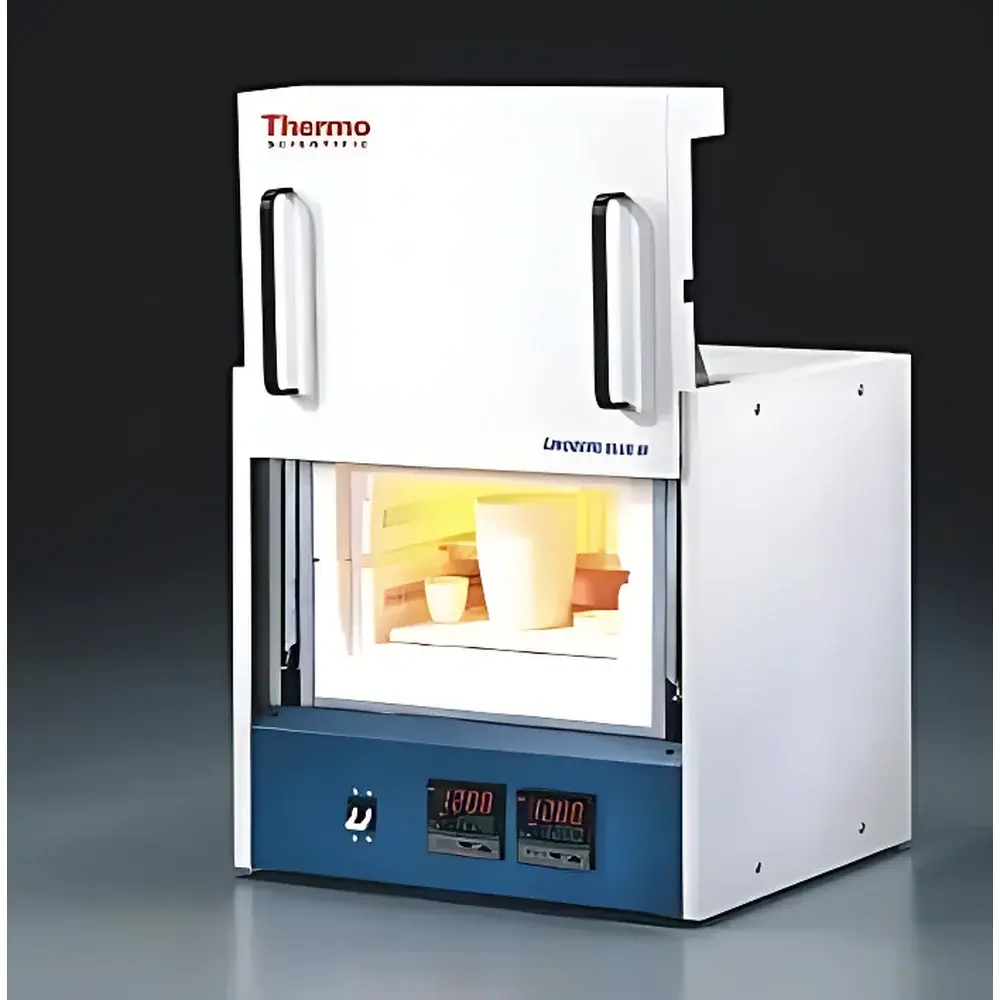
Thermo Fisher Scientific LGO Series 1200°C Box Furnace
| Brand | Thermo Fisher Scientific |
|---|---|
| Origin | USA |
| Model Variants | BF51731, BF51732, BF51841, BF51842 |
| Max Temperature | 1200°C |
| Temperature Uniformity | ±2°C @ 1200°C |
| Control Accuracy | ±0.3% of setpoint |
| Max Power | 4500 W |
| Ramp Time to 1200°C | 20 min |
| Heating Method | Calibrated tubular heating elements |
| Internal Dimensions (H×D×W) | 177.8 × 279.4 × 330.2 mm (BF517xx) / 381 × 381 × 381 mm (BF518xx) |
| External Dimensions (H×D×W) | 685.8 × 584.2 × 609.6 mm (BF517xx) / 838.2 × 711.2 × 736.6 mm (BF518xx) |
| Voltage/Frequency | 208–240 V, 50/60 Hz |
| Net Weight | 75 kg (BF517xx) / 127 kg (BF518xx) |
| Controller Options | Single-setpoint, multi-segment single-program, or multi-segment multi-program digital controllers with optional Over-Temperature Control (OTC), RS485 interface, and inert gas flow meter (FM) integration |
| Safety Features | Door-interlocked power cutoff, Platinel II R thermocouple, top 25.4-mm exhaust port, rear 9.5-mm inlet port |
| Insulation | Moldatherm® high-density ceramic fiber board with embedded LGO (Low-Glow Oxide) heating elements |
| Construction | Dual-wall steel housing with air-gap thermal barrier |
Overview
The Thermo Fisher Scientific LGO Series 1200°C Box Furnace is a precision-engineered laboratory muffle furnace designed for repeatable, high-fidelity thermal processing across materials science, metallurgy, ceramics, and analytical chemistry applications. Utilizing patented Low-Glow Oxide (LGO) tubular heating elements partially embedded within Moldatherm® high-density ceramic fiber insulation, the furnace achieves exceptional thermal efficiency, minimized external surface temperature rise (<60°C at ambient), and superior temperature uniformity of ±2°C at 1200°C—verified per ASTM E220 and ISO 9001 calibration protocols. Its dual-wall structural architecture incorporates an air-gap thermal barrier between inner and outer steel casings, reducing heat loss by up to 35% compared to conventional single-wall designs while maintaining mechanical robustness under cyclic thermal stress. The furnace operates across a programmable range of 100–1200°C and delivers full-rated power (4500 W) with controlled ramp rates, enabling precise thermal profiles for annealing, ashing, sintering, and heat-treatment protocols requiring strict adherence to GLP and GMP thermal validation standards.
Key Features
- Patented LGO heating elements embedded in Moldatherm® insulation ensure uniform radiant heat distribution and extended element service life (>10,000 h at 1100°C)
- Dual-wall construction with passive air-gap thermal barrier minimizes external casing temperature and improves energy efficiency
- Two configurable door configurations: vertical lift (BF517xx series) and horizontal side-swing (BF518xx series), both equipped with safety-interlocked power cutoff switches
- Standard 25.4-mm top exhaust port and 9.5-mm rear inlet port support inert atmosphere operation (N₂, Ar) with optional FM-integrated mass flow control
- Platinel II R thermocouple (Type R equivalent stability) provides long-term drift resistance (<0.5°C/year) and traceable NIST-calibrated accuracy
- Configurable digital controllers: single-setpoint, multi-segment single-program, or multi-segment multi-program variants—all supporting user-defined ramp/soak profiles and OTC (Over-Temperature Control) fail-safe logic
- Removable modular hearth plate and adjustable shelf system accommodate diverse sample geometries and crucible stacking requirements
- RS485 serial interface enables integration with LabVIEW, SCADA, or LIMS platforms for audit-trail-compliant data logging per FDA 21 CFR Part 11
Sample Compatibility & Compliance
The LGO furnace accommodates standard alumina, quartz, and silicon carbide crucibles (up to Ø100 mm × 80 mm H for BF517xx; Ø150 mm × 150 mm H for BF518xx), as well as custom fixtures for wire annealing, powder sintering, and catalyst calcination. All models comply with UL 61010-1, IEC 61000-6-3 (EMC), and CE marking requirements. Temperature uniformity mapping is performed per ISO/IEC 17025-accredited procedures using 9-point thermocouple array validation. Optional IQ/OQ documentation packages are available to support GxP lab qualification under USP , ASTM E1142, and ISO 17025 frameworks.
Software & Data Management
Controller firmware supports real-time temperature logging at 1-second intervals, with onboard memory retaining ≥1000 hours of profile history. RS485 output enables bidirectional communication for remote setpoint adjustment, alarm acknowledgment, and event-triggered data export. When paired with Thermo Fisher’s optional FurnaceLink™ software suite (Windows-based), users generate 21 CFR Part 11–compliant electronic records—including operator ID, timestamped parameter changes, deviation alerts, and thermal profile signatures—with encrypted database storage and role-based access control.
Applications
- Quantitative ashing of biological, pharmaceutical, and environmental samples per AOAC 923.03 and EPA Method 3010A
- Controlled-atmosphere annealing of thin-film metal oxides and battery cathode precursors
- Thermal gravimetric pre-treatment prior to XRD or SEM-EDS analysis
- Ceramic glaze firing and porcelain vitrification at 1150–1200°C
- Heat treatment of tool steels and superalloys per AMS 2750E pyrometry requirements
- Calibration of secondary temperature standards using fixed-point cells (e.g., Al, Zn, Sn)
FAQ
What is the recommended maintenance interval for the LGO heating elements?
Routine visual inspection is advised every 200 operating hours; replacement is typically required after 10,000 hours at ≤1100°C or 5,000 hours continuously operated at 1200°C.
Can the furnace be validated for GMP compliance?
Yes—Thermo Fisher provides IQ/OQ documentation templates, temperature mapping reports, and calibration certificates traceable to NIST standards to support regulatory submissions.
Is inert gas purging compatible with all controller configurations?
Gas flow meter (FM) integration is only available on BF51732P/FMC and BF51842P/FMC models with multi-program controllers and OTC.
What electrical infrastructure is required for installation?
A dedicated 30 A, 240 V AC circuit with grounded NEMA 6-30R receptacle is mandatory; hardwiring requires qualified electrician verification per NEC Article 424.
How is temperature uniformity verified during factory acceptance testing?
Each unit undergoes 9-point spatial mapping at 1200°C using calibrated Type R thermocouples per ASTM E220 Annex A3, with results documented in the Certificate of Conformance.



