
Thermo Fisher Scientific SSL Instant Connect Inlet for Gas Chromatography
| Brand | Thermo Fisher Scientific |
|---|---|
| Origin | Italy |
| Manufacturer Type | Original Equipment Manufacturer (OEM) |
| Product Category | Imported |
| Model | SSL Inlet |
| Instrument Type | Gas Chromatography Injector |
| Compatibility | GC and GC-MS systems |
| Operating Modes | Split, Splitless, Cool-on-Column (COC), Large Volume Injection (LVI) |
| Thermal Management | Optimized heater profile with minimal thermal stress on septum |
| Septum Compatibility | Merlin Microseal™ (with adapter) |
| Column Compatibility | Capillary columns (50–530 µm ID) |
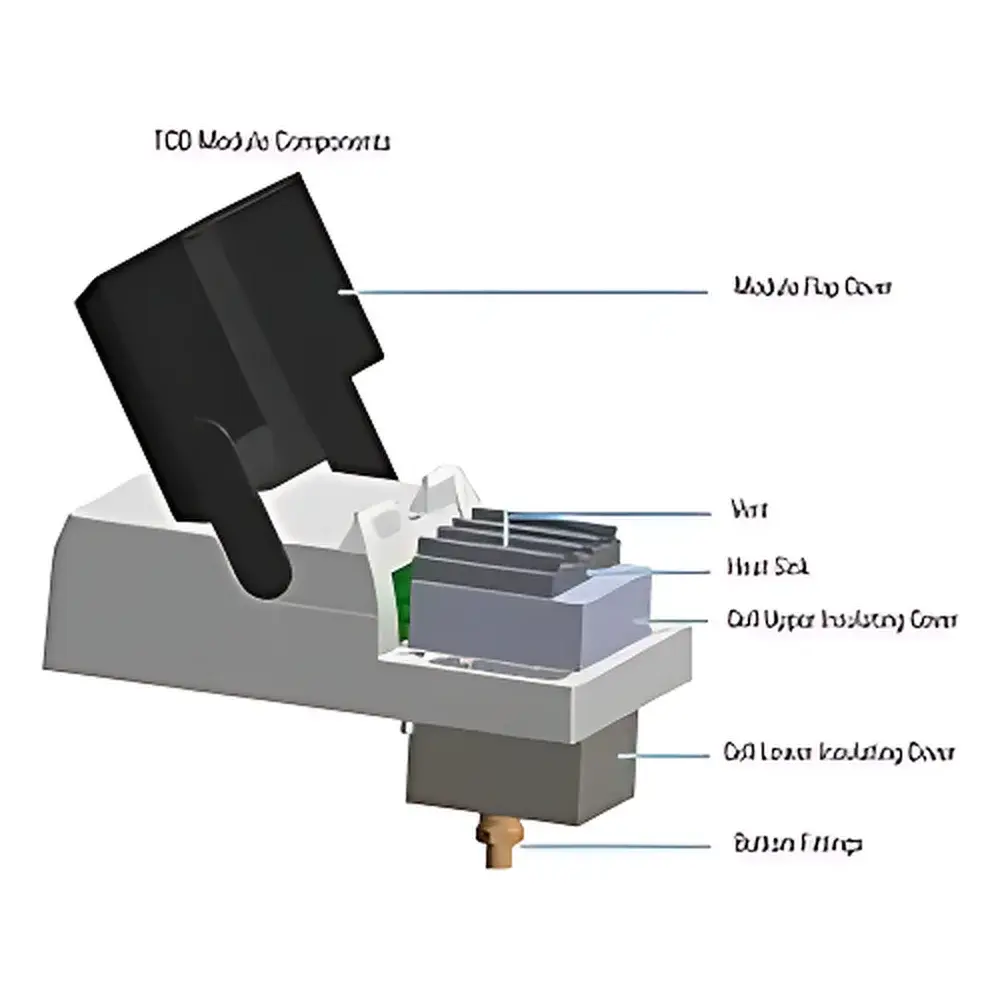
| Maintenance Design | Tool-free, top-access inlet body with removable liner and septum assembly |
| Oxygen-Free Operation | Certified inert flow path for high-fidelity transfer to mass spectrometers |
Overview
The Thermo Fisher Scientific SSL Instant Connect Inlet is an engineered solution for gas chromatography (GC) and GC-mass spectrometry (GC-MS) platforms requiring high reproducibility, method flexibility, and robust routine operation. Designed around the principle of controlled vaporization and precise carrier gas flow management, the SSL inlet employs a thermally optimized heating profile to ensure uniform temperature distribution across the liner and septum—critical for minimizing analyte degradation, discrimination, and carryover. Its core architecture supports four operational modes: split, splitless, cool-on-column (COC), and large volume injection (LVI), enabling laboratories to maintain validated methods while scaling throughput or adapting to new analytical requirements without hardware replacement. The inlet’s inert, oxygen-free flow path is specifically validated for seamless integration with high-sensitivity mass spectrometers, preserving molecular integrity during transfer and ensuring accurate quantitation in trace-level applications.
Key Features
- Instant Connect modular interface enables rapid configuration of single- or multi-inlet/multi-detector GC systems—ideal for labs expanding capacity or implementing method parallelization.
- Tool-free, top-access inlet body design allows full removal of the liner and septum assembly without disassembling gas lines or column fittings—reducing maintenance downtime by up to 70% compared to conventional inlets.
- Patented thermal management minimizes heat-induced stress on the septum, extending Merlin Microseal™ septum lifetime by ≥3× versus standard inlets under continuous operation at 300 °C.
- Universal column compatibility: accepts all standard capillary columns (50–530 µm ID); accommodates packed columns (1/8″ and 1/16″ OD) via field-installable adapters; supports P&T, TD, and HS interfaces through application-specific accessory kits.
- Oxygen-free internal pathway certified per ASTM D7217 and ISO 17025-compliant installation protocols—ensuring baseline stability and reduced background noise in electron ionization (EI) and chemical ionization (CI) MS detection.
Sample Compatibility & Compliance
The SSL inlet delivers consistent performance across volatile and semi-volatile organic compounds (VOCs/SVOCs), including polar, thermally labile, and high-boiling analytes (e.g., pesticides, PAHs, fatty acid methyl esters). Its splitless mode enables quantitative injection of complex matrices with minimal fractionation, while LVI capability supports sub-pg-level detection limits in environmental and food safety testing. The inlet meets key regulatory alignment requirements: fully compatible with USP , FDA 21 CFR Part 11-compliant data acquisition workflows when paired with Chromeleon CDS software; supports GLP/GMP audit trails, electronic signatures, and instrument qualification documentation (IQ/OQ/PQ). All wetted materials comply with USP Class VI biocompatibility standards and are certified non-leaching per ISO 10993-5.
Software & Data Management
When integrated with Thermo Fisher’s Chromeleon Chromatography Data System (CDS) v7.3+, the SSL inlet enables automated method-driven parameter switching—including inlet temperature ramping, pressure programming, and solvent vent timing—without manual intervention. The system logs all inlet-related events (septum counter, liner change timestamp, temperature deviations >±2 °C) into a tamper-evident audit trail compliant with 21 CFR Part 11 Annex 11. Remote diagnostics and predictive maintenance alerts are accessible via Thermo Fisher’s Instrument Connect cloud platform, supporting proactive service scheduling and uptime optimization.
Applications
- Environmental analysis: EPA Methods 502.2, 524.4, 8260D, and 8270E for VOCs, SVOCs, and chlorinated hydrocarbons.
- Pharmaceutical QC: Residual solvent testing per ICH Q2(R2) and USP , extractables/leachables profiling.
- Food & flavor chemistry: FAME profiling, terpene quantitation, and off-flavor compound screening.
- Forensic toxicology: Blood alcohol and drug metabolite analysis using splitless and LVI protocols.
- Materials science: Monomer purity assessment and polymer additive migration studies.
FAQ
Is the SSL inlet compatible with third-party GC systems?
Yes—mechanical and pneumatic interfaces conform to ISO 8573-1 Class 2 compressed air specifications and standard GC column nut dimensions; however, full firmware-level control requires Thermo Fisher GC or TriPlus RSH autosampler integration.
Can the inlet be qualified under GMP conditions?
Yes—the inlet supports documented IQ/OQ/PQ protocols, including temperature uniformity mapping (per ASTM E2877), leak integrity verification (helium leak rate ≤1×10⁻⁹ atm·cm³/s), and pressure accuracy validation (±0.1 psi from 0–100 psi range).
What is the recommended liner type for highly adsorptive samples?
Deactivated fused-silica liners with gooseneck geometry and silanized surface treatment (e.g., Thermo Fisher part #290VT145) are recommended for basic nitrogen-containing compounds and phenols.
Does the inlet support cryogenic trapping?
No—cryo-trapping functionality requires external cooling modules (e.g., Thermo Fisher Cryo-Trap Option); the SSL inlet itself operates in ambient-to-450 °C range with active temperature control.
How often should the septum be replaced during routine operation?
Under typical split mode conditions (250 °C, 100 injections/day), Merlin Microseal™ septa last ≥200 injections; in splitless mode at 300 °C, replacement is advised every 80–100 injections—automatically tracked via Chromeleon’s septum counter.





