
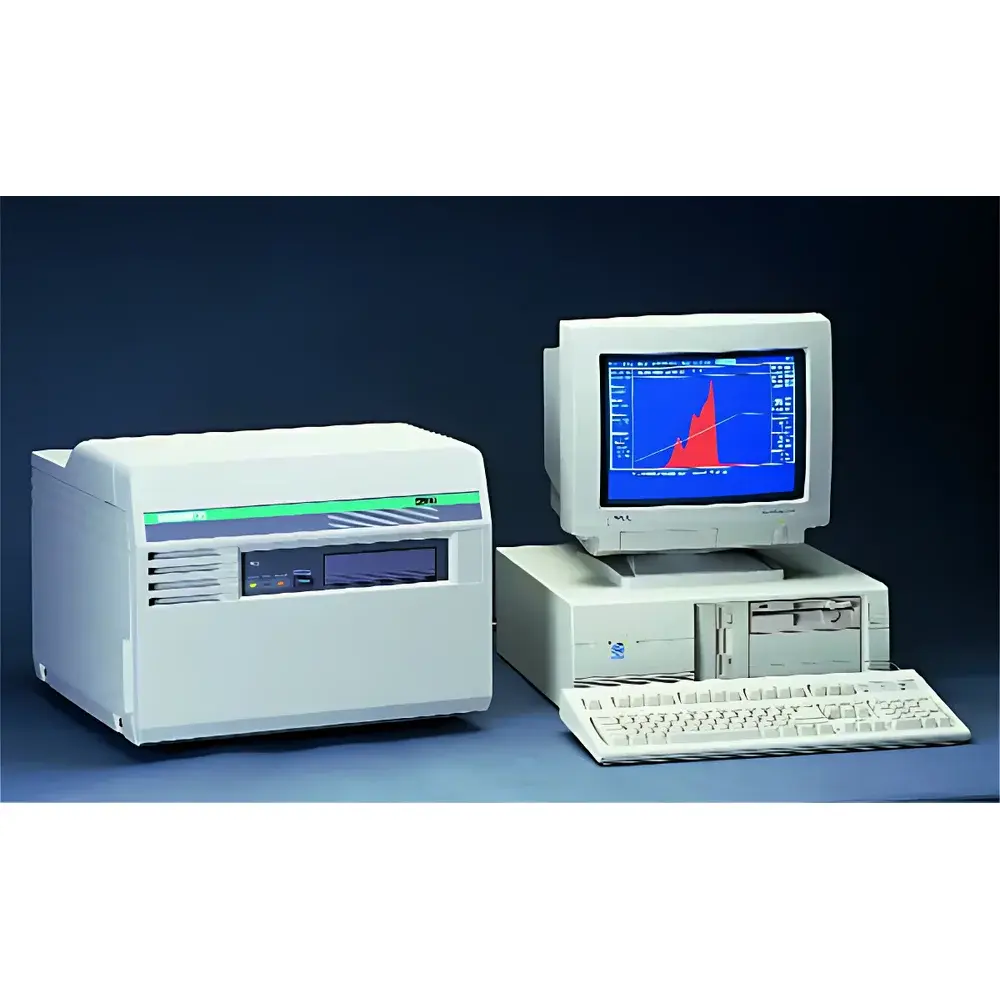
Thermo Fisher Scientific TLD 3500 / 5500 / 6600 Thermoluminescent Dosimeter Readers
| Brand | Thermo Fisher Scientific |
|---|---|
| Origin | USA |
| Manufacturer Type | Original Equipment Manufacturer (OEM) |
| Product Category | Imported Instrument |
| Model Series | TLD 3500, TLD 5500, TLD 6600 |
| Instrument Class | Radiation Dosimetry Reader |
| Portability | Portable (TLD 3500), Benchtop Automated (TLD 5500), Fully Automated Floor-Standing System (TLD 6600) |
| Radiation Types Measured | Beta (β⁻), Photons (X-ray, γ), Neutrons (via converter foils) |
| Detector Compatibility | LiF:Mg,Ti (TLD-100), LiF:Mg,Cu,P (TLD-100H), CaF₂:Dy, CaSO₄:Dy, Al₂O₃:C (for OSL-compatible variants), and custom geometries (ribbons, rods, chips, powders) |
| Heating Method | Resistive (TLD 3500), Hot-Gas Convection (TLD 5500), Nitrogen-Heated Non-Contact (TLD 6600) |
| Max Heating Temperature | 600 °C |
| Readout Sensitivity | ≤1 µGy (LiF-based elements, typical) |
| Calibration Traceability | NIST-traceable, compliant with ANSI N13.11, N13.32, N545 |
| Software Platform | WinREMS v5.x (data acquisition, QA/QC logging, audit trail), WinAlgorithms v3.x (dose conversion per ICRP 74, ISO 4037, IEC 62387) |
Overview
Thermo Fisher Scientific’s TLD 3500, TLD 5500, and TLD 6600 thermoluminescent dosimeter (TLD) readers are precision-engineered instruments for quantitative measurement of ionizing radiation dose absorbed in crystalline phosphor materials. Based on the physical principle of thermoluminescence—where trapped electrons in lattice defects are released as visible photons upon controlled thermal stimulation—the systems deliver high reproducibility, long-term stability, and metrological traceability required in regulatory, clinical, and research environments. Each model is purpose-built to address distinct operational scales and technical constraints: the TLD 3500 serves as a manual, single-element reader ideal for laboratory validation and small-batch analysis; the TLD 5500 introduces automated batch processing (up to 50 elements per cycle) with linear heating profiles optimized for radiotherapy QA and environmental monitoring networks; and the TLD 6600 represents a fully integrated, nitrogen-heated platform with built-in 90Sr/90Y reference source for daily performance verification—designed specifically for nuclear power plant personnel dosimetry programs and national radiation protection services.
Key Features
- Resistive heating (TLD 3500): Precision-welded thermocouples ensure uniform disk temperature distribution across preheat, readout, and annealing phases; programmable ramp rates from 0.1–40 °C/s.
- Hot-gas convection system (TLD 5500): Enables repeatable, low-thermal-mass heating of up to 50 TLD elements simultaneously; integrated Peltier-cooled photomultiplier tube (PMT) reduces dark current noise by >90% at 25 °C ambient.
- Nitrogen-purged non-contact heating (TLD 6600): Eliminates mechanical wear and cross-contamination risk; enables precise thermal profiling (±0.5 °C accuracy) and extends TLD element lifetime by minimizing thermal stress.
- Seven-decade dynamic range (TLD 3500/5500): Achieved via selectable neutral-density optical filters (OD 0–4), supporting measurements from 10 µGy to 10 kGy without hardware reconfiguration.
- Built-in 90Sr/90Y check source (TLD 6600): Automatically initiates daily system response verification prior to sample readout—fully documented in WinREMS audit logs per FDA 21 CFR Part 11 requirements.
- Comprehensive thermal cycle control: All models support multi-step protocols including preheat (to remove shallow traps), main glow curve acquisition, and post-readout annealing (up to 400 °C for LiF reconditioning).
Sample Compatibility & Compliance
The TLD series accommodates standard and custom-form factor dosimeters—including 3.2 mm × 3.2 mm chips, 10 mm ribbons, cylindrical rods (1.5–6 mm diameter), micro-pellets, and powder-filled capsules—compatible with widely used phosphors such as LiF:Mg,Ti (TLD-100), LiF:Mg,Cu,P (TLD-100H), CaF2:Dy, and Al2O3:C. Dose reporting conforms to ICRU Report 57 and ICRP Publication 74 definitions for personal dose equivalents Hp(10), Hp(3), and Hp(0.07). All systems are validated against ANSI N13.11 (2023 draft), ANSI N13.32 (2019), and ISO/IEC 17025:2017 requirements for testing laboratories. NVLAP accreditation (Lab Code 200651-0) covers performance testing per DOE ELAP criteria for personnel dosimetry processors.
Software & Data Management
WinREMS (Windows Radiation Evaluation and Measurement System) provides full lifecycle data management: instrument control, raw glow curve acquisition (16-bit ADC resolution), real-time background subtraction, peak deconvolution, and GLP-compliant electronic signatures. Audit trails record operator ID, timestamp, calibration status, QC results, and parameter changes—with immutable storage meeting FDA 21 CFR Part 11 and EU Annex 11 expectations. WinAlgorithms performs standardized dose conversion using energy-dependent fluence-to-dose coefficients per ISO 4037-3 and IEC 62387 Annex B. Export formats include ASCII (.txt), CSV, and XML for integration with LIMS or enterprise radiation safety databases. Automated QC routines execute daily background checks, linearity verification, and reproducibility assessment per ISO/IEC 17025 Clause 7.7.
Applications
- Radiation protection programs in nuclear facilities, medical radiotherapy departments, and industrial radiography sites.
- Environmental monitoring networks measuring terrestrial gamma dose rates and fallout deposition (e.g., EPA RadNet, EURADOS projects).
- Clinical dosimetry verification: IMRT/VMAT plan validation, skin dose mapping, stereotactic radiosurgery output factor calibration, and CT dose index (CTDI) audits.
- Research applications: high-dose irradiation studies (e.g., polymer degradation, food sterilization validation), neutron dosimetry using 6LiF/7LiF paired elements, and retrospective dating of geological/archaeological samples.
- Regulatory compliance: Accredited dosimetry processor (ADP) services under NRC, CNSC, and IAEA frameworks; annual proficiency testing participation via IAEA TL Proficiency Testing Program.
FAQ
What distinguishes TLD technology from optically stimulated luminescence (OSL)?
Unlike OSL, TLD does not require light-tight handling post-irradiation; it is immune to ambient light exposure during transport or storage—critical for field-deployed environmental monitoring and remote nuclear site operations.
Can the TLD 6600 measure neutron dose directly?
No—neutron detection requires converter materials (e.g., 6LiF or polyethylene moderators) placed adjacent to the TLD element; WinAlgorithms applies appropriate correction factors based on neutron energy spectrum assumptions per ISO 8529.
Is routine calibration required between NVLAP assessments?
Yes—daily system checks using the internal 90Sr/90Y source and quarterly full-scale calibration with NIST-traceable 137Cs or 60Co reference fields are mandated by ANSI N13.11 Section 6.3.
Does WinREMS support multi-user role-based access control?
Yes—administrator, analyst, and reviewer roles enforce separation of duties; all actions generate time-stamped, digitally signed entries in the audit database.
What maintenance intervals are recommended for PMT cooling systems?
Peltier coolers (TLD 5500/6600) require biannual inspection of condensate drainage paths and thermal interface compound integrity; no consumables are needed within 5-year service cycles.







