
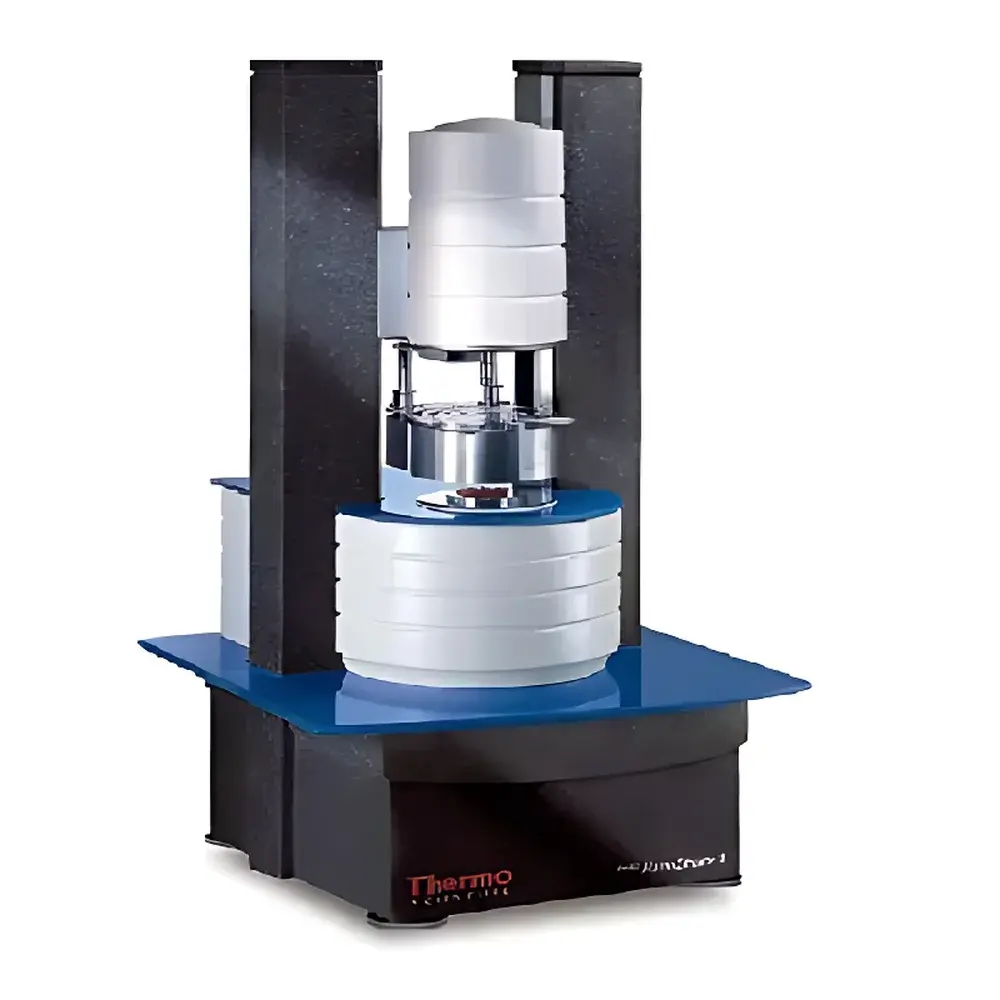
Thermo Fisher Scientific VT550 Advanced Rotational Viscometer
| Brand | Thermo Fisher Scientific |
|---|---|
| Origin | Germany |
| Manufacturer | Yes |
| Origin Category | Imported |
| Model | VT550 |
| Instrument Type | Rotational Viscometer |
| Viscosity Range | 2 – 10⁷ mPa·s |
| Speed Range | 0.5 – 800 rpm |
| Torque Range | 0.1 – 50 mN·m (up to 400 rpm), 0.1 – 20 mN·m (up to 800 rpm) |
| Temperature Range | −40 °C to +350 °C (dependent on optional temperature control unit) |
| Compliance Standards | ISO 2555, ISO 3219, DIN 53018, DIN 53019 |
| Control Mode | Preset Programs (10 built-in), Controlled Deformation (CD) mode for yield stress determination |
| Software Integration | RheoWin (HAAKE proprietary software) |
Overview
The Thermo Fisher Scientific VT550 Advanced Rotational Viscometer is a precision-engineered instrument designed for the quantitative characterization of flow behavior in liquids and semi-solid materials under controlled shear conditions. Based on Couette-type rotational viscometry principles, the VT550 applies defined torque to a rotating spindle immersed in the sample, enabling direct measurement of dynamic viscosity (η), shear stress (τ), shear rate (γ̇), and yield stress—critical parameters for rheological profiling in quality control, R&D, and process development environments. Its modular architecture supports both standalone operation via high-resolution LCD interface and full PC-based automation through HAAKE RheoWin software. The system is calibrated traceably to international standards (ISO 2555, ISO 3219, DIN 53018/53019), ensuring metrological integrity across laboratories operating under GLP, GMP, or ISO/IEC 17025 frameworks.
Key Features
- High-precision dual-range torque sensor: 0.1–50 mN·m (≤400 rpm) and 0.1–20 mN·m (≤800 rpm), optimized for resolution across low- and high-viscosity regimes
- Wide operational speed range: 0.5–800 rpm with 1,000 s⁻¹ depending on spindle geometry
- Integrated real-time display of viscosity (mPa·s), shear stress (Pa), shear rate (s⁻¹), yield stress (Pa), and sample temperature (°C)
- Ten preprogrammed test protocols—including single-point viscosity, time-scan, shear-rate ramp, and yield stress determination via Controlled Deformation (CD) mode—reducing operator dependency and method transfer variability
- Compatibility with HAAKE temperature-controlled accessories (e.g., Peltier cabinets, circulating baths) extending thermal operation from −40 °C to +350 °C
- Modular spindle system supporting standardized geometries (e.g., coaxial cylinders, cone-and-plate, vane spindles) for Newtonian and non-Newtonian fluid analysis
Sample Compatibility & Compliance
The VT550 accommodates diverse sample classes—from low-viscosity solvents (e.g., hydrocarbons, alcohols) and industrial coatings (paints, inks) to structured semi-solids including pharmaceutical ointments, food pastes (cream, chocolate), polymer melts (PVC sols), and ceramic slurries. Its design conforms to ASTM D2196, ISO 2555 (for capillary and rotational methods), and ISO 3219 (for non-Newtonian fluids), making it suitable for regulatory submissions requiring documented adherence to pharmacopoeial (USP <911>, EP 2.9.34) and industrial testing standards. All calibration certificates are NIST-traceable, and audit trails generated via RheoWin comply with FDA 21 CFR Part 11 requirements when configured with electronic signature and data integrity controls.
Software & Data Management
RheoWin software provides comprehensive instrument control, method scripting, real-time curve visualization, and automated report generation (PDF, CSV, XML). It supports multi-step test sequences, statistical evaluation (mean, SD, CV%), and comparative overlay of up to 16 datasets. Raw torque and angular velocity data are stored with full metadata (operator ID, timestamp, environmental conditions, calibration history), satisfying ALCOA+ data integrity principles. Exported files integrate seamlessly with LIMS platforms and statistical analysis tools (e.g., JMP, Minitab). Optional RheoWin Connect enables remote monitoring and centralized fleet management for multi-instrument labs.
Applications
- Quality assurance of raw materials and finished products in paint, ink, adhesives, and sealant manufacturing
- Rheological screening of topical pharmaceutical formulations (creams, gels, suspensions) per ICH Q5C and USP <911>
- Process optimization of food emulsions (mayonnaise, sauces) and dairy concentrates (evaporated milk, condensed whey)
- Characterization of drilling muds, cement slurries, and battery electrode slurries in energy and construction sectors
- Yield stress quantification for膏-like systems using CD-mode ramp tests, critical for pumpability and stability assessment
- Educational use in polymer science and colloid chemistry laboratories for teaching fundamental rheological concepts
FAQ
What spindle geometries are compatible with the VT550?
Standard options include cylindrical spindles (LV, RV, HA, HB series), coaxial cylinder systems (CC27, CC13), and cone-and-plate configurations (CP40-1, CP50-1). Custom spindles can be validated upon request.
Does the VT550 support automatic yield stress determination?
Yes—via Controlled Deformation (CD) mode, where torque is incrementally increased until a predefined strain threshold is exceeded, enabling reproducible yield point identification per ISO 3219 Annex B.
Can the VT550 be integrated into an automated production line?
When paired with optional PLC interface modules and RheoWin Automation Server, the VT550 supports OPC UA communication and batch-triggered measurements aligned with MES workflows.
Is temperature control mandatory for ISO-compliant viscosity testing?
Per ISO 2555, viscosity measurements must be performed at specified temperatures (typically 25 °C ± 0.1 °C); therefore, a calibrated temperature-controlled environment—either ambient-stabilized lab or active Peltier/circulating bath—is required for accredited reporting.
How often does the VT550 require recalibration?
Annual recalibration is recommended per ISO/IEC 17025; however, daily verification using certified standard oils (e.g., Cannon-Manning series) is advised before critical measurements.



