
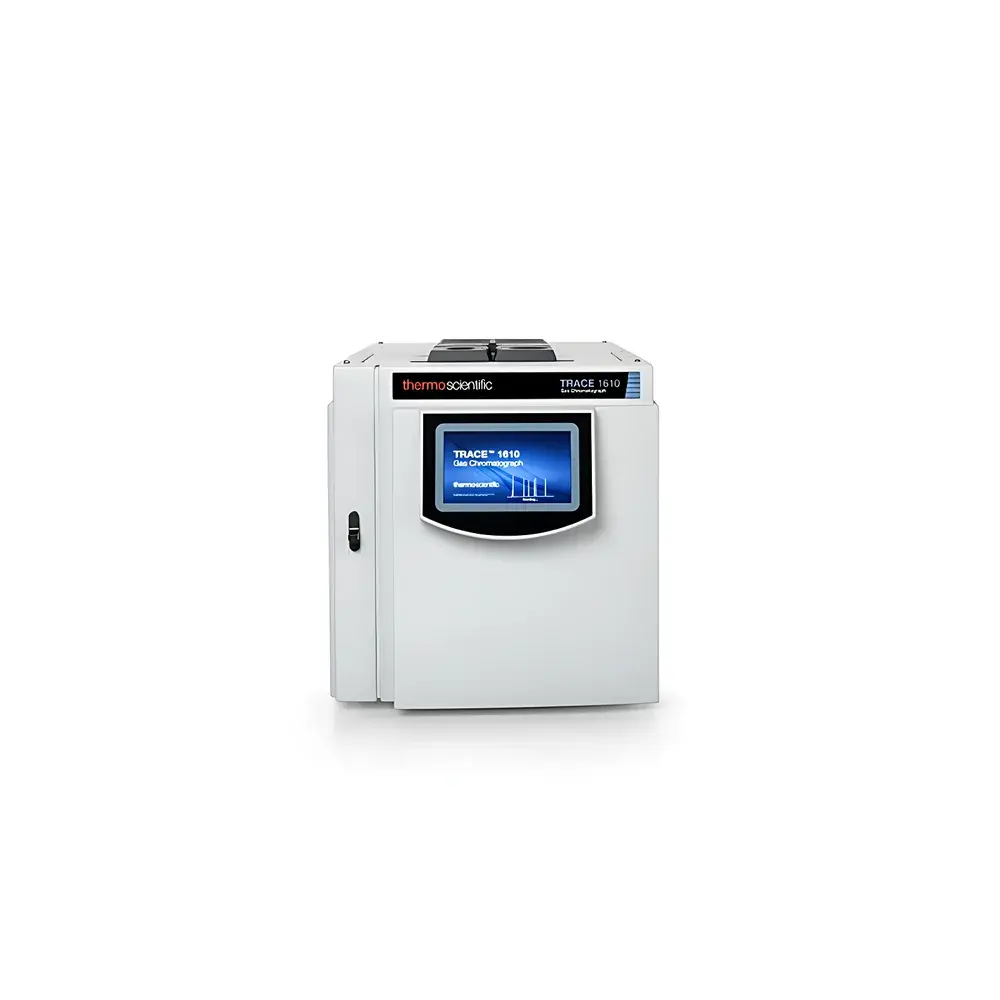
Thermo Fisher Trace 1600 Gas Chromatograph
| Brand | Thermo Fisher |
|---|---|
| Origin | Italy |
| Manufacturer Type | Original Equipment Manufacturer (OEM) |
| Origin Category | Imported |
| Model | Trace 1600 & 1610 |
| Instrument Type | Laboratory Gas Chromatograph |
| Application Scope | General-Purpose |
| Oven Temperature Range | +3 °C to 450 °C |
| Maximum Ramp Rate | 125 °C/min |
| Cooling Rate | <4 minutes from 450 °C to 50 °C |
| Injector Maximum Operating Temperature | 450 °C |
Overview
The Thermo Fisher Trace 1600 Gas Chromatograph is a modular, high-performance laboratory GC engineered for precision, operational continuity, and long-term analytical reliability. Built on a robust platform developed at Thermo Fisher’s manufacturing facility in Milan, Italy, the system employs conventional packed and capillary column separation coupled with carrier gas flow control via electronic pneumatic control (EPC) modules. Its core architecture supports isothermal and programmable temperature ramping across the full oven range (+3 °C to 450 °C), enabling method development and routine quantification for volatile and semi-volatile organic compounds—including hydrocarbons, pesticides, residual solvents, flavors, fragrances, and environmental contaminants. The instrument integrates seamlessly into regulated environments where traceability, reproducibility, and audit readiness are mandatory, supporting compliance with ISO/IEC 17025, USP , ASTM D3606/D5501, and EPA Methods 8021B/8260.
Key Features
- Modular hardware architecture enabling hot-swap replacement of injectors, detectors, and oven modules—minimizing instrument downtime during maintenance or configuration changes.
- Ultra-fast thermal management: 125 °C/min maximum heating rate and sub-4-minute cooling from 450 °C to 50 °C, significantly reducing cycle time for high-throughput labs.
- Intuitive 7-inch capacitive touchscreen interface with icon-driven navigation, embedded video-guided maintenance workflows, and real-time status alerts for consumables (e.g., liner life, septum wear, column bleed).
- iConnect Column Lock mechanism—tool-free column installation with visual alignment feedback and consistent retention time reproducibility across installations.
- Integrated oven illumination and low-power EPC design reduce energy consumption by up to 35% versus legacy GC platforms, while helium conservation modes dynamically adjust flow during standby and post-run phases.
- Compact footprint (W × D × H: 54 × 53 × 49 cm) optimizes bench space in multi-instrument laboratories without compromising thermal stability or flow accuracy.
Sample Compatibility & Compliance
The Trace 1600 accommodates standard 0.1–0.53 mm ID fused-silica capillary columns and packed columns up to 6 mm ID. It supports all common GC-compatible injection techniques—including split/splitless, on-column, PTV, and headspace—and interfaces with a broad range of detectors (FID, TCD, ECD, NPD, FPD, and optional MS coupling via Thermo ISQ EC). All firmware and system logs comply with FDA 21 CFR Part 11 requirements when operated with Chromeleon CDS v7.3 or later, providing electronic signatures, audit trails, and role-based access control. Routine operation meets GLP/GMP documentation standards for pharmaceutical QC, food safety testing, and contract research organizations.
Software & Data Management
Controlled exclusively via Thermo Fisher Chromeleon Chromatography Data System (CDS), the Trace 1600 delivers full method lifecycle management—from sequence definition and instrument calibration to peak integration, reporting, and raw data archiving. Chromeleon supports automated calibration verification (ACV), system suitability testing (SST), and customizable report templates aligned with LIMS export protocols (e.g., ASTM E1702, HL7). Data integrity safeguards include write-protected raw files, timestamped audit logs, and encrypted database backups. Remote monitoring and diagnostics are enabled through secure HTTPS-based connectivity, facilitating centralized fleet management across distributed lab sites.
Applications
The Trace 1600 serves as a foundational analytical tool across diverse sectors: environmental testing (soil/water VOC analysis per EPA SW-846), petrochemical QA/QC (gasoline hydrocarbon profiling per ASTM D5769), pharmaceutical residual solvent screening (ICH Q3C-compliant), food authenticity and adulteration detection (fatty acid methyl ester profiling), and forensic toxicology (blood alcohol and drug metabolite quantification). Its modularity allows rapid reconfiguration between applications—e.g., switching from an FID-based pesticide screen to an ECD-based PCB assay—without requiring system recalibration or extended equilibration.
FAQ
Is the Trace 1600 compatible with mass spectrometry detection?
Yes—the system supports direct coupling to Thermo ISQ EC single-quadrupole MS and can be configured for GC-MS operation with appropriate interface hardware and Chromeleon MS control modules.
What column dimensions and phases are supported?
Standard capillary columns up to 60 m length, 0.53 mm ID, and film thicknesses from 0.1 to 5.0 µm; compatible with all commercially available stationary phases (e.g., DB-5ms, HP-INNOWAX, VF-WAXms).
Does the instrument support unattended overnight operation?
Yes—full sequence scheduling, automatic shutdown, and power-fail recovery are natively supported via Chromeleon CDS with validated runtime stability exceeding 72 hours.
How is detector performance verified?
Built-in diagnostic routines assess baseline noise, signal-to-noise ratio, and linear dynamic range using certified reference standards; results are logged and exportable for internal SOP documentation.
Can modules from Trace 1300 or 1310 systems be used interchangeably?
No—Trace 1600 modules are mechanically and electrically specific to the 1600/1610 platform; cross-platform compatibility is not supported due to revised EPC firmware and thermal management architecture.
Related Products




