
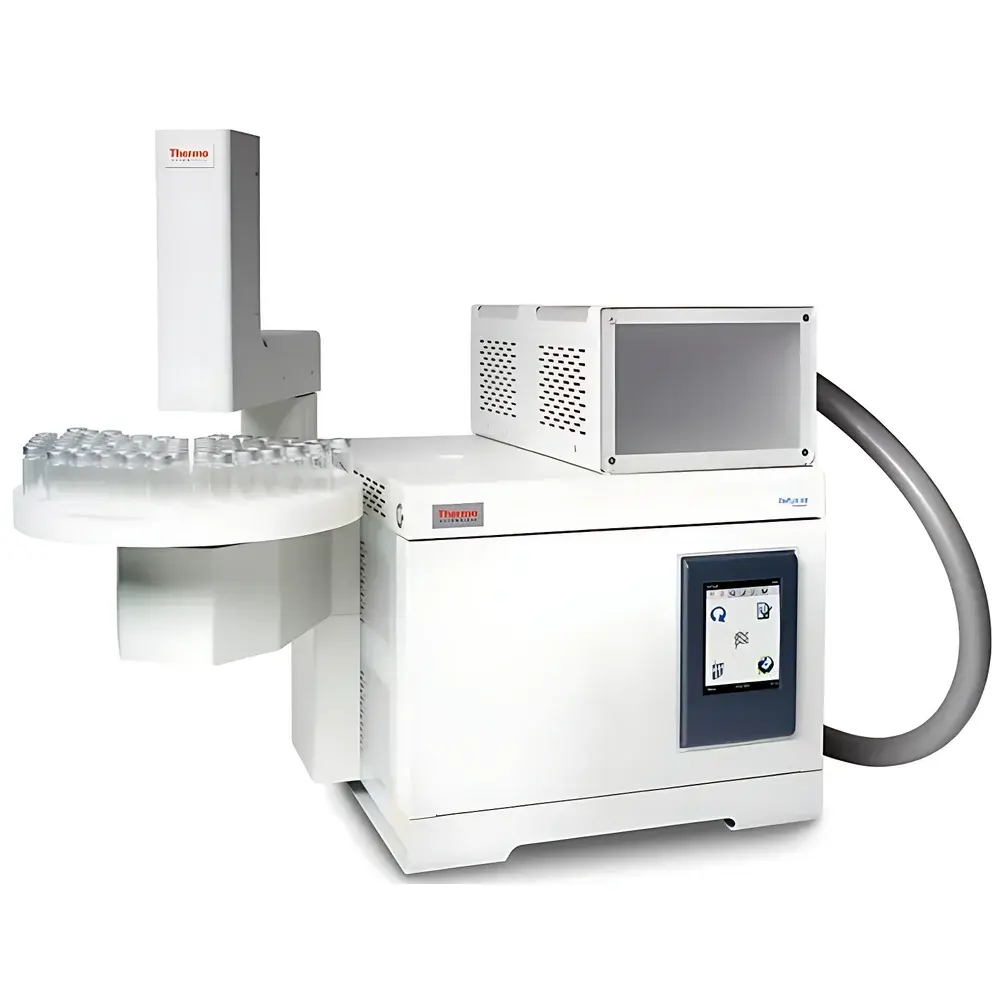
Thermo Fisher TriPlus 300 Headspace Autosampler
| Brand | Thermo Fisher |
|---|---|
| Origin | Italy |
| Manufacturer Type | Original Equipment Manufacturer (OEM) |
| Origin Category | Imported |
| Model | TriPlus 300 |
| Instrument Type | Static Headspace Sampler |
| Automation Level | Fully Automated |
Overview
The Thermo Fisher TriPlus 300 Headspace Autosampler is a fully automated, static headspace sampling system engineered for precise, reproducible, and high-throughput analysis of volatile and semi-volatile organic compounds (VOCs and SVOCs) in complex matrices. It operates on the principle of equilibrium headspace sampling—where a sealed sample vial is heated to a controlled temperature, allowing analytes to partition between the liquid/solid phase and the gas phase above it. A precisely metered volume of this equilibrated headspace vapor is then transferred via a valve-quantitative loop system into a gas chromatograph (GC) or GC-mass spectrometer (GC-MS). Designed for laboratories requiring regulatory compliance, method robustness, and operational flexibility, the TriPlus 300 integrates seamlessly into GLP-, GMP-, and ISO/IEC 17025-aligned workflows. Its inert sample pathway—from vial cradle through heated transfer lines to the injection valve—minimizes adsorption, degradation, and carryover, ensuring integrity across diverse applications including pharmaceutical residual solvent testing (per USP , ICH Q2(R2)), environmental VOC monitoring (EPA Methods 502.2, 524.4, 8260), forensic toxicology, and food safety screening.
Key Features
- Fully automated static headspace sampling with integrated 120-position sample carousel and 18 independently controllable incubation heating zones—enabling overlapping thermal equilibration for uninterrupted high-throughput operation
- Valve-and-quantitative-loop injection architecture delivering exceptional precision (<1.5% RSD for peak area), minimal carryover (<0.01%), and long-term method stability
- Heating range from 30 °C to 300 °C across all thermal zones—including vial oven, transfer line, and injection valve—supporting both low-boiling volatiles and thermally labile or high-boiling analytes
- Full inertness: SilcoNert®-treated stainless-steel flow path, fused-silica transfer lines, and chemically resistant seals ensure compatibility with aggressive solvents and reactive compounds
- Gas and energy-saving mode: Automatically activates after 10 minutes of inactivity; reduces oven temperature setpoints, carrier gas flow, and touchscreen brightness per user-defined thresholds—reducing power consumption and environmental footprint without compromising readiness
- Barcode-enabled sample tracking with audit-trail-capable logging, supporting 21 CFR Part 11-compliant electronic records when paired with Thermo Scientific Chromeleon CDS or compatible third-party chromatography data systems
Sample Compatibility & Compliance
The TriPlus 300 accommodates standard 10–22 mm crimp-top or screw-cap headspace vials (including 10 mL, 20 mL, and custom formats) and supports both single- and multi-phase samples (aqueous solutions, suspensions, solids, polymers, and biological tissues). Its modular design permits configuration-specific validation per ASTM D7699 (standard practice for headspace analysis), ISO 15640 (water quality—determination of VOCs), and pharmacopeial monographs (USP , Ph. Eur. 2.4.24). All thermal and pneumatic parameters are software-controllable and logged with time-stamped metadata, enabling full traceability required under GLP and GMP audits. The system meets CE marking requirements and complies with IEC 61000-6-3 (EMC) and IEC 61010-1 (safety) standards.
Software & Data Management
Native integration with Thermo Scientific Chromeleon Chromatography Data System (CDS) provides unified instrument control, sequence management, real-time diagnostics, and report generation. The embedded touchscreen interface offers intuitive local operation—including method editing, manual injection, and status monitoring—without requiring host PC connectivity. For enterprise-scale deployment, the TriPlus 300 supports remote monitoring and control via Ethernet, with driver-level compatibility for major third-party CDS platforms (e.g., Agilent OpenLab, Waters Empower, Shimadzu GCMSsolution). All method parameters, run logs, error events, and calibration history are stored with cryptographic hashing to prevent tampering—fulfilling ALCOA+ (Attributable, Legible, Contemporaneous, Original, Accurate, Complete, Consistent, Enduring, Available) data integrity principles.
Applications
- Pharmaceutical: Residual solvent quantification in APIs and finished dosage forms per ICH Q3C guidelines
- Environmental: Analysis of BTEX, chlorinated hydrocarbons, and pesticides in soil, water, and air samples per EPA SW-846 methods
- Food & Beverage: Ethanol, aldehydes, esters, and off-flavor compounds in wines, dairy, and packaged foods
- Forensics: Blood alcohol content (BAC), volatile drug metabolites, and ignitable liquid residues (ILR) in fire debris
- Materials Science: Monomer release from polymers, outgassing profiling of electronics encapsulants, and packaging migration studies
FAQ
Is the TriPlus 300 compatible with non-Thermo GC and GC-MS systems?
Yes—it supports analog and digital communication protocols (RS-232, Ethernet, TTL triggers) and includes drivers for leading third-party CDS platforms.
Can the system perform dynamic headspace or purge-and-trap sampling?
No—the TriPlus 300 is designed exclusively for static headspace analysis. Dynamic headspace functionality requires the TriPlus RSH or dedicated purge-and-trap modules.
What maintenance intervals are recommended for optimal performance?
Valve seal replacement every 10,000 injections; quantitative loop cleaning every 500 runs; annual calibration verification using certified standard gas mixtures.
Does the system support method transfer from legacy Thermo headspace autosamplers?
Yes—Chromeleon CDS enables direct import of TriPlus 100/200 methods with automatic parameter mapping and validation-ready audit trails.
How is sample integrity ensured during extended unattended runs?
Real-time pressure and temperature monitoring, vial cap integrity detection, and automated leak-check routines are executed before each injection cycle to prevent compromised analyses.





