
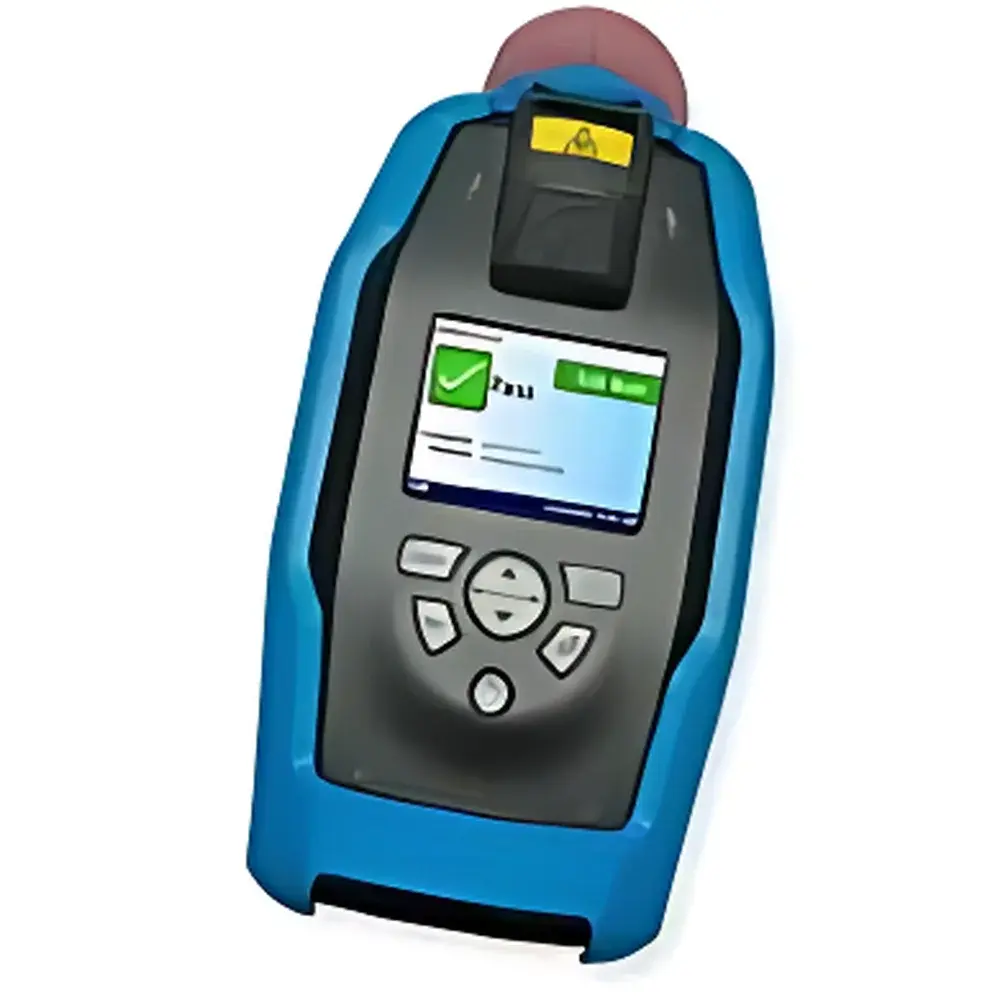
Thermo Fisher TruScan Handheld Raman Spectrometer for Pharmaceutical and Chemical Applications
| Brand | Thermo Fisher |
|---|---|
| Origin | USA |
| Manufacturer | Thermo Fisher Scientific |
| Product Type | Imported |
| Model | TruScan |
| Instrument Category | Portable/Handheld Raman Spectrometer |
Overview
The Thermo Fisher TruScan Handheld Raman Spectrometer is an engineered field-deployable analytical instrument designed specifically for rapid, non-destructive identification of raw materials and excipients in regulated pharmaceutical and fine chemical manufacturing environments. Operating on the principle of inelastic light scattering (Raman spectroscopy), the TruScan leverages monochromatic laser excitation (typically 785 nm) to generate molecular fingerprint spectra that are highly specific to chemical structure, crystalline form, hydration state, and polymorphic configuration. Unlike FTIR or NIR, Raman signals are minimally attenuated by water and transparent packaging—enabling direct analysis through glass vials, plastic bottles, blister packs, and laminated pouches without sample preparation, opening, or environmental containment. Introduced in 2007, the TruScan was the first handheld Raman system validated for cGMP-compliant material verification at receiving docks, quarantine areas, and production lines—effectively bridging the gap between laboratory-grade spectral fidelity and operational agility in Good Manufacturing Practice (GMP) settings.
Key Features
- True handheld architecture with ergonomic, IP54-rated enclosure for use in industrial environments including warehouses, loading bays, and cleanroom-adjacent zones.
- Integrated DecisionEngine™ chemometric software delivering binary pass/fail results in ≤30 seconds per measurement—no user interpretation required.
- Laser-safe Class 1 design compliant with IEC 60825-1; no external interlocks or laser safety officers needed during routine operation.
- No consumables, solvents, or sample preparation—analysis performed through primary packaging with minimal operator training.
- On-device method creation capability: administrators can build, validate, and deploy new spectral libraries using as few as three representative samples per compound.
- Built-in audit trail, electronic signatures, and data encryption aligned with FDA 21 CFR Part 11 requirements for electronic records and signatures.
Sample Compatibility & Compliance
The TruScan demonstrates high specificity for distinguishing structurally similar compounds critical to pharmaceutical quality control—including hydrates (e.g., monohydrate vs. dihydrate forms), solvates, enantiomers, and common excipients such as lactose, microcrystalline cellulose, and polyvinylpyrrolidone. It is routinely applied to verify active pharmaceutical ingredients (APIs), intermediates, reagents, and cleaning agents across API synthesis, formulation, and packaging operations. The system meets ASTM E1840–22 (Standard Guide for Raman Spectroscopy in Pharmaceutical Analysis) and supports compliance with ICH Q5A(R2), Q7, and EU GMP Annex 19. All spectral data, measurement metadata, and user actions are recorded with time-stamped, immutable audit trails suitable for regulatory inspections and GLP/GMP audits.
Software & Data Management
DecisionEngine™ software employs proprietary multivariate algorithms—including PCA, SIMCA, and spectral correlation matching—to compare acquired spectra against reference libraries stored locally on the device. Libraries are managed via TruControl™ desktop software (Windows-based), which enables version-controlled library updates, cross-instrument synchronization, and integration with LIMS or MES systems via secure CSV or ASTM E1384-compliant export protocols. Each measurement captures full spectral data (wavenumber range: ~200–2000 cm⁻¹), acquisition parameters, GPS coordinates (optional), operator ID, and timestamp. Data integrity safeguards include role-based access control, password-protected administrator functions, and cryptographic hashing of all stored spectra.
Applications
- Raw material identity testing (IDT) at receipt—eliminating quarantine delays and reducing reliance on off-site lab testing.
- In-process verification of blend uniformity and API concentration in dry powder formulations (when combined with validated partial least squares models).
- Counterfeit detection of APIs and finished dosage forms through spectral deviation analysis.
- Verification of cleaning effectiveness by detecting residual traces of previous batches on shared equipment surfaces.
- Supporting Quality by Design (QbD) initiatives through real-time material characterization during process development and tech transfer.
- Field deployment in contract manufacturing organizations (CMOs) and regulatory inspection readiness assessments.
FAQ
Does the TruScan require calibration verification before each use?
No—TruScan incorporates an internal wavelength reference standard and automatic intensity normalization. Daily system suitability checks (SSC) are configurable but not mandatory per 21 CFR Part 11; however, periodic verification using NIST-traceable polystyrene or silicon standards is recommended per internal SOPs.
Can TruScan identify unknown substances?
No—it is a confirmatory identification tool, not a discovery instrument. It compares acquired spectra only against pre-enrolled reference spectra within its library. Unknown screening requires laboratory-based techniques such as GC-MS or HPLC-MS.
Is the TruScan compatible with controlled substance handling environments?
Yes—the non-contact, through-barrier measurement capability allows safe verification of high-potency APIs without opening containment, supporting ISO 14644-1 Class 5–8 environments and OSHA-recommended exposure controls.
How is spectral library validation documented for regulatory submission?
TruControl™ generates IQ/OQ documentation templates aligned with ASTM E2500 and ISPE GAMP 5. Each library entry includes spectral acquisition parameters, sample provenance, and statistical confidence metrics (e.g., match score, residual variance) required for FDA or EMA submissions.
What is the typical service life and maintenance schedule?
The TruScan features solid-state laser diodes and no moving optical components. Thermo Fisher recommends annual performance qualification (PQ) and firmware updates; battery replacement is typically required every 2–3 years under normal usage conditions.




