
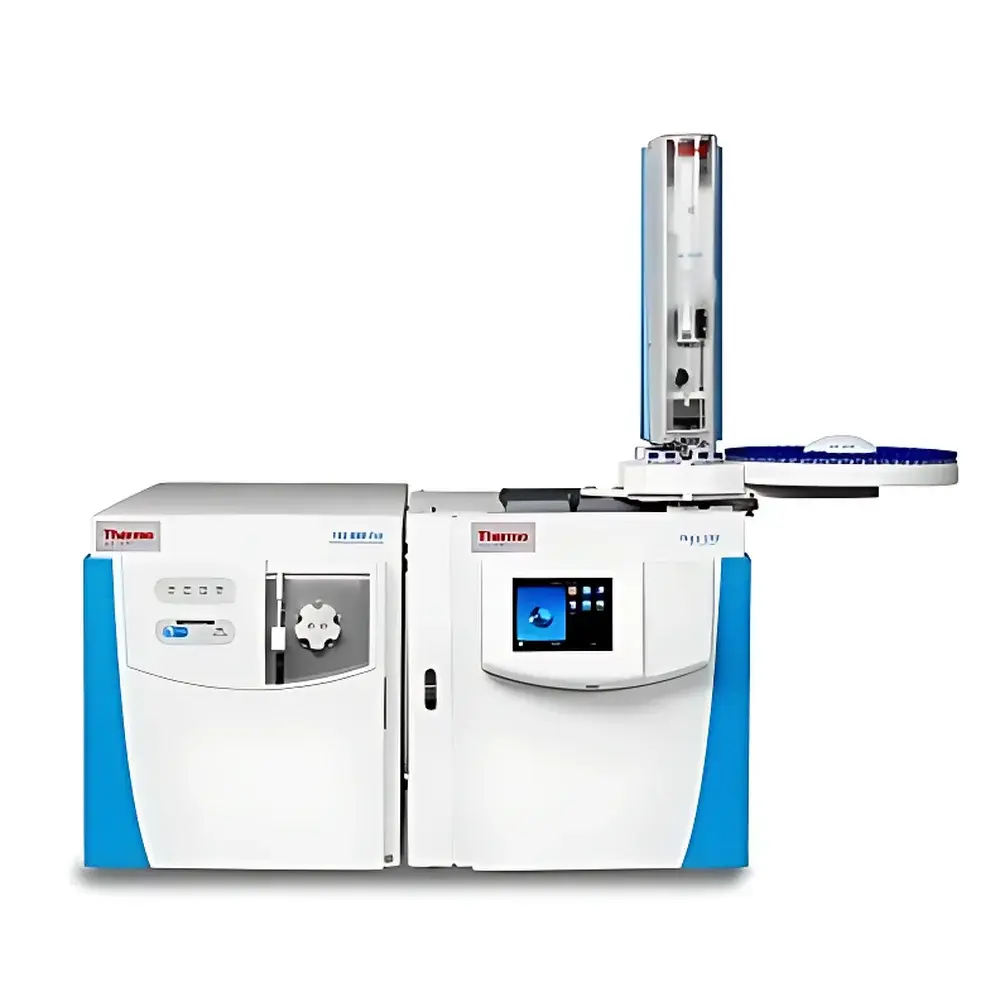
Thermo Fisher TSQ 8000 Evo Triple Quadrupole Gas Chromatography Mass Spectrometry System
| Brand | Thermo Fisher |
|---|---|
| Origin | USA |
| Manufacturer Type | Original Equipment Manufacturer (OEM) |
| Product Category | Imported Instrument |
| Model | TSQ 8000 Evo |
| Instrument Type | Triple Quadrupole Mass Spectrometer |
| GC Configuration | Conventional Capillary Gas Chromatograph |
| Detection Principle | Electron Ionization (EI) / Chemical Ionization (CI) with Tandem Mass Spectrometry (MS/MS) in SRM/MRM mode |
Overview
The Thermo Fisher TSQ 8000 Evo is a high-performance triple quadrupole gas chromatography–tandem mass spectrometry (GC-MS/MS) system engineered for laboratories requiring robust, reproducible quantification of trace-level analytes in complex matrices. Operating on the fundamental principle of selected reaction monitoring (SRM), also known as multiple reaction monitoring (MRM), the instrument isolates precursor ions in Q1, fragments them in the collision cell (q2), and detects specific product ions in Q3—delivering exceptional selectivity, sensitivity, and dynamic range. Designed as the evolutionary successor to the widely deployed TSQ 8000 platform, the Evo variant integrates hardware refinements and software enhancements specifically to address the operational demands of regulated, high-throughput analytical environments—including environmental testing, food safety, clinical toxicology, and forensic chemistry laboratories.
Key Features
- Fast EvoCell Technology: A redesigned collision cell architecture enabling rapid polarity switching (<50 ms), improved ion transmission efficiency, and enhanced stability during extended SRM method runs.
- ExtractaBrite Ion Source with Dual-Heating: Independently heated ion source block and RF lens assembly minimize condensable matrix deposition, significantly extending source cleaning intervals and maintaining consistent ionization efficiency across diverse sample types.
- Vacuum-Locked Ion Source: Allows full source removal—including EI/CI ion boxes, extraction lenses, and focusing optics—without breaking high-vacuum conditions, reducing instrument downtime and preserving calibration integrity.
- T-SRM (Targeted SRM) Mode: Optimizes dwell time allocation across large ion transition lists without sacrificing cycle time, ensuring high data point density per chromatographic peak for accurate integration in multi-analyte workflows.
- DynaMax Detector System: A high-dynamic-range electron multiplier with real-time gain compensation, delivering linear response over six orders of magnitude (10⁶) without detector saturation or signal compression.
- Modular GC Integration: Compatible with Thermo Scientific TRACE™ 1300/1310 Series GCs featuring plug-and-play detector interfaces, programmable oven ramping, and optional backflush or heart-cutting capabilities.
Sample Compatibility & Compliance
The TSQ 8000 Evo supports both electron ionization (EI) and chemical ionization (CI) modes, accommodating volatile and semi-volatile organic compounds (VOCs/SVOCs) with molecular weights up to ~1,000 Da. It is routinely applied to regulated analyses aligned with EPA Methods 1613, 1668C, 8270, and 8082; EU EN 1948; ISO 18073; and ASTM D7622. The system architecture supports 21 CFR Part 11-compliant audit trails when paired with TraceFinder v5.x or later, and meets GLP/GMP documentation requirements through configurable electronic signatures, user access controls, and method versioning. All firmware and control logic are validated per IEC 62304 standards for medical device software lifecycle management.
Software & Data Management
- TraceFinder Software: A purpose-built, workflow-driven platform supporting automated peak detection, integration, calibration curve generation, and report export in customizable templates compliant with LIMS interfaces (e.g., LabWare, STARLIMS).
- AutoSRM Method Development: Employs intelligent algorithmic optimization of collision energy (CE) and declustering potential (DP) for each precursor→product transition, reducing manual tuning time by >70% compared to legacy approaches.
- TargetQuan Module: Dedicated quantitative engine for persistent organic pollutants (POPs), pre-configured with compound libraries, isotope dilution protocols, and congener-specific retention indexing for PCDD/Fs, PCBs, PBDEs, and dioxin-like compounds.
- Data Archiving & Retrieval: Raw data files (.raw) are stored in vendor-neutral formats compatible with third-party reprocessing tools (e.g., MS-DIAL, Skyline). Metadata embedding follows mzML 1.2 schema specifications.
Applications
The TSQ 8000 Evo delivers validated performance in mission-critical applications where regulatory compliance and method ruggedness are non-negotiable. These include but are not limited to: quantification of dioxins and furans in soil and sediment per EPA 1613B; screening of pesticide residues in fruits and vegetables under EU MRL regulations; confirmation and quantitation of mycotoxins (e.g., aflatoxins, ochratoxin A) in cereals per AOAC 2012.01; analysis of brominated flame retardants (PBDEs, HBCDs) in polymer extracts; and targeted metabolite profiling in clinical urine specimens for drugs of abuse testing. Its SRM sensitivity enables sub-pg-on-column detection limits for many priority contaminants, while its throughput capacity supports >100 samples per day in routine laboratory operations.
FAQ
What ionization modes does the TSQ 8000 Evo support?
Electron Ionization (EI) and Chemical Ionization (CI), with field-replaceable ion source modules enabling rapid switching between modes without vacuum break.
Is the system compatible with existing TSQ 8000 methods?
Yes—method migration from legacy TSQ 8000 platforms is supported via backward-compatible .srmd and .mrm file import; minor optimization of CE/DP may be required due to EvoCell efficiency gains.
How is data integrity ensured during long unattended runs?
Instrument control logs, acquisition metadata, and raw spectral data are timestamped and cryptographically hashed at acquisition; all changes are recorded in an immutable audit trail accessible via TraceFinder’s Security Console.
Can the TSQ 8000 Evo be integrated into a networked laboratory environment?
Yes—it supports standard Ethernet TCP/IP communication, OPC UA server interface for SCADA integration, and HL7 messaging for clinical lab connectivity, with role-based authentication enforced at both OS and application layers.
Related Products





