
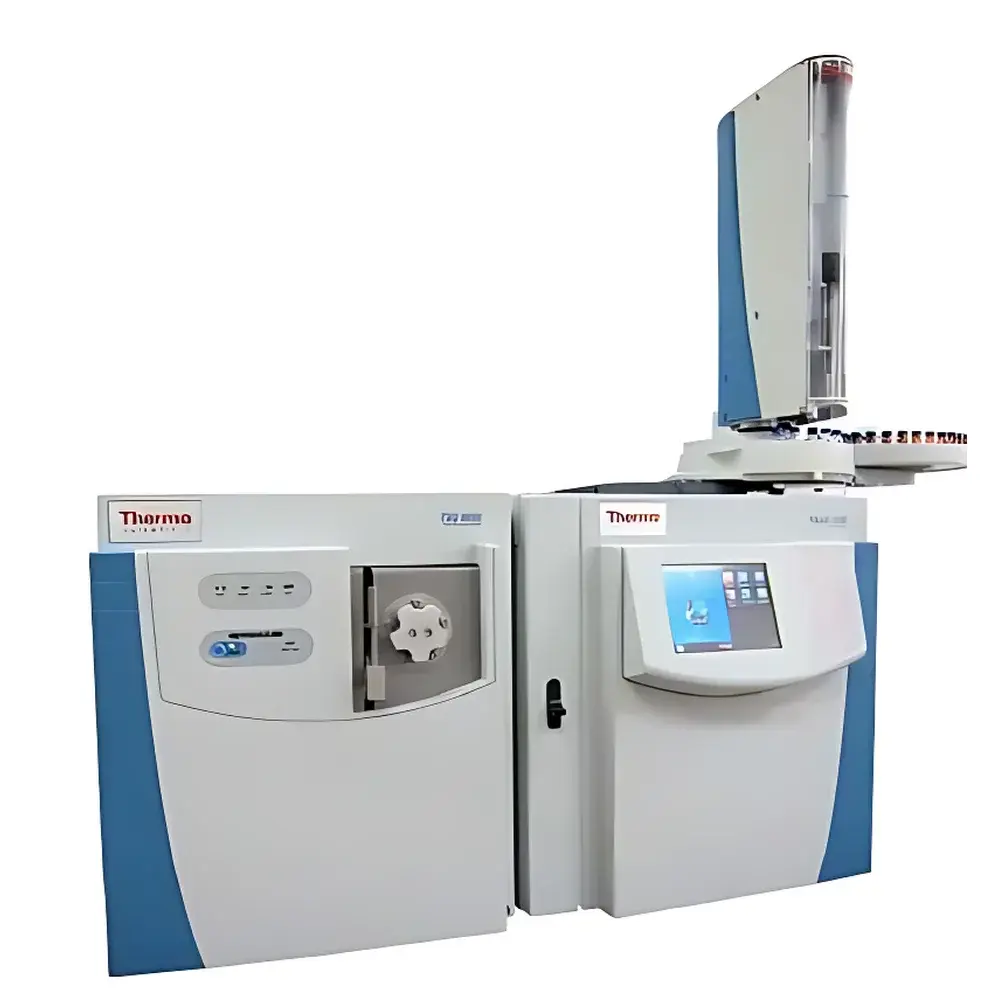
Thermo Fisher TSQ 8000 Triple Quadrupole Gas Chromatography Mass Spectrometer
| Brand | Thermo Fisher |
|---|---|
| Origin | USA |
| Manufacturer | Thermo Fisher Scientific |
| Product Type | Imported Instrument |
| Model | TSQ 8000 |
| Instrument Category | Triple Quadrupole Mass Spectrometer |
| Chromatography Type | Gas Chromatography (GC) Coupled System |
| Collision Gas Options | Nitrogen or Argon (Helium-Free Operation) |
| Ion Source | Dual-Heated, Removable Without Venting |
| Detector | DynaMax™ High-Dynamic-Range Electron Multiplier |
| Software Platform | Thermo Scientific TraceFinder™ and AutoSRM™ |
Overview
The Thermo Fisher TSQ 8000 is a high-performance triple quadrupole gas chromatography mass spectrometer (GC-MS/MS) engineered for robust, high-throughput quantitative analysis in regulated and research laboratories. Operating on the principle of tandem mass spectrometry via three sequential quadrupole stages—Q1 (mass selection), Q2 (collision-induced dissociation cell), and Q3 (product ion detection)—the system delivers exceptional selectivity, sensitivity, and reproducibility in complex matrix environments. Its core architecture supports Selected Reaction Monitoring (SRM) and Time-Scheduled SRM (t-SRM), enabling precise quantification of trace-level analytes across multi-residue methods without compromising signal-to-noise ratio or duty cycle efficiency. Designed for compliance-critical workflows, the TSQ 8000 meets foundational requirements for GLP, GMP, and FDA 21 CFR Part 11–aligned data integrity when deployed with validated software configurations.
Key Features
- Triple quadrupole mass analyzer with independently controlled RF/DC voltages for high mass resolution and transmission stability across wide dynamic ranges.
- DynaMax™ detector delivering >106 linear dynamic range and sub-femtogram limit of detection (LOD) in SRM mode—validated per ASTM D7574 and ISO 17025–compliant protocols.
- Helium-free operation: nitrogen or argon selectable as collision gas—reducing operational cost and dependency on scarce helium supplies while maintaining fragmentation efficiency and spectral fidelity.
- Fully removable ion source without breaking vacuum: enables rapid maintenance, cleaning, or replacement of source components—including dual-heated zones and dual filament assembly—minimizing instrument downtime.
- Pre-quadrupole off-axis optics design suppresses neutral noise and chemical background, improving signal purity and lowering method detection limits (MDLs) in high-matrix samples such as food extracts, environmental water, or biological fluids.
- Integrated heated pre-quadrupole acts as an ion filter and thermal shield, protecting the main quadrupole rods from contamination and eliminating routine rod cleaning or replacement over extended service intervals.
Sample Compatibility & Compliance
The TSQ 8000 is optimized for volatile and semi-volatile organic compounds amenable to gas chromatographic separation, including pesticides, pharmaceutical impurities, environmental pollutants (e.g., PAHs, PCBs, dioxins), and small-molecule metabolites. It supports standard GC inlet configurations (split/splitless, PTV, GC×GC interfaces) and is compatible with common capillary columns (e.g., 5% phenyl methylpolysiloxane, wax-based phases). Method validation adheres to ICH Q2(R2), USP , and EU Commission Decision 2002/657/EC criteria for confirmatory analysis. Full audit trail, electronic signatures, and secure user access control are enabled through TraceFinder™ when configured in 21 CFR Part 11–compliant mode.
Software & Data Management
Thermo Scientific TraceFinder™ serves as the unified acquisition, processing, and reporting platform—supporting automated peak integration, calibration curve fitting (linear/non-linear), and customizable report generation compliant with LIMS integration standards (ASTM E1482, HL7). AutoSRM™ automates SRM transition optimization, dwell time allocation, and retention time scheduling—reducing method development time by up to 70% versus manual approaches. t-SRM functionality dynamically allocates instrument time based on compound elution windows, maximizing sensitivity per target without sacrificing multiplexing capacity. All raw and processed data files conform to mzML 1.1.0 format for long-term archival and third-party reprocessing.
Applications
- Residue analysis in food safety testing (EU MRL enforcement, USDA FSIS surveillance)
- Environmental monitoring of persistent organic pollutants in soil, sediment, and wastewater
- Pharmaceutical quality control for genotoxic impurity screening (ICH M7)
- Clinical toxicology and forensic drug testing requiring low pg/mL quantification
- Metabolomics profiling where structural confirmation and absolute quantitation are required
FAQ
Does the TSQ 8000 require helium as a carrier or collision gas?
No. The system operates with nitrogen or argon as the collision gas and is fully compatible with hydrogen or nitrogen carrier gases—eliminating helium dependency without sacrificing SRM specificity or sensitivity.
Can the ion source be cleaned without venting the mass spectrometer?
Yes. The entire ion source assembly—including emitter, repeller, lens stack, and dual-heated zones—is designed for tool-free removal under full vacuum, reducing maintenance time to under 15 minutes.
How does t-SRM improve method scalability compared to conventional SRM?
t-SRM dynamically assigns dwell time and Q1/Q3 settings only during predicted elution windows, allowing >500 transitions per run while maintaining optimal dwell times and signal-to-noise ratios—unlike static SRM, which degrades sensitivity as transition count increases.
Is TraceFinder™ compliant with regulatory data integrity requirements?
When deployed with appropriate administrative controls (role-based permissions, audit trail activation, electronic signature enforcement), TraceFinder™ supports full 21 CFR Part 11 and Annex 11 compliance for GxP environments.
What is the expected lifetime of the dual-filament assembly under routine use?
With intelligent filament switching logic and thermal management, typical operational life exceeds 3,000 injections in high-sensitivity SRM assays using dirty matrices—validated per Thermo Fisher’s internal MTBF protocol.




