
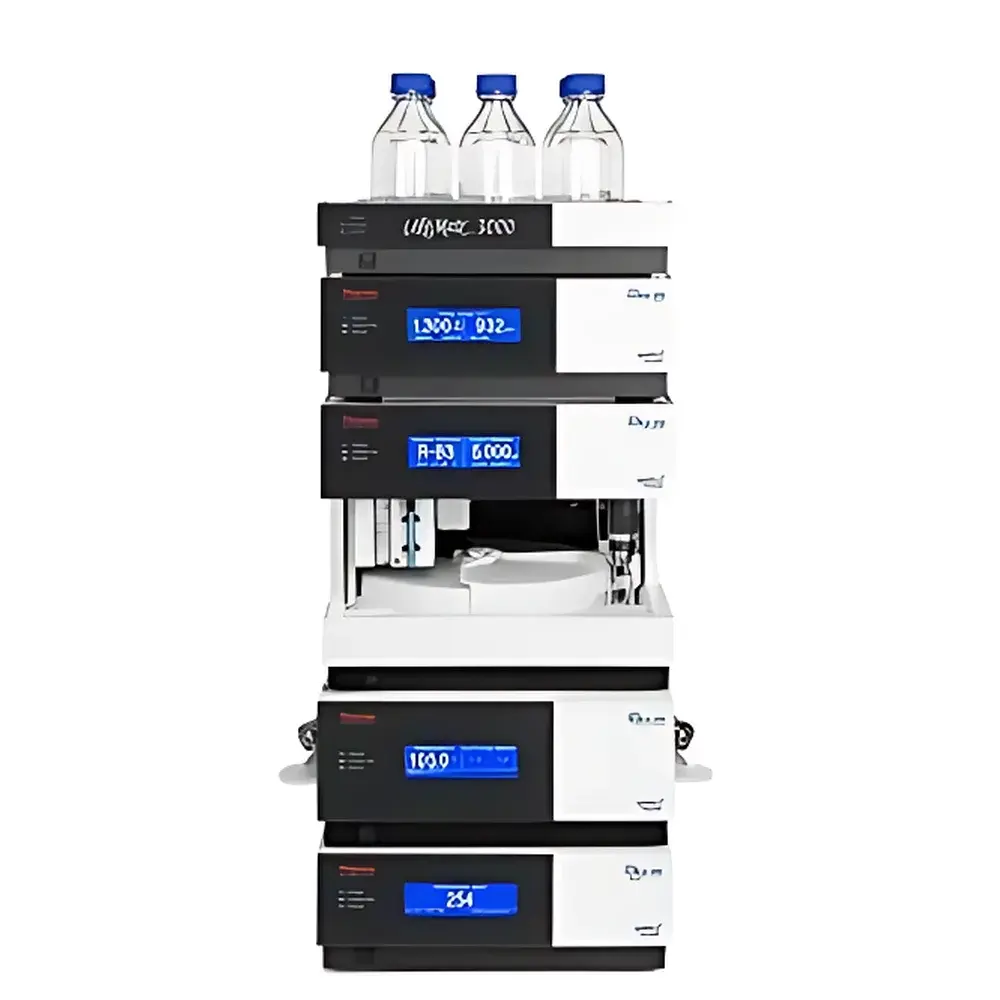
Thermo Fisher UltiMate 3000 Binary Rapid Separation Liquid Chromatography System
| Brand | Thermo Fisher |
|---|---|
| Origin | USA |
| Manufacturer Type | Original Equipment Manufacturer (OEM) |
| Origin Category | Imported |
| Model | UltiMate 3000 Binary Rapid Separation System (U3000) |
| Instrument Type | Ultra-High Performance Liquid Chromatograph (UHPLC) |
| Maximum Flow Rate | 8 mL/min |
| Maximum Backpressure | 100 MPa (15,000 psi / 1000 bar) |
| Column Oven Temperature Range | 5–110 °C |
| Gradient Delay Volume | Adjustable via SpinFlow™ Technology |
| Autosampler Injection Precision | <0.25% RSD |
| Carryover | <0.005% |
| Detector Compatibility | UV-Vis (DAD, MWD, VWD), Fluorescence, CAD, RID, MS interfaces |
Overview
The Thermo Fisher UltiMate 3000 Binary Rapid Separation Liquid Chromatography System is an engineered UHPLC platform designed for laboratories requiring seamless coexistence of legacy HPLC method continuity and next-generation high-resolution, high-throughput separation performance. Built upon a dual-pump binary gradient architecture, the system employs precise low-dispersion fluidic design and pressure-stable pumping to deliver reproducible separations under ultra-high backpressure conditions—up to 100 MPa (15,000 psi). Its core operational principle relies on high-pressure liquid delivery, precise gradient formation, thermally controlled column elution, and real-time detection of analytes based on optical absorption, fluorescence, or mass-to-charge ratio (when coupled with MS). This architecture enables robust method transfer between conventional HPLC and UHPLC environments while maintaining compliance with regulatory chromatographic data integrity requirements.
Key Features
- Dual-solvent binary pumping with SmartFlow™ technology: Ensures ±0.1% flow accuracy and <0.05% RSD over 24-hour operation, delivering exceptional retention time stability critical for regulated QC and method validation.
- Adjustable gradient delay volume via SpinFlow™ mixing technology: Allows optimization of dwell volume per application—essential for method scalability across column dimensions (2.1 mm to 4.6 mm i.d.) and particle sizes (1.7 µm to 5 µm).
- Viper™ fingertight fitting system: Achieves near-zero dead volume connections (<100 nL) without tools, minimizing band broadening and ensuring peak shape fidelity across multi-day sequence runs.
- Ultra-low carryover autosampler (WPS-3000RS/TRS): Features permanently wetted sample loop and needle path, with active needle wash and programmable rinse cycles—validated to <0.005% carryover for trace-level bioanalysis and impurity profiling.
- Thermally managed column compartment (TCC-3000RS): Supports temperature control from 5 °C to 110 °C with optional post-column cooling; enables elevated-temperature LC for viscosity reduction, improved resolution of isomers, and faster method development.
- Integrated degassing (SRD-3200/SRD-3400): Four-channel membrane-based degasser mounted directly on solvent rack ensures consistent baseline stability and eliminates bubble-induced pressure spikes during gradient elution.
Sample Compatibility & Compliance
The UltiMate 3000 Binary RS system accommodates a broad range of sample matrices—including small-molecule pharmaceuticals, peptides, oligonucleotides, natural products, food extracts, environmental extracts, and polymer additives—without hardware modification. It supports reversed-phase, HILIC, ion-exchange, and size-exclusion chromatography modes using columns from 50 mm to 250 mm in length and internal diameters from 2.1 mm to 4.6 mm. The system conforms to key international regulatory frameworks: it operates in full alignment with FDA 21 CFR Part 11 when deployed with Chromeleon CDS v7.x (including electronic signatures, audit trails, and role-based access control); supports GLP/GMP-compliant instrument qualification (IQ/OQ/PQ) protocols; and meets ISO/IEC 17025 requirements for analytical laboratory competence. All firmware and software versions are validated per Thermo Fisher’s documented lifecycle management process.
Software & Data Management
Controlled exclusively through Thermo Scientific™ Dionex™ Chromeleon™ Chromatography Data System (CDS) versions 6.x and 7.x, the system provides integrated instrument control, sequence scheduling, real-time monitoring, and automated reporting. Chromeleon 7.2 introduces eWorkflow™ templates for standardized method execution across labs, reducing operator-dependent variability. Audit trail functionality logs all user actions—including method edits, sequence modifications, and calibration events—with immutable timestamps and user attribution. Remote data processing and centralized server deployment options support enterprise-scale deployment across multiple instruments and locations. Data export complies with ASTM E1957 (Chromatographic Data Exchange Standard) and is compatible with LIMS integration via ODBC and RESTful APIs.
Applications
- Pharmaceutical development: Forced degradation studies, stability-indicating assays, chiral separations, and impurity profiling per ICH Q2(R2) guidelines.
- Academic proteomics/metabolomics: High-resolution peptide mapping, intact protein analysis, and untargeted metabolite screening using sub-2-µm particles and elevated temperature gradients.
- Food & beverage authenticity testing: Multi-residue pesticide analysis, mycotoxin quantification, and origin verification via fingerprint chromatographic profiling.
- Chemical synthesis QC: Reaction monitoring, intermediate purity assessment, and polymer dispersity characterization by SEC.
- MS-coupled workflows: Optimized for nano-, micro-, and standard-flow electrospray ionization with minimized system dispersion and low nanogram-level injection precision.
FAQ
Is method transfer from conventional HPLC to UltiMate 3000 Binary RS straightforward?
Yes—the system uses identical dwell volume specifications as standard binary HPLC systems, enabling direct translation of isocratic and gradient methods without re-optimization of timing parameters.
Can the system operate under GMP-regulated environments?
Yes—when configured with Chromeleon CDS v7.x and appropriate validation documentation, it satisfies ALCOA+ data integrity principles and supports full 21 CFR Part 11 compliance including electronic signatures and audit trail review.
What detector types are natively supported?
All Thermo Scientific detectors—including Vanquish DAD, RF-3000 fluorescence, Corona CAD, and TSQ series mass spectrometers—are fully integrated via native drivers; third-party detectors may be connected via analog/digital I/O or vendor-specific SDKs.
Does the system support column switching and heart-cutting 2D-LC?
Yes—the TCC-3000RS column compartment supports up to two field-upgradable 6-port/2-position valves, enabling comprehensive 2D-LC configurations with automated fraction transfer and re-injection logic.
Is remote monitoring and troubleshooting possible?
Yes—Chromeleon Remote Access (CRA) allows secure web-based instrument status viewing, sequence initiation, and diagnostic log retrieval without local network exposure, compliant with modern IT security policies.





