
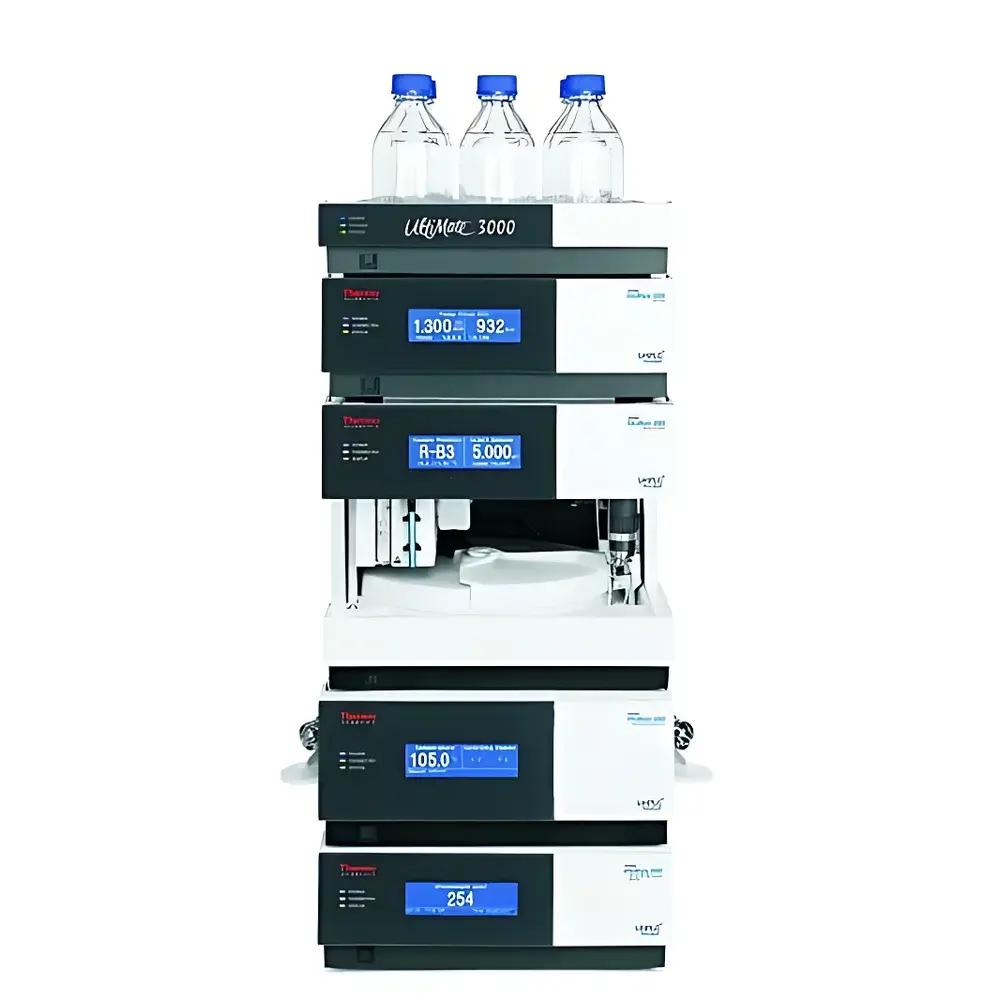
Thermo Fisher UltiMate 3000 BioRS Dual-Gradient UHPLC System
| Brand | Thermo Fisher |
|---|---|
| Origin | Germany |
| Manufacturer Type | Original Equipment Manufacturer (OEM) |
| Origin Category | Imported |
| Model | UltiMate 3000 BioRS |
| Price Range | USD 25,000 – 65,000 |
| Instrument Type | Rapid Liquid Chromatograph (UHPLC) |
Overview
The Thermo Fisher UltiMate 3000 BioRS is a dual-gradient ultra-high-performance liquid chromatography (UHPLC) system engineered specifically for demanding biomolecular separations. It operates on the fundamental principles of high-pressure liquid chromatography with precise gradient elution control, leveraging two independent quaternary or binary solvent delivery systems to enable true parallel or sequential multi-dimensional LC workflows. Unlike conventional single-pump UHPLC platforms, the BioRS architecture supports simultaneous method execution—such as orthogonal separation of monoclonal antibody (mAb) variants via sequential ion-exchange and reversed-phase chromatography—without method re-development or hardware modification. Its pressure rating of up to 100 MPa (15,000 psi / 1,000 bar) and flow rate capability up to 8 mL/min accommodate sub-2 µm particle columns, wide-bore analytical columns, and preparative-scale applications. The non-stainless-steel fluidic path—constructed from PEEK, titanium, and ceramic components—ensures compatibility with aggressive mobile phases (e.g., high-pH buffers, organic solvents with additives) commonly used in glycan, peptide, and intact protein analysis.
Key Features
- Dual independent gradient pumping units (HPG-3400RS or LGP-3400RS) enabling synchronized or staggered elution profiles across multiple columns
- Viper fingertight fitting technology delivering near-zero dead volume and reproducible peak shapes over extended operational cycles
- Thermo Scientific Dionex SmartFlow technology for real-time flow rate correction, ensuring retention time stability (<0.05% RSD) and robust peak integration
- SpinFlow gradient mixing optimization with adjustable delay volume for improved gradient fidelity and reduced dwell volume variability
- Integrated pH and conductivity monitoring (PCM-3000) supporting pH-gradient applications in weak cation/anion exchange chromatography
- Temperature-controlled autosampler (WPS-3000TBRS) with ultra-low carryover (<0.005%) via fixed-loop/ceramic needle design and active wash protocols
- Column compartment (TCC-3000RS) with dual column switching valves, programmable temperature range (5–110 °C), and support for PEEK/titanium valve configurations
- Bio-inert fluidic path certified for use with ProPac™, MAbPac™, GlycanPac™ AXH-1, and DNAPac™-PA200RS columns
Sample Compatibility & Compliance
The UltiMate 3000 BioRS is validated for analysis of large biomolecules including intact mAbs, antibody-drug conjugates (ADCs), fusion proteins, viral vectors, and oligonucleotides. Its bio-compatible flow path meets ISO 13485 requirements for medical device-related QC testing and supports GLP/GMP-compliant operation when paired with Chromeleon CDS 7.2. System validation modules include IQ/OQ/PQ templates aligned with ASTM E2500-13 and FDA 21 CFR Part 11 for electronic records and signatures. All hardware components—including Viper fittings, PEEK tubing, and titanium check valves—are compliant with USP for extractables and leachables in biopharmaceutical process monitoring.
Software & Data Management
Chromeleon Chromatography Data System (CDS) version 7.2 provides full instrument control, automated method sequencing, and audit-trail-enabled data handling. The software supports eWorkflow templates for standardized mAb charge variant analysis, glycosylation profiling, and aggregate quantification. Integrated system suitability assessment, automatic calibration curve generation, and peak purity evaluation via spectral deconvolution (DAD mode) are embedded within the acquisition engine. Remote monitoring and multi-user network deployment are enabled through Chromeleon Server architecture, with optional integration into LIMS environments via ASTM E1482 or HL7 interfaces. All raw data files adhere to ANDI/NetCDF format for long-term archival and third-party reprocessing.
Applications
This platform serves laboratories engaged in biopharmaceutical development, quality control, and life science research where resolution, reproducibility, and method transferability are critical. Typical use cases include: characterization of post-translational modifications (PTMs) in therapeutic proteins; orthogonal separation of mAb acidic/basic species using IEX-RP 2D-LC; high-throughput release testing of biosimilars per ICH Q5E guidelines; glycan mapping using HILIC-UHPLC with exoglycosidase digestion workflows; and oligonucleotide purity assessment under denaturing conditions. The system’s modular detector interface accommodates UV-Vis (DAD/VWD), fluorescence, CAD, RID, and direct coupling to mass spectrometers (e.g., Orbitrap, Q-Exactive series) via heated electrospray ionization (HESI) sources.
FAQ
Is the UltiMate 3000 BioRS compatible with existing Thermo Scientific column chemistries?
Yes—it natively supports all Thermo Scientific BioLC columns, including MAbPac RP, ProPac WCX/WAX, GlycanPac AXH-1, and DNAPac PA200RS, with full pressure and pH tolerance specifications verified.
Can the system perform fully automated 2D-LC without manual intervention?
Yes—the dual-gradient architecture, combined with WPS-3000TBRS fraction collection and TCC-3000RS column switching logic, enables unattended multidimensional separations such as comprehensive 2D-LC for proteomics or mAb heterogeneity studies.
What regulatory documentation is provided for GMP environments?
Thermo Fisher supplies vendor-specific IQ/OQ protocols, 21 CFR Part 11 compliance reports, and risk-based validation guides aligned with Annex 11 and EU GMP Annex 15 requirements.
Does the system support pH-gradient elution for weak ion-exchange methods?
Yes—integrated PCM-3000 module enables real-time monitoring and feedback-controlled pH adjustment during gradient runs, essential for reproducible weak cation exchange (WCX) separations of mAb charge variants.
How does the BioRS differ from the standard UltiMate 3000 RSLC system?
The BioRS features enhanced bio-inertness (titanium/PEEK fluidics), higher pressure rating (100 MPa vs. 80 MPa), dual-pump synchronization capability, dedicated column oven with dual valve support, and native integration of pH/conductivity sensing—making it purpose-built for biopharma QC and characterization labs.
Related Products





