
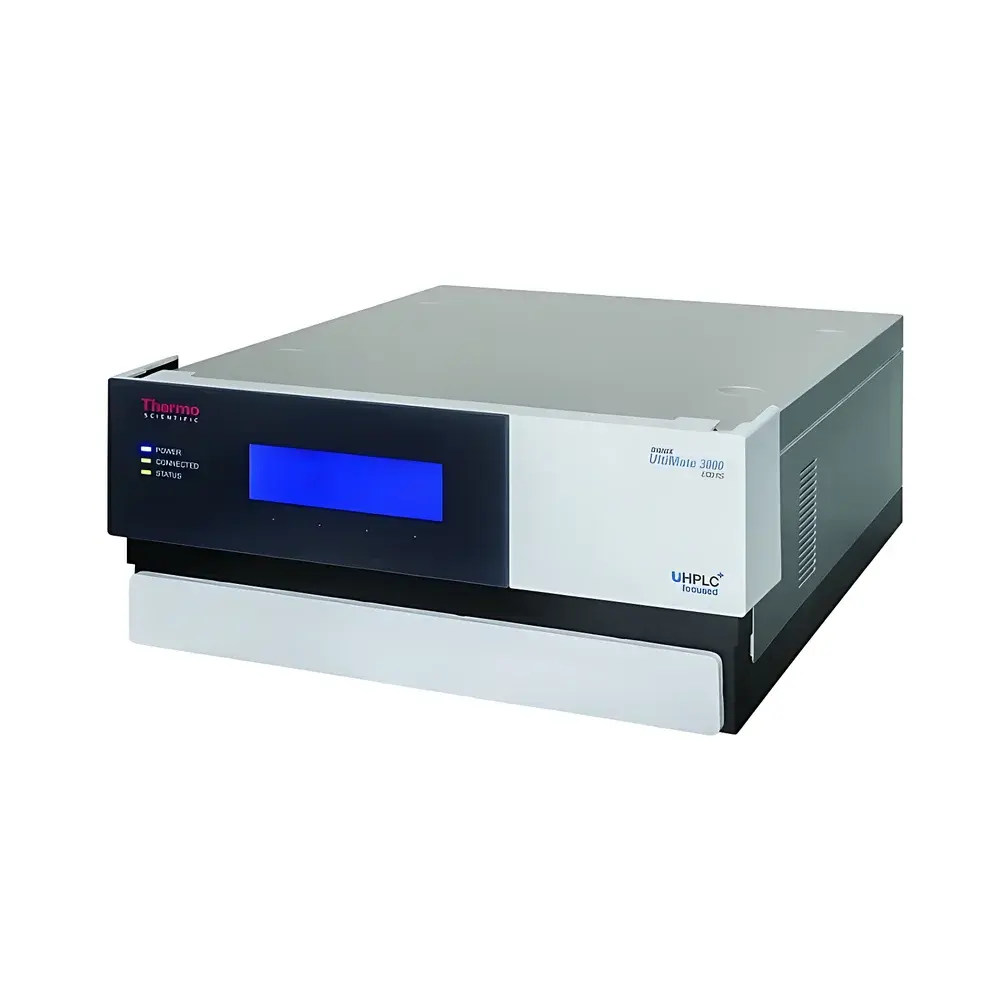
Thermo Fisher UltiMate® 3000 ECD-3000RS Electrochemical Detector
| Brand | Thermo Fisher |
|---|---|
| Origin | USA |
| Manufacturer Type | Original Equipment Manufacturer (OEM) |
| Product Category | Imported Instrument |
| Model | UltiMate® 3000 ECD-3000RS |
| Detection Principle | Amperometric & Coulometric Electrochemical Detection |
| Instrument Type | Electrochemical Detector (ECD) |
Overview
The Thermo Fisher UltiMate® 3000 ECD-3000RS is a high-performance electrochemical detector engineered for integration with ultra-high-performance liquid chromatography (UHPLC) and high-performance liquid chromatography (HPLC) systems. It operates on well-established electrochemical detection principles—primarily amperometry and coulometry—enabling selective, label-free quantification of redox-active analytes. Unlike optical or mass-based detection methods, electrochemical detection responds only to species capable of undergoing oxidation or reduction at controlled electrode potentials, thereby delivering exceptional selectivity in complex biological and environmental matrices. The detector is designed to meet the rigorous demands of modern analytical laboratories requiring sub-femtogram sensitivity, minimal sample consumption (as low as 1–5 µL), and robust interference rejection—particularly critical in neurochemical, clinical, pharmaceutical, and natural product research.
Key Features
- SmartChip® sensor technology: Embedded microcontroller enables automatic sensor identification, electrode material validation, operational potential range enforcement, and real-time diagnostic logging—supporting audit-ready GLP/GMP workflows.
- Dual-sensor architecture: Supports interchangeable amperometric (e.g., 6041RS) and coulometric (e.g., 6011RS) flow cells, each optimized for distinct application profiles—high-sensitivity trace analysis versus near-quantitative redox conversion.
- UHPLC-compatible fluidic design: Ultra-low internal dead volume (< 100 nL) and rapid data acquisition (up to 100 Hz) preserve chromatographic resolution across gradient elution methods, including fast and shallow gradients typical of modern UHPLC separations.
- Gradient-tolerant operation: Unique electronic compensation allows stable baseline performance under changing mobile phase composition—eliminating drift commonly observed in conventional ECDs during gradient runs.
- Auto-ranging capability: Simultaneous detection of analytes spanning five orders of magnitude in concentration without manual gain adjustment or signal saturation.
- Modular expandability: Configurable for multi-channel detection via independent sensor modules, enabling parallel monitoring of multiple redox events or orthogonal detection modes within a single chromatographic run.
Sample Compatibility & Compliance
The ECD-3000RS demonstrates broad compatibility with biological and chemical samples—including cerebrospinal fluid, plasma, urine, tissue homogenates, plant extracts, and environmental water matrices. Its selectivity minimizes matrix-derived background current, reducing the need for extensive sample cleanup. All sensors utilize solid-state reference electrodes (no liquid junctions), ensuring long-term stability and eliminating maintenance downtime. The system complies with key regulatory frameworks: data integrity features—including electronic signatures, audit trails, and method version control—are fully compatible with FDA 21 CFR Part 11 requirements when operated under Chromeleon™ CDS v7.3 or later. Sensor diagnostic logs and calibration records are exportable in PDF or CSV format for inclusion in GLP study reports per OECD Principles of Good Laboratory Practice.
Software & Data Management
Fully integrated with Thermo Fisher Chromeleon Chromatography Data System (CDS), the ECD-3000RS supports automated method deployment, real-time sensor health monitoring, and synchronized data acquisition across multiple detectors. SmartChip® metadata—including sensor serial number, installed electrode material, calibration history, and cumulative operating hours—is automatically ingested into Chromeleon’s instrument database. Raw current vs. time chromatograms are stored in open-format .cdf files, enabling third-party processing and statistical validation. Optional compliance packs provide enhanced security controls, role-based access management, and electronic record retention aligned with ISO/IEC 17025 and ICH M10 guidelines.
Applications
- Neurotransmitter profiling: Dopamine, serotonin, norepinephrine, and their metabolites in microdialysates and brain tissue extracts—with attomole-level detection limits.
- Clinical toxicology: Quantification of catecholamines, biogenic amines, and therapeutic drugs (e.g., levodopa, methyldopa) in serum and urine without derivatization.
- Pharmaceutical quality control: Stability-indicating assays for redox-labile APIs; impurity profiling of antioxidants and phenolic excipients.
- Natural product characterization: Selective detection of polyphenols, flavonoids, alkaloids, and quinones in herbal matrices where UV absorbance overlaps are problematic.
- Environmental analysis: Trace-level detection of nitroaromatics, hydrazines, and heavy metal chelates in wastewater and soil leachates.
FAQ
What electrochemical detection modes does the ECD-3000RS support?
Amperometric (DC and pulsed), coulometric (full-electrolysis), and integrated couloamperometric modes—all configurable via Chromeleon CDS.
Is the detector compatible with non-Thermo HPLC/UHPLC systems?
Yes—via analog voltage output (±1 V) and digital RS-232/USB interfaces; full bidirectional communication requires Thermo’s Active Flow Control (AFC) module.
How does SmartChip® technology support regulatory compliance?
It enforces sensor-specific operational parameters, logs all calibration and diagnostic events with timestamps and user IDs, and prevents unauthorized configuration changes—fulfilling ALCOA+ data integrity criteria.
Can the 6011RS coulometric cell be used for quantitative analysis?
Yes—the dual-electrode design achieves >99.5% electrolytic conversion efficiency across flow rates from 0.05 to 3.0 mL/min, enabling absolute quantitation without external calibration curves in selected applications.
What electrode materials are available for the 6041RS amperometric sensor?
Standard options include glassy carbon, gold, platinum, and boron-doped diamond (BDD); custom electrode configurations are available upon request for specialized redox windows.





