
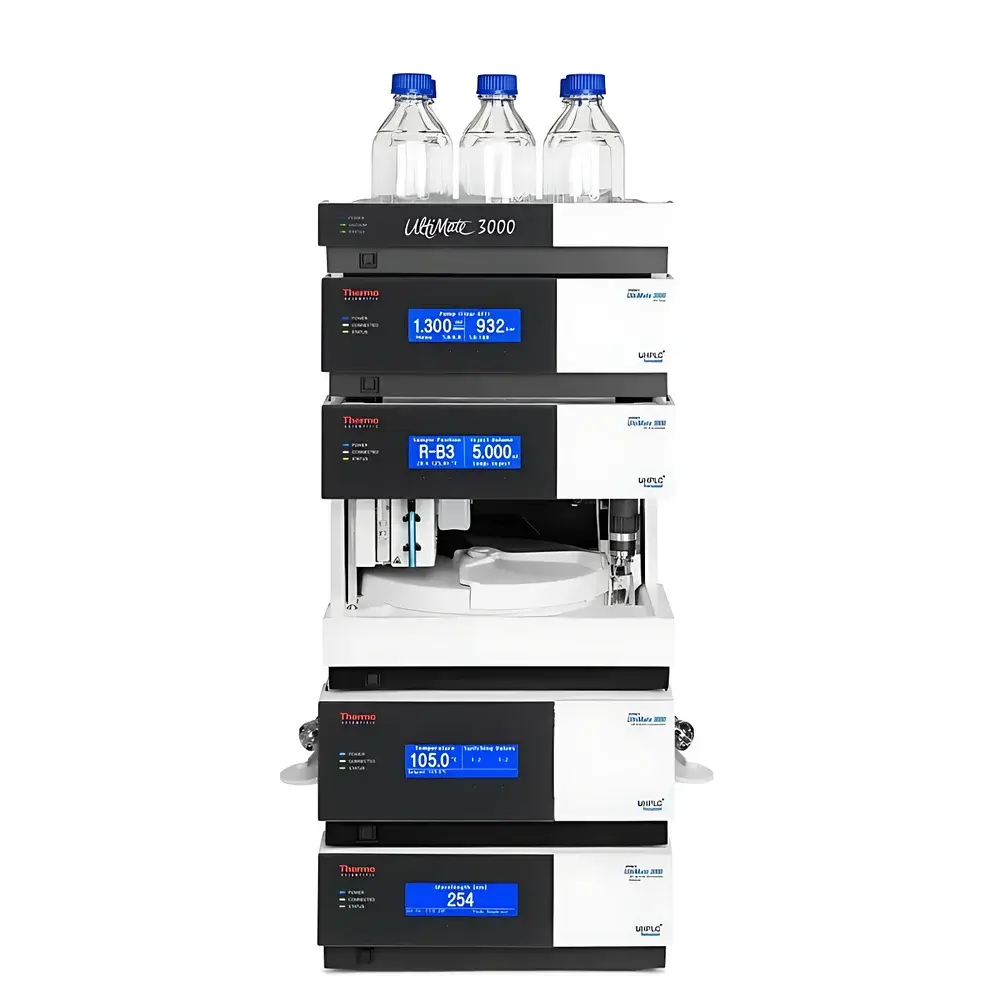
Thermo Fisher UltiMate 3000 Rapid Separation Dual LC System
| Brand | Thermo Fisher |
|---|---|
| Origin | USA |
| Manufacturer Type | Original Equipment Manufacturer (OEM) |
| Origin Category | Imported |
| Model | U3000 Rapid Separation Dual System |
| Price Range | USD $65,000 – $130,000 |
| Instrument Type | Ultra-High-Performance Liquid Chromatograph (UHPLC) with Dual Parallel/Serial Flow Paths |
Overview
The Thermo Fisher UltiMate 3000 Rapid Separation Dual LC System is a high-performance, dual-gradient liquid chromatography platform engineered for method flexibility, analytical robustness, and operational efficiency in modern analytical laboratories. Built upon the foundational architecture of Thermo Scientific’s UltiMate 3000 UHPLC platform, this system integrates two fully independent, high-pressure ternary gradient pumps—each capable of delivering flow rates up to 8 mL/min and operating at pressures up to 100 MPa (15,000 psi)—within a single chassis. Its core design enables true parallel or serial chromatographic separation pathways, supporting advanced workflows such as online solid-phase extraction (SPE), comprehensive 2D-LC (LC×LC), tandem column configurations, back-flush gradient delivery, and rapid method switching—all without hardware reconfiguration. Unlike conventional single-channel systems, the dual-flow architecture allows simultaneous analysis of identical or distinct samples across separate columns and detectors, significantly increasing throughput while preserving method integrity. The system is fully compatible with sub-2 µm particle-packed columns up to 250 mm in length, delivering enhanced peak capacity, improved resolution, lower detection limits, and extended column lifetime through precise flow and temperature control.
Key Features
- Two integrated, independently programmable ternary gradient UHPLC pumps (DGP-3600RS), each with built-in 6-channel degassing (SRD-3600)
- Pressure rating up to 100 MPa (15,000 psi), enabling full utilization of sub-2 µm stationary phases and long-column UHPLC methods
- Shared thermostatted column compartment (TCC-3000RS) with temperature control from 5 °C to 110 °C, ensuring retention time stability and method reproducibility
- Ultra-low carryover autosampler (WPS-3000TRS/WPS-3000RS) featuring flow-through needle and quantitative loop design—residual contamination < 0.005% (v/v)
- Dionex Viper fingertight fitting system for near-zero dead volume connections and consistent peak shape across extended run times
- Dionex SmartFlow technology for real-time flow rate monitoring and active pressure-compensated flow correction, delivering ±0.1% RSD flow precision
- Dionex SpinFlow technology for dynamically adjustable gradient delay volume optimization, improving solvent mixing homogeneity and gradient reproducibility
- Modular valve architecture supporting up to two field-upgradable column switching valves (e.g., for online SPE, heart-cutting 2D-LC, or column regeneration)
Sample Compatibility & Compliance
The UltiMate 3000 Rapid Separation Dual LC System is designed for broad sample compatibility across pharmaceutical, biopharmaceutical, environmental, food safety, and clinical research applications. It supports aqueous, organic, and mixed-solvent mobile phases—including aggressive solvents like trifluoroacetic acid (TFA) and formic acid—and accommodates both volatile and non-volatile buffers required for LC–MS coupling. The system meets key regulatory compliance requirements for GLP and GMP environments: it operates under full audit trail functionality within Chromeleon CDS v7.x, supports 21 CFR Part 11-compliant electronic signatures, user access controls, and instrument qualification protocols (IQ/OQ/PQ). All hardware modules are CE-marked and conform to IEC 61010-1 safety standards. Column switching configurations comply with ASTM D7976 (petroleum hydrocarbon analysis) and USP (chromatography) guidelines when deployed in validated workflows.
Software & Data Management
Control, acquisition, processing, and reporting are unified through Thermo Scientific Dionex Chromeleon Chromatography Data System (CDS) versions 6.x and 7.x. Chromeleon 7.2 provides native support for eWorkflows—enabling standardized, template-driven method development, sequence setup, and report generation. The software includes automated system initialization, standby mode scheduling, and shutdown routines to minimize downtime and ensure consistent baseline conditions. Integrated service and validation monitoring tools allow real-time tracking of pump performance, detector lamp usage, column pressure history, and valve actuation cycles—facilitating proactive maintenance and compliance documentation. Remote data processing and instrument control are supported via secure LAN/WAN deployment. All raw data files adhere to AIA/ANDI format standards, ensuring interoperability with third-party chemometric and statistical analysis platforms.
Applications
- High-throughput method development and transfer between conventional HPLC and UHPLC platforms
- Online SPE–LC–MS for trace-level bioanalysis (e.g., plasma drug quantification)
- Comprehensive two-dimensional liquid chromatography (LC×LC) for proteomics and complex natural product profiling
- Parallel method verification—running identical samples on different column chemistries or gradients simultaneously
- Back-flush gradient delivery to ESI or CAD detectors, eliminating gradient-induced ion suppression and improving quantitative accuracy
- Automated fraction collection (AFC-3000) coupled with dual detection (e.g., UV + MS) for preparative scouting and purity assessment
- Stability-indicating assays requiring orthogonal column/detector combinations per ICH Q5C and Q2(R2)
FAQ
Can the dual-system operate as a single-channel UHPLC when needed?
Yes—the system defaults to a standard single-flow-path configuration and can be reconfigured to dual operation via software-defined method parameters without hardware modification.
Is Chromeleon CDS validation support included out-of-the-box?
Chromeleon 7.x includes pre-validated IQ/OQ protocols and 21 CFR Part 11 compliance features; site-specific PQ must be performed by the end user per internal SOPs.
What detector types are natively supported?
All Thermo Scientific detectors—including Vanquish Diode Array (DAD), Fluorescence (FLR), Charged Aerosol (CAD), Refractive Index (RID), and all Thermo Orbitrap, TSQ, and ISQ mass spectrometers—are fully integrated via native drivers.
Does the system support column switching for heart-cutting 2D-LC?
Yes—up to two TCC-3000RS-integrated switching valves with selectable rotor configurations (6-, 10-, or 14-port) enable precise heart-cutting, trap-elute, or comprehensive modulation setups.
What is the maximum allowable gradient delay volume for accurate low-flow UHPLC methods?
Using SpinFlow technology, the effective gradient delay volume is tunable down to ≤100 µL, minimizing band broadening during fast gradient elution at flow rates as low as 50 µL/min.






