
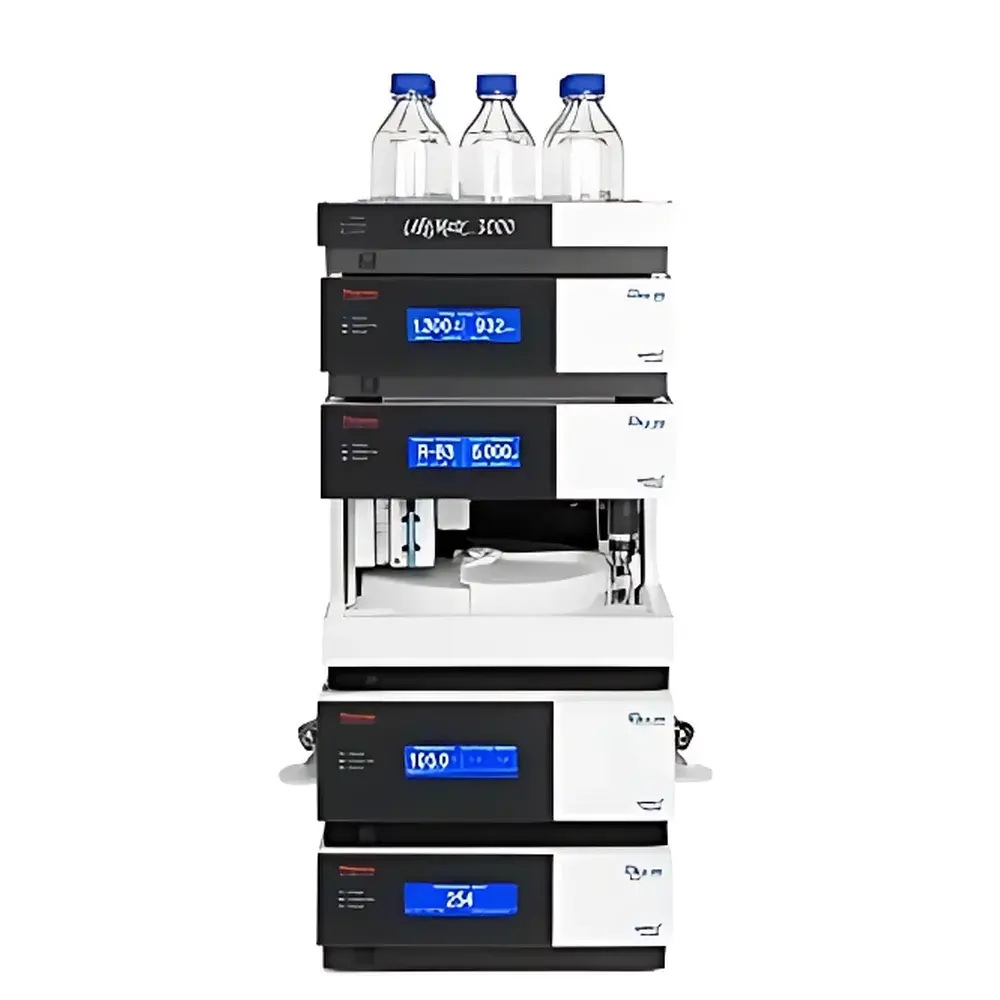
Thermo Fisher UltiMate 3000 Rapid Separation Quaternary LC System
| Brand | Thermo Fisher |
|---|---|
| Origin | USA |
| Manufacturer Type | Original Equipment Manufacturer (OEM) |
| Origin Category | Imported |
| Model | U3000 Rapid Separation Quaternary System |
| Instrument Type | Rapid Liquid Chromatograph |
| Maximum Flow Rate | 8 mL/min |
| Maximum Backpressure | 100 MPa (15000 psi / 1000 bar) |
| Column Temperature Range | 5–110 °C |
| Gradient Delay Volume | Adjustable via SpinFlow™ Technology |
| Autosampler Carryover | < 0.001% |
| Detector Compatibility | UV-Vis (DAD, MWD, VWD), FLR, CAD, RID, MS |
Overview
The Thermo Fisher UltiMate 3000 Rapid Separation Quaternary LC System is a high-performance liquid chromatography platform engineered for laboratories requiring method continuity, gradient flexibility, and robust separation scalability—without compromising on resolution or reproducibility. Built upon the proven quaternary low-pressure mixing architecture, this system delivers precise, stable gradient formation across four independent solvent channels, enabling seamless transfer of legacy 3–5 µm particle methods while supporting modern sub-2 µm UHPLC columns up to 100 MPa. Its design bridges the operational gap between conventional HPLC and ultra-high-performance LC: it maintains compatibility with standard 2–10 mm i.d. columns—including analytical, narrow-bore, and small-scale semi-preparative configurations—while delivering rapid separations through optimized dwell volume management, SmartFlow™ flow control, and thermally stabilized fluidic pathways. The system’s pressure rating, temperature-controlled column compartment (5–110 °C), and integrated pre-heater/post-cooler allow precise retention time control and backpressure mitigation across diverse mobile phase compositions and column chemistries.
Key Features
- Rapid Separation Architecture: Supports flow rates up to 8 mL/min and backpressures up to 100 MPa, enabling fast elution without sacrificing peak capacity or resolution.
- Quaternary Low-Pressure Gradient Mixing (LPG-3400RS): Integrated four-channel degasser ensures consistent solvent delivery; SpinFlow™ technology allows real-time adjustment of gradient delay volume to optimize mixing efficiency and method transfer fidelity.
- Thermally Controlled Fluidic Pathway: Column oven (TCC-3000RS) with dual field-upgradeable column switching valves; includes flow-through pre-heater and post-column cooler to minimize thermal band broadening and improve retention time stability.
- Ultra-Low Carryover Autosampler (WPS-3000TSL/WPS-3000SL): Fixed-loop and needle-in-loop design keeps injection components permanently in the flow path, achieving <0.001% carryover—critical for trace-level quantitation and regulated QC environments.
- Viper™ Fingertight Fitting System: Zero-dead-volume connections reduce extra-column band broadening and deliver superior peak shape, especially for narrow-bore and microbore applications.
- SmartFlow™ Precision Pumping: Real-time flow monitoring and active feedback control ensure ±0.1% flow accuracy and <0.05% RSD, delivering highly reproducible retention times and peak integration across long sequences.
Sample Compatibility & Compliance
The UltiMate 3000 Rapid Separation Quaternary System accommodates a broad range of sample matrices and column formats—from small-molecule pharmaceuticals and natural product extracts to synthetic polymers and biomolecules. It supports column internal diameters from 2.1 mm to 21.2 mm and particle sizes spanning 1.7 µm (UHPLC) to 10 µm (conventional HPLC). The system is designed and validated to meet key regulatory requirements including FDA 21 CFR Part 11 (with Chromeleon CDS 7.x audit trail, electronic signatures, and role-based access control), ISO/IEC 17025 method validation workflows, and USP chromatographic system suitability criteria. All hardware modules undergo factory calibration traceable to NIST standards, and system suitability testing (SST) protocols are fully scriptable within Chromeleon.
Software & Data Management
Controlled exclusively via Thermo Scientific™ Dionex™ Chromeleon™ Chromatography Data System (CDS) versions 6.x and 7.x, the system supports full lifecycle data integrity—from method development and instrument qualification (IQ/OQ/PQ) to routine operation and reporting. Chromeleon 7.2 provides automated system startup, standby, and shutdown sequences; integrated service monitoring with predictive maintenance alerts; and eWorkflow™ templates for standardized SOP execution. Remote operation, multi-user network deployment, and secure cloud-enabled data backup are natively supported. Audit trails are immutable, timestamped, and compliant with ALCOA+ principles. Advanced reporting modules support customizable PDF/Excel export, statistical process control (SPC) charts, and electronic batch records (EBR) integration for GMP environments.
Applications
- Method transfer and revalidation of legacy HPLC assays into higher-throughput, higher-resolution workflows
- High-throughput quality control in pharmaceutical manufacturing (API release testing, stability studies)
- Multi-analyte screening in academic and industrial metabolomics and environmental analysis
- Robust LC-MS coupling for demanding proteomics and small-molecule quantitation workflows
- Method development labs requiring flexible gradient programming, solvent scouting, and extended column cleaning protocols
- Semi-preparative purification support with compatible fraction collectors (AFC-3000) and high-flow-capable detectors
FAQ
Can this system run both conventional HPLC and UHPLC methods?
Yes—the UltiMate 3000 Rapid Separation Quaternary System is explicitly designed for method continuity. It supports particle sizes from 1.7 µm to 10 µm and column backpressures up to 100 MPa, enabling direct transfer of 3–5 µm methods while accommodating sub-2 µm columns for enhanced resolution.
Is gradient delay volume adjustable?
Yes—SpinFlow™ technology enables user-defined optimization of gradient delay volume to match column dimensions and detector response time, improving method robustness during system-to-system transfers.
What level of regulatory compliance does Chromeleon CDS provide?
Chromeleon 7.x supports full 21 CFR Part 11 compliance, including electronic signatures, audit trail review, user access controls, and data integrity safeguards aligned with Annex 11 and ALCOA+ guidelines.
Does the autosampler support cold storage for labile samples?
The WPS-3000TSL variant includes Peltier-based temperature control (4–45 °C), suitable for thermally sensitive compounds; the WPS-3000SL operates at ambient temperature with optional cooling accessories.
How is system suitability verified?
Chromeleon includes built-in SST wizards that calculate tailing factor, theoretical plates, resolution, and %RSD per USP/EP/JP monographs, with pass/fail thresholds configurable per method and subject to electronic sign-off.
Related Products





