
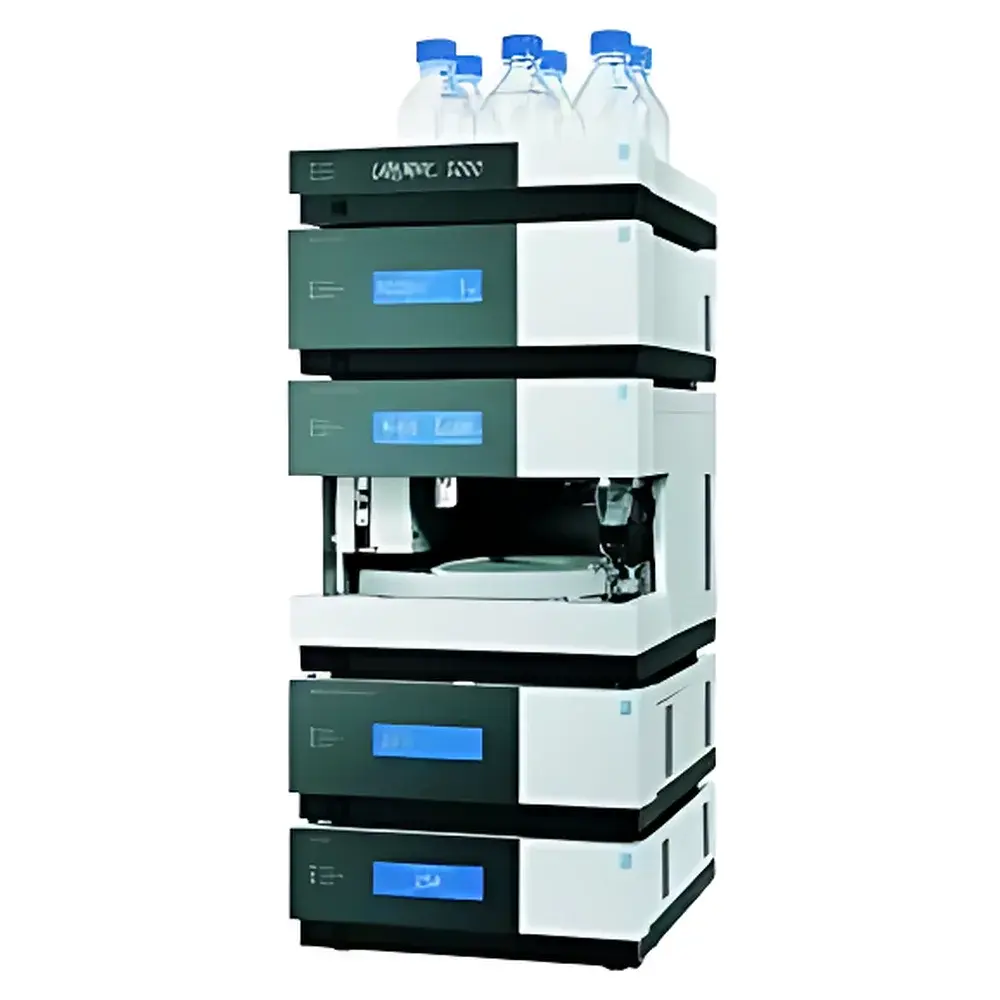
Thermo Fisher UltiMate 3000 RSLC Ultra-High-Performance Liquid Chromatograph
| Brand | Thermo Fisher |
|---|---|
| Origin | Netherlands |
| Manufacturer Type | Original Equipment Manufacturer (OEM) |
| Product Origin | Imported |
| Model | UltiMate 3000 RSLC |
| Instrument Category | Rapid Separation Liquid Chromatography (RSLC) |
| Maximum Pressure | 1034 bar (15,000 psi) |
| Maximum Flow Rate | 8 mL/min |
| System Configurations | Binary, Quaternary, or Dual Triple-Quaternary Pump Options |
| Column Particle Size Compatibility | Down to 1.7 µm |
| Software Platform | Chromeleon CDS (Chromatography Data System) with Method Transfer & Development Tools |
| Fitting Technology | Viper™ fingertight fittings |
| Separation Speed Gain vs. Conventional HPLC | Up to 50× |
Overview
The Thermo Fisher UltiMate® 3000 RSLC (Rapid Separation Liquid Chromatograph) is an engineered ultra-high-performance liquid chromatography platform designed for laboratories requiring maximum resolution, speed, and method robustness under high-pressure conditions. Based on the fundamental principles of reversed-phase, hydrophilic interaction (HILIC), ion-exchange, and size-exclusion chromatography, the RSLC system leverages sub-2-µm particle-packed columns—typically 1.7–1.9 µm—to achieve superior peak capacity and kinetic efficiency. Its hydraulic architecture supports pressures up to 1034 bar (15,000 psi), enabling rapid gradient elution, narrow peak widths, and enhanced mass sensitivity without compromising retention time reproducibility. Unlike conventional HPLC systems limited by dwell volume and pressure constraints, the UltiMate 3000 RSLC integrates low-dispersion fluidics, minimized system volume (<10 µL from injector to detector cell), and active solvent preheating to ensure thermodynamic consistency across runs—critical for method transfer between labs and platforms.
Key Features
- Modular pump configurations: Binary, quaternary, or dual triple-quaternary options support both UHPLC and legacy HPLC methods—enabling seamless method migration and scalability from research to QC environments.
- High-pressure stability: Precision-machined ceramic plungers, sapphire check valves, and real-time pressure monitoring deliver consistent flow accuracy (±0.1% RSD) at 8 mL/min and 1034 bar—validated per ISO 11607 and ASTM D7479 protocols.
- Viper™ fingertight fitting system: Eliminates torque-dependent leaks and column connection variability; certified for repeated use up to 1000 cycles at 1034 bar without degradation in seal integrity.
- Low-volume autosampler with needle seat wash and active cooling (4–40 °C): Achieves <0.005% carryover and injection precision ≤0.25% RSD (n=6) for trace-level quantitation.
- Column compartment with dual-zone temperature control (5–90 °C, ±0.1 °C stability): Supports orthogonal method development and retention time locking across diverse stationary phases.
- Integrated degasser with membrane-based vacuum technology: Maintains <5 ppm dissolved oxygen across all solvents, minimizing baseline drift and oxidation-sensitive analyte degradation.
Sample Compatibility & Compliance
The UltiMate 3000 RSLC accommodates a broad range of sample matrices—including biological fluids (plasma, urine), environmental extracts (PAHs, pesticides), pharmaceutical formulations (APIs, excipients), and polymer leachables—when paired with appropriate column chemistries (C18, HILIC, SEC, etc.). It complies with regulatory requirements for GxP environments: full audit trail capability, electronic signature support, and 21 CFR Part 11–compliant user access controls are embedded in Chromeleon CDS v7.3 and later. System suitability testing (SST) templates align with USP , EP 2.2.46, and ICH Q2(R2) guidelines. All hardware components meet CE, UL 61010-1, and RoHS directives. Factory calibration certificates include traceable pressure, flow, and temperature verification against NIST-traceable standards.
Software & Data Management
Chromeleon Chromatography Data System (CDS) serves as the unified software environment for instrument control, data acquisition, processing, reporting, and long-term archiving. Its RSLC-specific modules include Method Transfer Assistant (MTA), which calculates gradient delay compensation and dwell volume correction when porting methods from HPLC to UHPLC platforms; and Peak Capacity Optimizer, which recommends optimal gradient slope, temperature, and flow rate based on column dimensions and particle size. Raw data is stored in open-format .cdf files compliant with ASTM E1947 and ISO/IEC 17025 metadata requirements. Role-based permissions, automated backup to network drives or cloud repositories (AWS S3, Azure Blob), and integration with LIMS via HL7 or RESTful API ensure secure, auditable, and scalable data governance.
Applications
- Pharmaceutical QC/QA: Release testing of small molecules and biologics per ICH Q5, Q6, and Q7; forced degradation studies; impurity profiling with LODs <0.05% relative to main peak.
- Clinical research: Targeted metabolomics (acylcarnitines, bile acids) and therapeutic drug monitoring using tandem LC-MS/MS workflows.
- Environmental analysis: Multi-residue pesticide screening in water and soil per EPA Methods 531.1, 8081B, and EN 15662.
- Food safety: Mycotoxin quantification (aflatoxins, ochratoxin A) and adulterant detection (melamine, Sudan dyes) in compliance with EU Commission Regulation (EC) No 401/2006.
- Academic proteomics: Peptide mapping of monoclonal antibodies and top-down characterization of intact proteins using wide-pore C4 columns.
FAQ
What distinguishes RSLC from standard UHPLC systems?
RSLC refers specifically to Thermo Fisher’s implementation of ultra-high-pressure LC optimized for rapid method development and transfer—not merely higher pressure. It includes proprietary hardware synchronization (e.g., real-time pump/detector clock alignment), reduced dwell volume (<150 µL), and integrated method conversion tools absent in generic UHPLC platforms.
Can I run conventional 5-µm HPLC columns on the UltiMate 3000 RSLC?
Yes—the system’s pressure-limiting firmware and adjustable flow/pressure profiles allow safe operation with 3–5 µm columns at ≤400 bar, preserving column lifetime while maintaining compatibility with legacy methods.
Is Chromeleon CDS validated for 21 CFR Part 11 compliance?
Yes. Chromeleon v7.3+ includes configurable electronic signatures, immutable audit trails, and system validation packages (IQ/OQ/PQ documentation) aligned with FDA and EMA expectations for regulated laboratories.
How does the Viper™ fitting system improve method robustness?
By eliminating torque variability and thread wear, Viper™ ensures consistent connection geometry and dead-volume control—reducing retention time shifts <0.02 min across 500 injections and improving inter-laboratory reproducibility.
What column oven temperature uniformity is achievable?
The dual-zone oven maintains ±0.1 °C spatial uniformity across 60 cm of column length, verified per ASTM E2576, critical for retention time locking in multi-column switching applications.





