
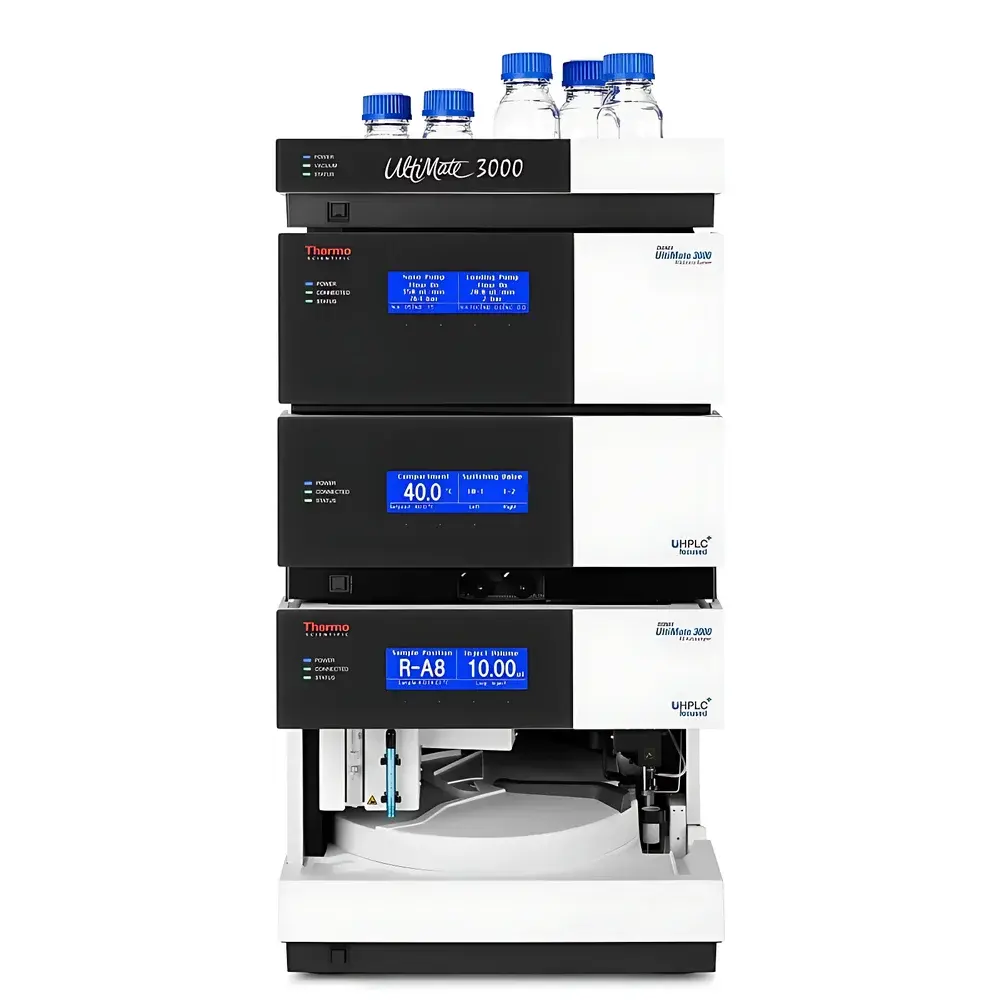
Thermo Fisher UltiMate 3000 RSLCo Nano-Liquid Chromatograph
| Brand | Thermo Fisher |
|---|---|
| Origin | USA |
| Manufacturer Type | Original Equipment Manufacturer (OEM) |
| Import Status | Imported |
| Model | UltiMate 3000 RSLCo |
| Instrument Type | Nano-LC System |
| Flow Range | 50 nL/min – 50 µL/min (nano to capillary/micro) |
| Auxiliary Microflow Pump | up to 2500 µL/min |
| Maximum Pressure | 860 bar |
| Technology | ProFlow™ Nanoflow Control, oViper™ Hand-Tight Fitting, Dual Gradient Architecture (High-Pressure Binary + Microflow Ternary) |
Overview
The Thermo Fisher UltiMate 3000 RSLCo Nano-Liquid Chromatograph is a high-performance, dual-gradient liquid chromatography system engineered for ultra-low-flow separations in proteomics, metabolomics, and other trace-level biomolecular analyses. It operates on the principle of reversed-phase liquid chromatography (RPLC) with precise nanoflow control enabled by Thermo Scientific’s proprietary ProFlow™ technology—a pressure-based flow regulation architecture that eliminates pulsation and delivers exceptional retention time reproducibility (<0.05% RSD over 100 injections) under nano- and capillary-scale conditions. The system integrates a high-pressure binary gradient pump (up to 860 bar) for analytical separation and an independent microflow ternary gradient pump for sample loading, trapping, desalting, and 2D-LC coupling—enabling uninterrupted solvent delivery during column switching and trap-elution workflows. Designed for compatibility with electrospray ionization (ESI) sources and nanospray emitters, it serves as a core front-end platform for bottom-up/top-down proteomics, single-cell analysis, and low-input omics applications where sensitivity, robustness, and method transferability are critical.
Key Features
- Dual-Gradient Architecture: Simultaneous operation of a high-pressure binary pump (for separation gradients) and a dedicated microflow ternary pump (for trapping, washing, and re-equilibration), ensuring continuous mobile phase delivery without flow interruption during valve actuation or column switching.
- ProFlow™ Nanoflow Control: Patented pressure-driven flow regulation delivering stable, pulse-free flow from 50 nL/min to 50 µL/min—optimized for retention time precision, peak shape integrity, and long-term method stability across nano-, capillary-, and microbore columns.
- oViper™ Hand-Tight Fittings: Zero-dead-volume, tool-free, reusable fittings with apex-sealing geometry; minimize extra-column dispersion and improve peak capacity and quantitative reproducibility—especially critical in sub-2-µm particle column applications.
- UHPLC-Capable Pressure Rating: 860 bar maximum operating pressure supports sub-2-µm fully porous and superficially porous particles, enabling high-resolution separations with short cycle times and enhanced peak capacity.
- Modular Workflow Expansion: Native support for 1D-nanoLC, 2D-LC (e.g., SCX-RPLC), direct injection, and trap-elute configurations via configurable valve manifolds and application-specific hardware kits (e.g., nanoViper™ Trap Column Kit, 2D-LC Interface Kit).
Sample Compatibility & Compliance
The UltiMate 3000 RSLCo accommodates a broad range of sample types—including complex peptide digests, intact proteins, polar metabolites, and post-translationally modified species—across input volumes from 1–100 µL and concentrations spanning low-femtomole to high-picomole levels. Its low-system-volume design (<100 nL from injector to column inlet) minimizes sample dilution and adsorption losses. The system complies with GLP/GMP-aligned data integrity requirements when operated with Chromeleon CDS v7.3+ under 21 CFR Part 11-compliant audit trail and electronic signature configuration. It supports ISO/IEC 17025 method validation protocols and is routinely deployed in laboratories adhering to ASTM E2947 (Standard Guide for LC Method Validation) and USP chromatographic system suitability criteria.
Software & Data Management
Control and data acquisition are managed through Thermo Scientific Chromeleon Chromatography Data System (CDS) v7.3 or later, featuring intuitive method setup wizards for nanoLC, trap-elute, and 2D-LC workflows. Seamless integration with Thermo Scientific SII (Scientific Instrument Integration) enables direct communication with Orbitrap, Q Exactive, and TSQ series mass spectrometers—including real-time MS trigger synchronization, dynamic exclusion coordination, and scheduled MRM transitions. All sequence methods, instrument logs, and raw data files are stored with full metadata tagging, version control, and automated backup to network drives or cloud repositories. Audit trails record user actions, parameter changes, and calibration events in tamper-evident format per FDA 21 CFR Part 11 requirements.
Applications
- Bottom-up and top-down proteomics: High-sensitivity identification and quantification of peptides/proteins from limited biological samples (e.g., laser-capture microdissected tissue, sorted cell populations).
- Single-cell and spatial omics: Coupled with nanoESI sources for sub-nanoliter injection volumes and femtomolar detection limits.
- Metabolite profiling: Separation of polar and non-polar small molecules using HILIC and RPLC modes with micro/nano-flow optimization.
- Post-translational modification (PTM) analysis: Enrichment-compatible workflows leveraging on-line desalting and fraction collection capabilities.
- Biopharmaceutical characterization: Intact mass analysis, peptide mapping, and glycan profiling under UHPLC-nano conditions.
FAQ
What is the minimum recommended injection volume for reliable nanoLC performance?
For optimal signal-to-noise and retention time stability, injection volumes between 1–5 µL are recommended when using trap-elute configurations; direct injection down to 100 nL is supported with appropriate autosampler precision and low-dead-volume tubing.
Can the RSLCo system be validated for regulated environments (e.g., pharmaceutical QC)?
Yes—when configured with Chromeleon CDS in 21 CFR Part 11 mode, IQ/OQ/PQ documentation packages, and calibrated flow/pressure sensors, the system meets GxP validation requirements for method development and release testing.
Is offline fraction collection supported?
Yes—the system supports timed or peak-triggered fraction collection via optional fraction collector modules compatible with standard 96-well plates and microvials.
How does ProFlow™ differ from conventional syringe-pump-based nanoflow systems?
ProFlow™ uses real-time pressure feedback and digital flow modeling to regulate flow without mechanical displacement components, eliminating wear, drift, and pulsation—resulting in superior long-term precision and reduced maintenance compared to positive-displacement nanoflow pumps.
What column formats are natively supported?
75 µm, 50 µm, and 30 µm ID fused-silica capillaries (packed in-house or pre-packed), as well as 1 mm and 2.1 mm ID microbore columns; all mounted via standardized nanoViper™ or standard stainless-steel fittings.
Related Products




