
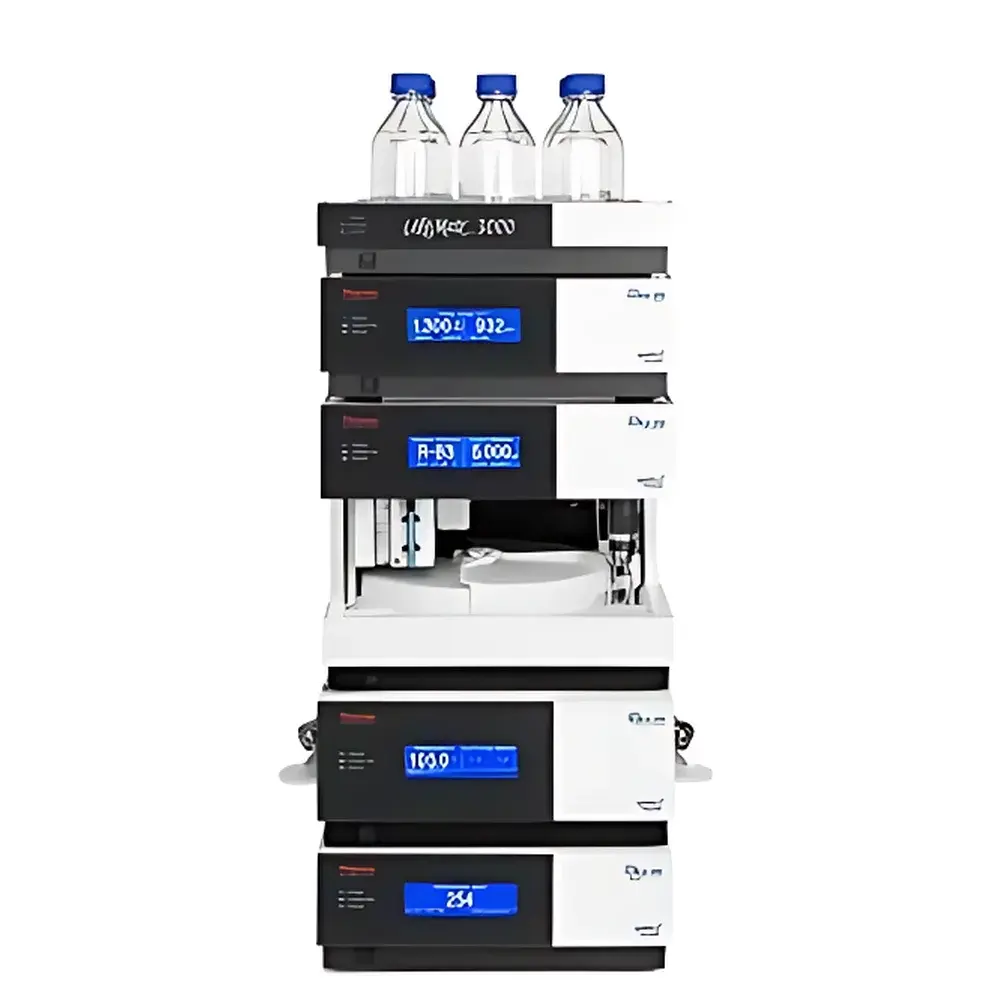
Thermo Fisher UltiMate 3000 Standard Binary UHPLC System
| Brand | Thermo Fisher |
|---|---|
| Origin | USA |
| Manufacturer Type | Original Equipment Manufacturer (OEM) |
| Origin Category | Imported |
| Model | U3000 Standard Binary System |
| Instrument Type | Ultra-High-Performance Liquid Chromatograph (UHPLC) |
| Maximum Flow Rate | 8 mL/min |
| Maximum Backpressure | 100 MPa (15,000 psi / 1000 bar) |
| Column Temperature Range | 5–110 °C |
| Gradient Delay Volume | Adjustable via SpinFlow™ Technology |
| Autosampler Carryover | < 0.001% |
| Detector Compatibility | UV-Vis (DAD, MWD, VWD), Fluorescence, CAD, RID, MS |
Overview
The Thermo Fisher UltiMate 3000 Standard Binary UHPLC System is an engineered solution for laboratories requiring seamless coexistence of legacy HPLC method compatibility and modern ultra-high-performance liquid chromatography capabilities. Built upon a robust dual-pump architecture, the system operates on the principle of high-pressure gradient elution with precise solvent mixing upstream of the column, enabling reproducible retention time control and enhanced peak capacity. Its design supports both conventional 3–5 µm particle-packed columns and sub-2 µm UHPLC columns, delivering resolution and speed improvements without compromising method transfer fidelity. The system’s rated pressure capability of 100 MPa (1000 bar) ensures compatibility with advanced stationary phases—including core-shell, wide-pore silica, and polymeric reversed-phase materials—while its thermally managed fluidic path (with pre-heater and post-column cooler) mitigates viscosity-induced backpressure fluctuations during elevated-temperature separations up to 110 °C.
Key Features
- Binary high-pressure gradient pump (HPG-3200RS or HPG-3400RS) with SmartFlow™ technology for ±0.1% flow accuracy and <0.05% RSD over 24 h, ensuring retention time stability critical for regulated environments.
- Viper™ fingertight fitting system delivering near-zero dead volume connections across all fluidic paths—minimizing band broadening and preserving chromatographic efficiency, especially in narrow-bore and capillary applications.
- Low-residue autosampler (WPS-3000RS or WPS-3000TRS) with permanently wetted sample loop and needle; carryover <0.001% enables trace-level quantitation in pharmacokinetic and impurity profiling workflows.
- Thermally stabilized column compartment (TCC-3000RS) supporting 5–110 °C operation with optional dual column-switching valves for online sample cleanup, heart-cutting, or multidimensional LC configurations.
- SpinFlow™ gradient delay volume optimization allows real-time adjustment of mixer dwell volume to match column dimensions and flow rates—critical for method scalability from analytical to preparative scale.
- Integrated degasser (SRD-3200 or SRD-3400) with 2- or 4-channel vacuum membrane configuration, reducing baseline noise and improving gradient reproducibility under low-flow conditions.
Sample Compatibility & Compliance
The UltiMate 3000 Standard Binary System accommodates a broad range of sample matrices—including biological fluids (plasma, urine), complex natural product extracts, synthetic intermediates, food digests, and polymer leachables—without requiring hardware modification. Its modular detector interface supports analog and digital outputs from industry-standard detectors: Thermo Scientific™ Dionex™ Corona CAD™, Vanquish™ DAD, Q Exactive™ MS systems, and third-party mass spectrometers via TTL synchronization. From a regulatory standpoint, the system meets key requirements for GLP and GMP environments when operated with Chromeleon CDS v7.x: full audit trail logging per FDA 21 CFR Part 11, electronic signature support, instrument qualification templates (IQ/OQ/PQ), and automated calibration verification reports. It also aligns with ISO/IEC 17025 documentation expectations for accredited testing laboratories performing pharmaceutical assay, dissolution, or stability-indicating methods.
Software & Data Management
Chromeleon Chromatography Data System (CDS) v6.x and v7.x serves as the unified software platform, providing end-to-end workflow control—from method development and acquisition through reporting and data archival. Version 7.2 introduces eWorkflow™ templates for standardized SOP execution across multiple instruments, reducing analyst training time and inter-lab variability. Remote monitoring and control are enabled via secure HTTPS-based client-server architecture, supporting both on-premise and hybrid cloud deployment models. All raw data files (.cdf, .raw) are stored in vendor-neutral formats compliant with ASTM E2524 and EU Annex 11 guidelines. System suitability tests (SST), peak integration parameters, and calibration curves are fully scriptable and version-controlled within the CDS database. Integrated service monitoring tracks lamp usage, seal wear, and pump pulse diagnostics—triggering preventive maintenance alerts before performance drift occurs.
Applications
- Pharmaceutical development: Forced degradation studies, chiral separation of enantiomeric impurities, and stability-indicating assays compliant with ICH Q2(R2).
- Academic proteomics and metabolomics: High-resolution peptide mapping, polar metabolite profiling using HILIC, and intact protein analysis with wide-pore BEH columns.
- Food and beverage safety: Mycotoxin screening (aflatoxins, ochratoxin A), pesticide multiresidue analysis (EN 15662), and authenticity verification via fingerprint chromatograms.
- Chemical synthesis QC: Reaction monitoring, purity assessment of fine chemicals, and polymer additive quantification using refractive index detection.
- Environmental analysis: PFAS quantification in water matrices using C18–HILIC mixed-mode columns and tandem MS detection.
FAQ
Can this system run both HPLC and UHPLC methods without hardware changes?
Yes—the binary pump architecture, adjustable gradient delay volume, and wide pressure/flow operating envelope allow direct method translation from 4.6 mm × 150 mm, 5 µm columns to 2.1 mm × 50 mm, 1.7 µm columns without reconfiguration.
Is Chromeleon CDS validation support included out-of-the-box?
Chromeleon 7.x includes preconfigured IQ/OQ protocols, Part 11-compliant user management, and electronic signature workflows—though site-specific PQ must be executed per local SOPs.
What is the minimum system dwell volume achievable with SpinFlow™ tuning?
Dwell volume can be reduced to ≤150 µL depending on flow rate and mixer configuration—enabling sharp gradient transitions required for fast LC-MS coupling.
Does the system support column switching for online SPE or 2D-LC?
Yes—the TCC-3000RS column compartment supports up to two field-upgradable switching valves, enabling comprehensive 2D-LC (LC×LC) or automated sample enrichment workflows.
How is carryover controlled in the autosampler during high-sensitivity bioanalysis?
The WPS-3000RS employs active needle wash with dual solvent ports and programmable rinse cycles, combined with inert flow-path materials (PEEKsil, titanium), achieving validated carryover <0.001% at 1 ng/mL levels.



