
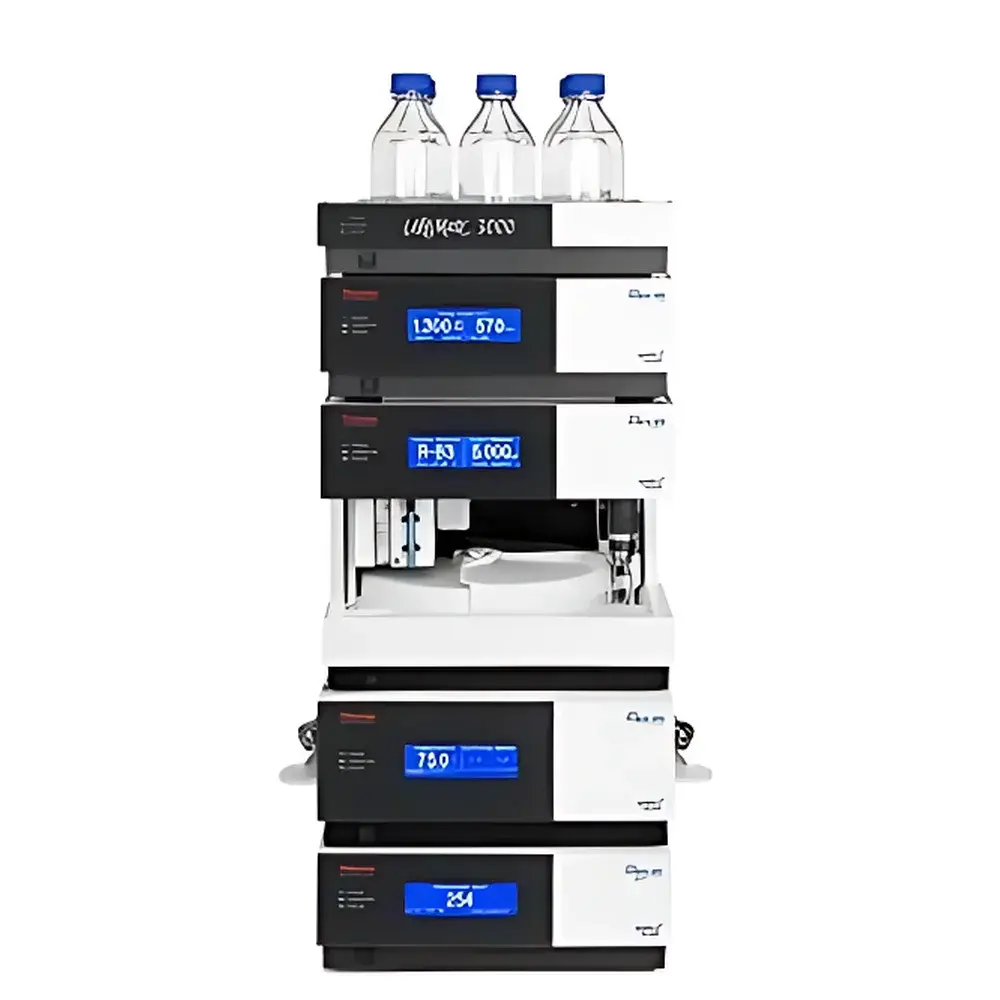
Thermo Fisher UltiMate 3000 Standard Quaternary LC System
| Brand | Thermo Fisher |
|---|---|
| Origin | USA |
| Manufacturer Type | Original Equipment Manufacturer (OEM) |
| Origin Category | Imported |
| Model | UltiMate 3000 Standard Quaternary System |
| Instrument Type | Ultra-High-Performance Liquid Chromatograph (UHPLC) |
| Maximum Backpressure | 62 MPa (9000 psi / 620 bar) |
| Flow Rate Range | Up to 10 mL/min |
| Solvent Channels | 4 integrated with degasser (LPG-3400SD) |
| System Delay Volume | Matched to UltiMate 3000 RS Quaternary System |
| Detector Compatibility | UV-Vis (DAD, MWD, VWD), Fluorescence, CAD, RID, MS |
| Autosampler Options | WPS-3000TSL (thermostatted) or WPS-3000SL (non-thermostatted) |
| Column Compartment | TCC-3000SD with dual field-upgradable column switching valves |
| Software Platform | Chromeleon CDS v6.x and v7.x (including eWorkflow™, audit trail, 21 CFR Part 11 compliance modules) |
Overview
The Thermo Fisher UltiMate 3000 Standard Quaternary LC System is a high-performance, modular ultra-high-performance liquid chromatograph engineered for laboratories requiring robust HPLC-to-UHPLC method compatibility without compromising on precision, reproducibility, or regulatory readiness. Built upon Thermo Scientific’s proven quaternary gradient architecture, the system employs low-dispersion, high-pressure fluidic design principles grounded in laminar flow dynamics and precise piston displacement control. It supports both conventional 3–5 µm particle-packed columns and sub-2 µm UHPLC columns, delivering consistent retention time stability, sharp peak resolution, and minimal band broadening across flow rates from 0.001 to 10 mL/min. Its rated pressure capability of 62 MPa (9000 psi) enables operation with narrow-bore and core-shell columns while maintaining gradient fidelity and low system dwell volume—critical for method transfer between instruments and multi-laboratory workflows.
Key Features
- Integrated four-channel solvent delivery with vacuum-membrane degassing (LPG-3400SD), minimizing bubble formation and baseline noise.
- Dionex SmartFlow technology ensures <±0.1% RSD flow accuracy across full operating range, directly contributing to retention time repeatability (<0.05 min RSD over 100 injections).
- Viper hand-tightened zero-dead-volume fittings eliminate ferrule-based variability and reduce extra-column dispersion—essential for sub-2 µm column performance.
- Ultra-low carryover autosampler (WPS-3000TSL/WPS-3000SL) features permanent in-line needle and loop design, achieving <0.005% cross-contamination (measured per USP guidelines).
- SpinFlow gradient mixing optimization allows real-time adjustment of delay volume to match column dimensions and mobile phase viscosity, improving gradient shape fidelity and method robustness.
- Thermostatted column compartment (TCC-3000SD) supports temperature control from 5 °C to 80 °C with optional dual column-switching valves for automated method scouting or heart-cutting 2D-LC configurations.
Sample Compatibility & Compliance
The UltiMate 3000 Standard Quaternary System accommodates diverse sample matrices—including small-molecule APIs, peptides, natural products, food additives, environmental contaminants, and cosmetic actives—without modification to core fluidic pathways. Its hardware and software stack are validated for GLP/GMP environments: Chromeleon CDS v7.2 includes full 21 CFR Part 11 compliance features (electronic signatures, role-based access control, immutable audit trails, and event logging). The system meets ISO/IEC 17025 requirements for analytical instrument qualification and supports IQ/OQ/PQ protocols. All detector interfaces—including UV-Vis diode array (DAD), fluorescence (FLD), charged aerosol (CAD), refractive index (RID), and mass spectrometry (via analog/digital or API-MS interfaces)—are CE-marked and comply with IEC 61000-6-3 EMC standards.
Software & Data Management
Chromeleon Chromatography Data System (CDS) v6.x and v7.x serves as the unified control, acquisition, processing, and reporting platform. Version 7.2 introduces eWorkflow™ templates for standardized SOP execution, automated calibration verification, and instrument self-diagnostics. System startup, standby, and shutdown sequences are programmable and logged with timestamps and operator IDs. Remote monitoring and control are supported via secure HTTPS endpoints, enabling centralized fleet management across distributed lab networks. Data integrity is enforced through AES-256 encryption at rest and TLS 1.2+ in transit; raw data files (.cdf, .raw) are immutable and retain full metadata including instrument configuration, sequence parameters, and environmental logs. Audit trail review functionality satisfies FDA inspection expectations for traceability and accountability.
Applications
This system is routinely deployed in pharmaceutical quality control laboratories for assay, dissolution, and stability-indicating assays per ICH Q2(R2) guidelines. In food and beverage testing, it supports multi-residue pesticide analysis (EN 15662), mycotoxin quantification (AOAC 2005.08), and vitamin profiling (AOAC 992.16). Environmental labs apply it to EPA Method 8330B (PAHs), 8082A (PCBs), and ASTM D7089 (dioxins/furans). Academic research groups leverage its modularity for method development in metabolomics (using sub-2 µm BEH C18 columns) and polymer characterization (SEC-MALS coupling). Its gradient flexibility—supporting linear, step, concave, convex, and custom-defined profiles—enables rapid method optimization for complex biological matrices.
FAQ
Can this system be upgraded to support mass spectrometry detection?
Yes—the UltiMate 3000 Standard Quaternary System features standard analog/digital output ports and optional API-MS interface kits compatible with Thermo Scientific Orbitrap, TSQ, and ISQ platforms.
Is method transfer from an UltiMate 3000 RS system straightforward?
Yes—identical system delay volume, gradient mixer design, and pump timing algorithms ensure direct method portability with minimal re-optimization.
Does Chromeleon 7.2 support electronic lab notebook (ELN) integration?
Yes—via RESTful API and vendor-agnostic LIMS/ELN connectors compliant with ASTM E1578 and ISO/IEC 11179 metadata standards.
What is the minimum injection volume achievable with the WPS-3000TSL autosampler?
The system supports precise 0.1 µL partial-loop injections with <1% RSD volume precision when using appropriate syringe and loop configurations.
Can the column compartment accommodate multiple column types simultaneously?
Yes—the TCC-3000SD supports up to two independently controlled column switching valves, enabling automated column selection, backflushing, or parallel column screening within a single run sequence.
Related Products





