
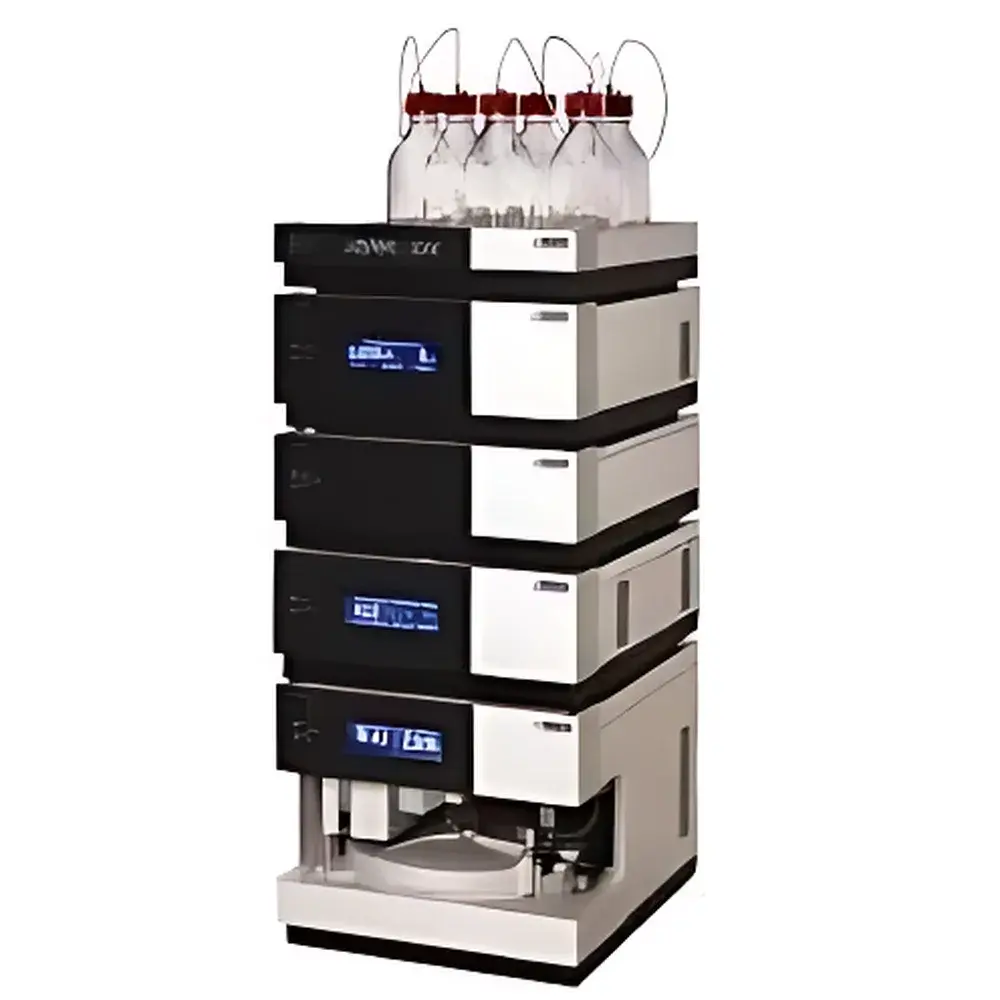
Thermo Fisher Ultimate NanoLC / Capillary Liquid Chromatograph
| Brand | Thermo Fisher |
|---|---|
| Model | Ultimate |
| Type | Nano-LC / Capillary LC System |
| Flow Range | 50 nL/min – 10 µL/min |
| Column Compatibility | 50–360 µm ID capillary & nano columns |
| Detection Interface | ESI-MS, nano-ESI source compatible |
| Regulatory Compliance | GLP-ready architecture, 21 CFR Part 11–ready software options |
| Pump Technology | Dual high-precision micro-piston pumps with active solvent compressibility compensation |
| Injector | FAMOS autosampler with <100 nL injection precision |
| UV Detection | Scanning diode array detector (DAD), optional nano-flow UV cell (Z- or U-path, 10–50 nL volume) |
| Temperature Control | Optional thermostatted column compartment (4–80 °C) |
| Software Platform | Chromeleon CDS (Chromatography Data System), supporting audit trail, electronic signatures, and method validation workflows |
Overview
The Thermo Fisher Ultimate NanoLC / Capillary Liquid Chromatograph is a purpose-engineered chromatographic platform designed for ultra-low-flow separations in conjunction with mass spectrometry (LC-MS and LC-MS/MS). Operating across nanoflow (50–500 nL/min) and capillary flow (0.5–10 µL/min) regimes, it leverages microfluidic precision engineering to deliver robust, reproducible separations of complex biological matrices—particularly peptides, metabolites, post-translational modifications, and low-abundance biomarkers. Unlike conventional HPLC systems, the Ultimate employs dual independent micro-piston pumping technology with real-time solvent compressibility correction, enabling stable gradient formation at sub-microliter per minute flow rates without pulse dampening or backpressure instability. Its integrated design eliminates dead volume through inert, passivated stainless steel and PEEK-silicone fluidic pathways—critical for minimizing analyte adsorption, carryover, and oxidation of labile species such as phosphopeptides or disulfide-bonded proteins.
Key Features
- Dual high-accuracy micro-piston pumps with active solvent compressibility compensation for sub-100 nL/min flow stability and <0.1% RSD gradient precision
- FAMOS autosampler featuring <100 nL injection repeatability, low-volume needle wash, and integrated sample cooling (4–10 °C)
- GLP-compliant hardware architecture—including non-volatile memory logging, hardware timestamping, and configurable lockout protocols
- Modular column compartment with optional Peltier-based temperature control (4–80 °C, ±0.1 °C stability) for retention time reproducibility
- Inert fluidic path (siliconized stainless steel, PEEKsil tubing, zero-metal contact zones) validated for sensitive proteomics and glycomics applications
- Scanning diode array detector (DAD) with selectable nano-capillary flow cells (U- or Z-path, 10–50 nL volume) for orthogonal UV confirmation alongside MS detection
Sample Compatibility & Compliance
The Ultimate NanoLC system supports direct coupling to electrospray ionization (ESI) sources—including nano-ESI emitters (2–10 µm tip ID), sheathless interfaces, and commercial nanospray stages—without flow splitting or post-column dilution. It accommodates columns ranging from 50 µm to 360 µm inner diameter, including packed fused-silica capillaries, monolithic silica, and porous graphitic carbon phases. All wetted components are certified for compatibility with aqueous/organic mobile phases containing up to 0.1% formic acid, 0.1% TFA, or ammonium acetate/bicarbonate buffers—ensuring stability across bottom-up proteomics, targeted metabolomics, and biopharmaceutical characterization workflows. From a regulatory standpoint, the system meets core requirements for GLP and GMP environments: hardware event logs are time-stamped and tamper-evident; Chromeleon CDS supports 21 CFR Part 11 compliance via role-based access control, electronic signatures, and full audit trail generation for all acquisition, processing, and reporting events.
Software & Data Management
Control and data acquisition are managed through Thermo Fisher’s Chromeleon Chromatography Data System (CDS) v7.3 or later—validated for regulated laboratories. The software provides method development tools for gradient optimization at nano-flow rates, automated peak integration using adaptive baseline algorithms, and seamless export of processed chromatograms and peak tables to third-party proteomics platforms (e.g., Proteome Discoverer, MaxQuant, Skyline). Raw data files are stored in open-format .RAW containers compliant with mzML standards. Audit trail functionality records every user action—including method edits, sequence changes, and report generation—with immutable timestamps and operator identification. Validation packages—including IQ/OQ/PQ documentation templates—are available upon request for pharmaceutical QC labs operating under FDA or EMA guidelines.
Applications
- Bottom-up and top-down proteomics: single-shot identification of >5,000 proteins from sub-microgram tissue digests
- Pharmacokinetic and metabolite profiling: direct analysis of plasma, CSF, and microdialysate samples with minimal sample preparation
- Post-translational modification (PTM) mapping: enrichment-compatible workflows for phosphorylation, acetylation, ubiquitination, and glycosylation site localization
- Biopharmaceutical characterization: intact mAb analysis, subunit mapping, and charge variant profiling using capillary-RPLC
- High-throughput screening (HTS) support: automated online sample cleanup (solid-phase extraction, immunoaffinity capture) integrated into the LC cycle
FAQ
What column dimensions and chemistries are supported?
The system is validated for 50–360 µm ID fused-silica capillaries and nano-columns packed with C18, C8, HILIC, SCX, and porous graphitic carbon phases—up to 50 cm length.
Can the Ultimate NanoLC be retrofitted to an existing HPLC system?
Yes—Thermo Fisher offers LC/MS TOOLS upgrade kits including micro-capillary分流 modules, nano-UV flow cells, and low-dead-volume interface fittings compatible with select legacy HPLC platforms.
Is method transfer possible between nano-, capillary-, and standard-flow LC methods?
Method scaling is supported via linear velocity equivalence principles; Chromeleon includes built-in calculators for gradient time, flow rate, and injection volume conversion across flow regimes.
Does the system support automated online sample preparation?
Yes—integrated valve switching enables online SPE, protein digestion, and buffer exchange without manual intervention, with full method scripting in Chromeleon.
What regulatory documentation is provided for GxP environments?
Standard delivery includes hardware IQ/OQ protocols; full validation support—including PQ execution, risk assessment (ICH Q9), and change control templates—is available through Thermo Fisher’s Professional Services group.
Related Products





