
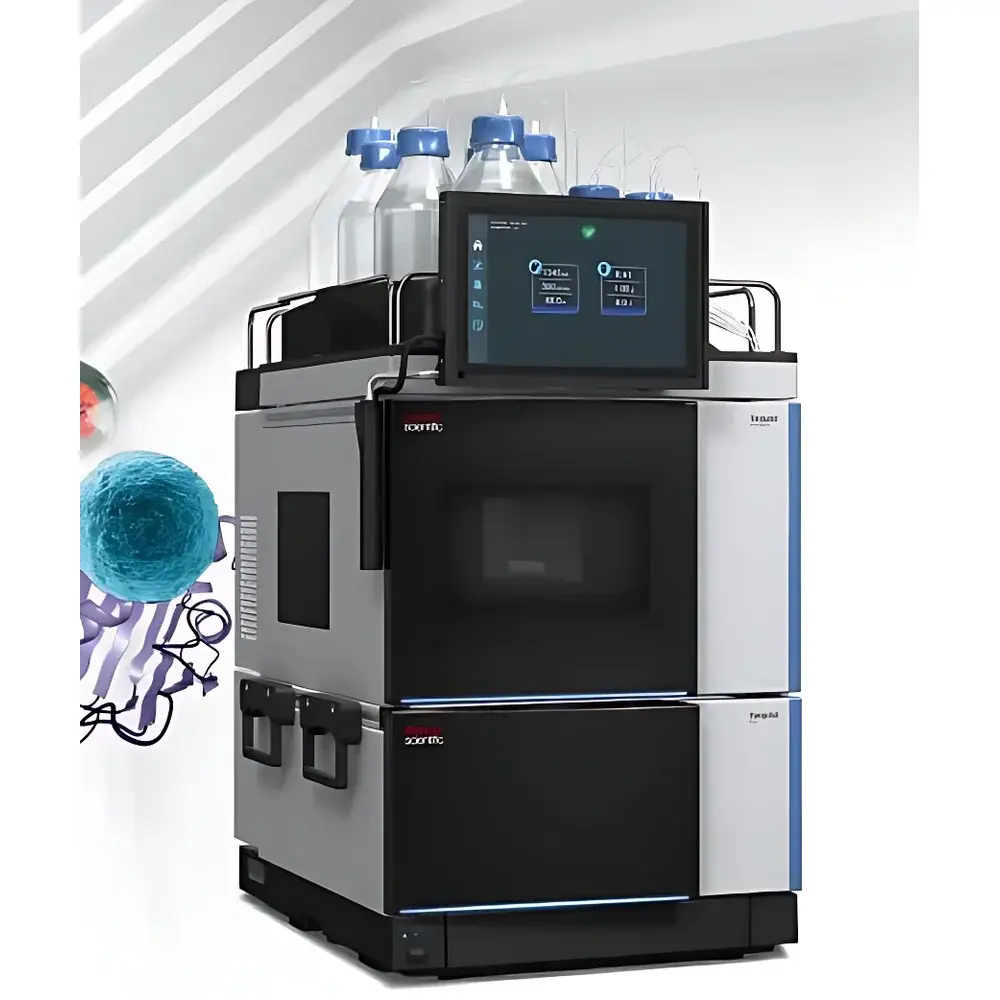
Thermo Fisher Vanquish Neo Ultra-High-Performance Liquid Chromatography System
| Brand | Thermo Fisher |
|---|---|
| Origin | Germany |
| Manufacturer Type | Original Equipment Manufacturer (OEM) |
| Origin Category | Imported |
| Model | Vanquish Neo UHPLC |
| Instrument Type | Ultra-High-Performance Liquid Chromatograph |
| Application Scope | General-Purpose LC-MS Platform |
| Flow Rate Range | 100 nL/min–100 µL/min |
| Maximum Operating Pressure | 150 MPa |
| Flow Precision | ≤0.2% RSD or ≤0.1 µL/min SD (whichever is greater), validated per IQ protocol using Cytochrome C tryptic digest peptides (TGQAPGFSYTDANK) |
| Injection Volume Range | 100 nL–100 µL |
Overview
The Thermo Fisher Vanquish Neo UHPLC System is an engineered ultra-high-performance liquid chromatography platform designed for demanding LC-MS applications in proteomics, translational research, and precision medicine workflows. Built upon a modular, low-dispersion fluidic architecture, it employs dual-gradient pumping with active solvent compressibility compensation and real-time pressure feedback control to maintain exceptional gradient fidelity across the full operational pressure range up to 150 MPa. Its core measurement principle relies on high-precision piston displacement actuation combined with integrated piezoresistive pressure transduction and temperature-stabilized capillary flow paths—enabling reproducible separation of complex biological digests, post-translationally modified peptides, and low-abundance metabolites under nano- to micro-flow conditions. Unlike conventional UHPLC systems, the Vanquish Neo integrates native compatibility with nanoscale column formats without requiring external flow-splitting or make-up solvent addition, thereby preserving absolute sample integrity and maximizing MS ionization efficiency.
Key Features
- Modular binary or quaternary gradient pump system with dual-piston design and real-time solvent compressibility modeling for sub-microliter gradient delay volume (<1.5 µL) and minimized dwell time variability
- Integrated thermostatted autosampler with dual-seal needle seat technology, supporting injection volumes from 100 nL to 100 µL with ≤0.2% RSD precision (validated per IQ protocol using TGQAPGFSYTDANK peptide standard)
- Column compartment with active air-circulation temperature control (5–90 °C, ±0.1 °C stability) and optional column switching valve support for 2D-LC or heart-cutting configurations
- Low-volume, zero-dead-volume capillary interconnects and PEEK-silicone hybrid tubing throughout the flow path to minimize band broadening and carryover
- Onboard pressure sensor with continuous logging at 10 Hz sampling rate, enabling real-time monitoring of backpressure dynamics during method development and routine QC
- Fully configurable system controller compliant with IEEE 802.3 Ethernet and USB 3.0 interfaces for deterministic communication latency and synchronized data acquisition
Sample Compatibility & Compliance
The Vanquish Neo accommodates a broad spectrum of sample types—including intact proteins, enzymatic digests, synthetic oligonucleotides, polar small molecules, and lipid extracts—without hardware modification. Its low-flow architecture ensures compatibility with packed capillary columns (20–150 µm ID), monolithic silica phases, and porous graphitic carbon media. The system meets critical regulatory requirements for analytical traceability: all method parameters, sequence logs, and pressure/temperature telemetry are timestamped and stored with cryptographic hashing for audit readiness. It supports 21 CFR Part 11-compliant electronic signatures when deployed with Thermo Scientific Chromeleon CDS v7.3 or later, and includes built-in GLP/GMP features such as user access levels, change history tracking, and instrument qualification templates aligned with ASTM E2500 and ISO/IEC 17025 guidelines.
Software & Data Management
Control and data acquisition are managed via Thermo Scientific Chromeleon Chromatography Data System (CDS), which provides seamless integration with mass spectrometers from Thermo and third-party vendors. The software implements a hierarchical method library structure with version-controlled method templates, automated calibration curve generation, and peak integration algorithms optimized for narrow, asymmetric peaks typical of nano-LC separations. Raw data files (.raw) are generated in vendor-neutral mzML format upon export, while instrument metadata—including pump stroke count, seal wear index, and column usage statistics—is embedded directly into the acquisition log. All system events—including power cycles, firmware updates, and maintenance alerts—are recorded in a tamper-evident SQLite database with SHA-256 checksum validation.
Applications
- Deep-proteome profiling using label-free or TMT-labeled workflows with >10,000 protein group identifications per run
- Phosphoproteomics and glycoproteomics requiring extended gradient durations (>120 min) and sub-femtomole sensitivity
- Targeted quantification of clinical biomarkers via parallel reaction monitoring (PRM) with <5% inter-day CV across multi-center studies
- High-resolution metabolite mapping in single-cell lysates using 100-nL injections and 50-µm-ID columns
- Method transfer and robustness testing for ICH Q2(R2)-aligned validation protocols
FAQ
What is the minimum recommended injection volume for reliable quantitation?
The system achieves ≤0.2% RSD precision down to 100 nL injections when paired with a 20-µm-ID column and appropriate dwell volume compensation.
Does the Vanquish Neo support gradient delay volume calibration?
Yes—Chromeleon CDS includes an automated gradient delay volume measurement utility that uses acetone step gradients and UV detection at 254 nm.
Can the system be qualified for GxP environments?
Yes—comprehensive IQ/OQ/PQ documentation packages are available, including installation checklists, performance verification tests per USP , and electronic record retention policies.
Is remote monitoring supported?
The system supports secure TLS 1.2-based remote access through Chromeleon Web Services, enabling real-time status viewing and queue management from authorized endpoints.
How is seal lifetime tracked?
The pump module logs cumulative stroke count and pressure-dependent wear metrics; predictive alerts trigger at 85% estimated remaining service life based on Thermo’s empirical wear model.
Related Products




