
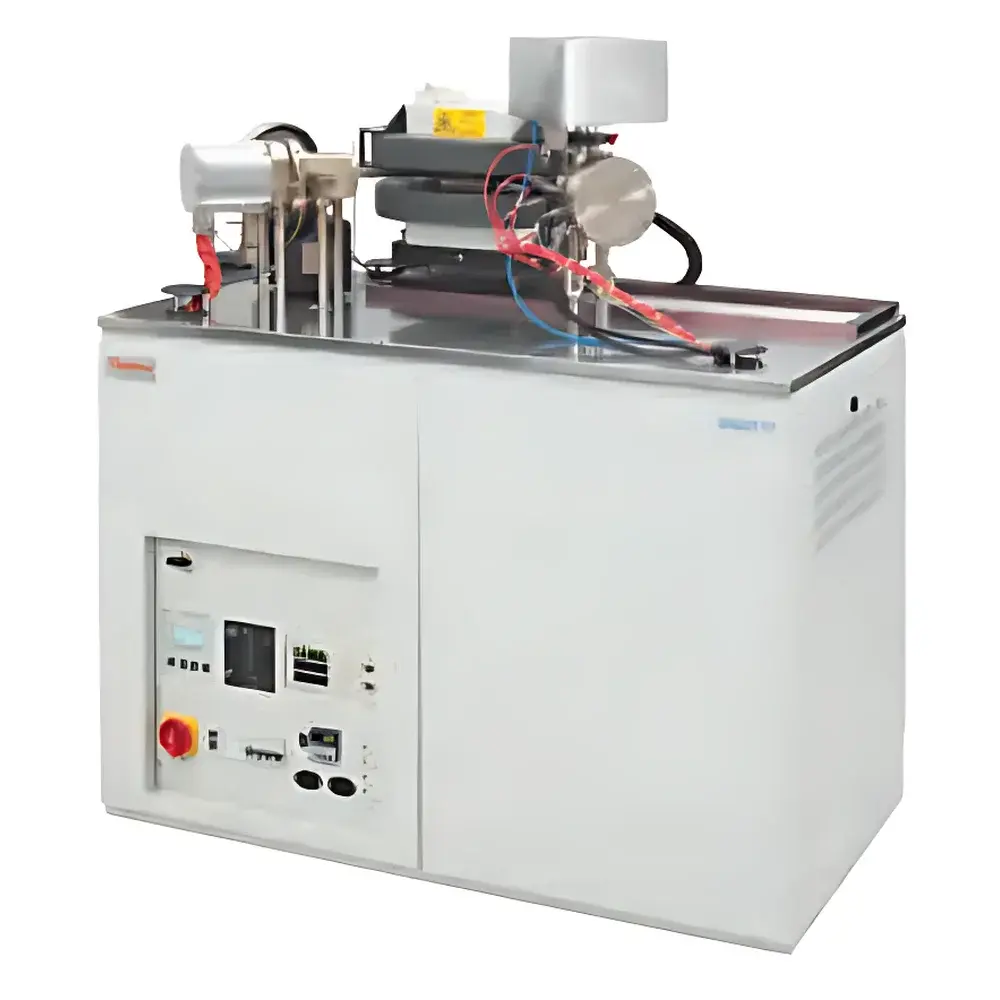
Thermo Scientific ARGUS VI Static Vacuum Multi-Collector Isotope Ratio Mass Spectrometer
| Brand | Thermo Fisher |
|---|---|
| Origin | Germany |
| Manufacturer | Thermo Fisher Scientific |
| Product Type | Imported Instrument |
| Model | ARGUS VI |
| Instrument Category | Stable Gas Isotope Ratio Mass Spectrometer |
| Measurement Precision | High Precision |
| Analyte Range | Noble Gases (He, Ne, Ar, Kr, Xe) |
| Mass Range | Full Mass Range for Noble Gases (m/z 2–132) |
| Resolution | High Mass Resolution (M/ΔM > 300 at 10% valley) |
Overview
The Thermo Scientific ARGUS VI is a static vacuum, multi-collector isotope ratio mass spectrometer (IRMS) engineered exclusively for high-precision noble gas isotope analysis. Operating on the principle of magnetic sector mass separation under ultra-high vacuum (<1×10⁻⁹ mbar), the ARGUS VI employs a fixed-magnet, multi-detector architecture to simultaneously acquire ion signals across the full mass range of noble gases—helium (³He, ⁴He), neon (²⁰Ne, ²¹Ne, ²²Ne), argon (³⁶Ar, ³⁷Ar, ³⁸Ar, ³⁹Ar, ⁴⁰Ar), krypton (⁷⁸Kr–⁸⁶Kr), and xenon (¹²⁴Xe–¹³²Xe). Its design reflects over two decades of iterative development in static noble gas MS, integrating proven beam optics with novel ion-optical innovations to deliver exceptional sensitivity, stability, and reproducibility. The instrument is purpose-built for ⁴⁰Ar/³⁹Ar geochronology but extends rigorously into nuclear safeguards (e.g., fission product noble gas monitoring), cosmochemistry (solar wind noble gas analysis), and groundwater dating (⁴He/³He, ⁸¹Kr/⁸⁵Kr). Unlike scanning instruments, the ARGUS VI’s static configuration eliminates time-dependent mass bias drift during acquisition, enabling sub-permil long-term precision on isotopic ratios under routine laboratory conditions.
Key Features
- Compact static vacuum platform: Total footprint <0.8 m²—smallest in its class—optimized for cleanroom or shared geochemical lab environments.
- High-efficiency ion source: 700 cm³ internal volume combined with low-energy electron impact ionization delivers ionization efficiency >1×10⁻³ A/Torr at sub-nA sample currents, critical for microgram-scale geological samples.
- True simultaneous multi-collection: Five Faraday cups configured for ³⁶Ar, ³⁷Ar, ³⁸Ar, ³⁹Ar, and ⁴⁰Ar enable complete isotopic ratio acquisition without peak jumping—eliminating time-correlated instrumental drift and reducing per-sample analysis time by ≥40%.
- Dynamic multi-reception via electrostatic ion deflection: A patented beam steering system allows real-time redistribution of ion beams across a fixed array of detectors, supporting adaptive measurement strategies (e.g., switching between high-gain CDD and low-noise Faraday modes mid-run).
- Multi-range amplification: Integrated resistor feedback amplifiers (10¹⁰ Ω, 10¹¹ Ω, 10¹² Ω, and 10¹³ Ω) provide seamless dynamic range coverage from ~10⁴ to >10¹² ions/sec—ensuring linear response across both major and trace isotopes within a single acquisition.
- Hybrid detection: Standard Faraday cup array supplemented by a new-generation continuous-dynode detector (CDD) optimized for low-abundance isotopes (e.g., ³⁶Ar in atmospheric blanks or ⁸¹Kr in groundwater), with noise-equivalent detection limit <500 ions/sec.
Sample Compatibility & Compliance
The ARGUS VI interfaces with Thermo’s proprietary Ultra-High Vacuum (UHV) noble gas extraction lines (e.g., HELIX MC Plus-compatible furnaces, laser probes, and cryogenic purification modules), supporting solid (minerals, glasses, meteorites), fluid (groundwater, mantle-derived fluids), and gaseous (air, reactor off-gas) samples. All UHV components meet ASTM E1977-22 specifications for residual gas analysis and conform to ISO 17025:2017 requirements for calibration traceability. Data acquisition complies with FDA 21 CFR Part 11 when paired with Thermo’s Qtegra ISM software (v3.5+), providing full audit trails, electronic signatures, and secure user-role management—essential for GLP-regulated nuclear forensics or regulatory environmental testing labs.
Software & Data Management
Controlled via Thermo Qtegra ISM (Isotope Science Module), the ARGUS VI supports automated method sequencing, real-time background subtraction, and integrated mass discrimination correction using on-the-fly standard bracketing (e.g., Air, NBS-22, or in-house mineral standards). Raw data are stored in vendor-neutral .raw format compliant with IUPAC-recommended metadata schemas. Batch processing includes offline peak integration, interference correction (e.g., ³⁷Ar from ³⁷Cl recoil, ⁴⁰Ar from ⁴⁰Ca), and age calculation using the ⁴⁰Ar/³⁹Ar plateau method per IUGS guidelines. Export options include CSV, Excel, and direct linkage to IsoplotR and Squid2 for geochronological modeling.
Applications
- Geochronology: High-resolution ⁴⁰Ar/³⁹Ar dating of volcanic minerals (sanidine, biotite), impact melt rocks, and metamorphic assemblages with ±0.05% (2σ) external reproducibility on plateau ages.
- Nuclear science: Quantification of fission-product noble gases (⁸⁵Kr, ¹³³Xe) for reactor monitoring and treaty verification; isotopic fingerprinting of uranium enrichment history.
- Cosmochemistry: In situ noble gas analysis of extraterrestrial materials (lunar regolith, chondrites) using laser micro-extraction coupled to ARGUS VI.
- Hydrogeology: Dual-isotope tracing (⁴He/³He, ⁸¹Kr/⁸⁵Kr) for groundwater residence time estimation up to 1.5 Ma, validated against USGS benchmark datasets.
- Atmospheric science: High-precision isotopic characterization of anthropogenic vs. natural noble gas emissions in urban air and volcanic plumes.
FAQ
What vacuum level does the ARGUS VI maintain during analysis?
The instrument achieves and sustains <1×10⁻⁹ mbar base pressure via dual-stage turbomolecular pumping and non-evaporable getter (NEG) panels, verified by residual gas analyzers per ISO 20486:2020.
Can the ARGUS VI measure helium isotopes with sufficient precision for mantle studies?
Yes—its optimized ion optics and low-noise ³He/⁴He measurement mode achieve long-term external reproducibility of ±0.2% (2σ) on mantle-like ratios (R/Ra = 8–40), meeting IAGC inter-laboratory benchmark criteria.
Is remote operation supported for unattended overnight runs?
Fully supported via Qtegra ISM’s secure TLS-encrypted web interface; includes automatic vacuum integrity checks, ion signal stability monitoring, and email/SNMP alerts upon predefined failure thresholds.
How is mass fractionation corrected during data reduction?
Using both on-line (standard-sample bracketing) and off-line (exponential law or power law) models, with optional incorporation of correlated uncertainties from amplifier gain calibration files traceable to NIST SRM 2820.
Does ARGUS VI comply with ISO/IEC 17025 accreditation requirements for testing laboratories?
Yes—the system’s documented calibration procedures, uncertainty budgets, and traceable reference material protocols (e.g., NIST SRM 1400, 1450) are pre-validated for ISO/IEC 17025:2017 Clause 7.7 implementation.
Related Products





