
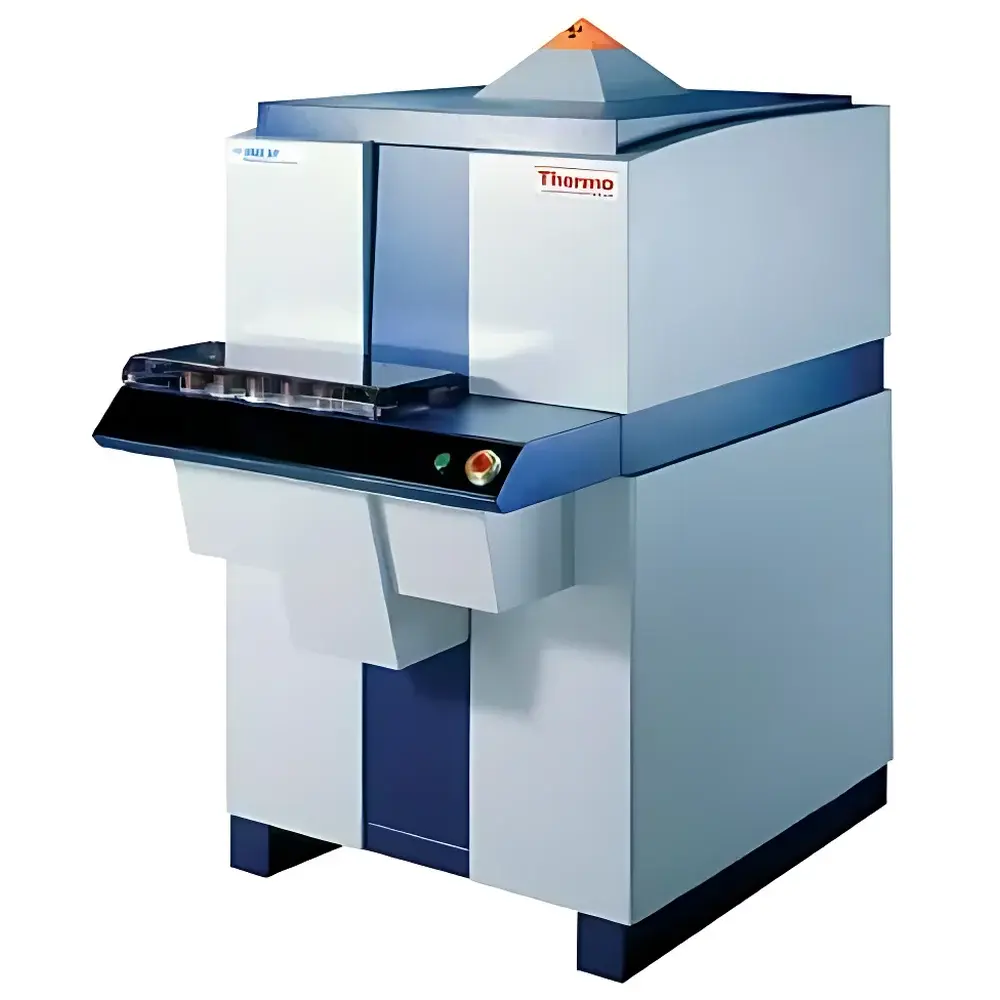
Thermo Scientific ARL 9900 Wavelength Dispersive X-Ray Fluorescence Spectrometer with Integrated XRD Capability
| Brand | Thermo Fisher |
|---|---|
| Origin | Switzerland |
| Manufacturer | Yes |
| Import Status | Imported |
| Model | ARL 9900 |
| Instrument Type | Floor-standing |
| X-ray Tube Power Options | 1.2 kW, 2.5 kW, 3.6 kW, 4.2 kW |
| Elemental Range | Be to U (with appropriate analyzing crystals) |
| Sample Introduction | 8-position, 12-position or 98-position autosampler |
| Weight | ~750 kg |
| Max. Power Consumption | 4.8 kVA |
| Configuration | Scanning-type WDXRF spectrometer with optional simultaneous XRD channel |
Overview
The Thermo Scientific ARL 9900 is a high-performance, floor-standing wavelength dispersive X-ray fluorescence (WDXRF) spectrometer engineered for industrial process control and laboratory-based quantitative elemental analysis. Unlike energy dispersive (EDXRF) systems, the ARL 9900 employs sequential or simultaneous crystal diffraction—based on Bragg’s law—to resolve characteristic X-ray lines with exceptional spectral resolution and peak-to-background ratios. Its integrated X-ray diffraction (XRD) channel enables concurrent collection of both elemental composition and crystalline phase data from the same sample measurement position, without repositioning or instrument modification. This dual-mode capability is particularly critical in industries where phase quantification directly impacts product quality and process stability—such as cement clinker analysis (e.g., free lime, alite C3S, belite C2S), sintered iron ore (e.g., FeO content), and metallurgical slags. The system operates under vacuum for light-element analysis down to beryllium (Be), and its robust mechanical architecture supports continuous 24/7 operation in demanding production environments.
Key Features
- Simultaneous WDXRF and XRD data acquisition from a single sample excitation—enabling correlative elemental and structural characterization in one analytical cycle.
- Modular high-power X-ray tube options (1.2 kW, 2.5 kW, 3.6 kW, or 4.2 kW) with programmable kV/mA control, optimized for matrix-specific excitation and detection sensitivity across major and trace elements.
- Up to 32 fixed-channel spectrometers configurable for routine high-speed multi-element monitoring—ideal for QA/QC in metal production, cement manufacturing, and mining operations.
- Top-illumination optical geometry minimizes particle-size and surface-texture effects, enhancing measurement reproducibility for heterogeneous solid samples including pressed pellets, fused beads, and bulk metals.
- Vacuum-controlled spectrometer chamber with active thermal stabilization (±0.01 °C) and individually temperature-regulated analyzing crystals—ensuring long-term calibration stability and minimal drift over extended runs.
- Moiré fringe-based goniometer with gearless rotation mechanism: achieves angular positioning accuracy better than ±0.0005° and scanning speeds up to 5°/s, supporting rapid qualitative surveys and high-resolution quantitative scans.
- Automated sample handling with scalable carousel configurations (8-, 12-, or 98-position), fully compatible with LIMS integration and unattended overnight operation under GLP/GMP-compliant audit trails.
Sample Compatibility & Compliance
The ARL 9900 accepts standard 32–40 mm diameter solid samples—including pressed powder pellets, glass fusion beads, metallic discs, and irregular bulk specimens—with optional accessories for loose powders and thin films. Vacuum or helium purge modes enable reliable quantification of elements from Be (Z=4) through U (Z=92), contingent upon crystal selection (e.g., LiF, PET, TAP). The system complies with IEC 61000-6-3 (EMC), IEC 61000-6-4 (industrial emission), and EN 61010-1 (safety for electrical equipment). For regulated environments, it supports 21 CFR Part 11–compliant software modules—including electronic signatures, role-based access control, and immutable audit logs—facilitating validation in pharmaceutical excipient testing, catalyst certification, and raw material release per ISO/IEC 17025 and ASTM E1361 standards.
Software & Data Management
Controlled by Thermo Scientific ARL QUANTX software, the ARL 9900 provides method development, calibration management, real-time spectrum visualization, and automated phase identification via integrated XRD libraries (ICDD PDF-4+). All analytical sequences—including XRF quantification, XRD Rietveld refinement, and combined pattern fitting—are scriptable and exportable in ASTM E1347-compliant .csv and .trc formats. Data integrity is enforced through time-stamped metadata, version-controlled method archives, and automatic backup to network storage. Optional connectivity includes OPC UA and Modbus TCP protocols for direct integration into MES/SCADA systems used in smart manufacturing deployments.
Applications
- Cement & Building Materials: Quantitative determination of free CaO, C3S, C2S, and C4AF phases alongside major oxides (SiO2, Al2O3, Fe2O3, CaO, MgO) for kiln optimization and clinker quality assurance.
- Metallurgy & Mining: High-precision analysis of alloy composition (Fe, Ni, Cr, Mo, Co), slag chemistry, and ore grade assessment—including low-Z elements (Na, Mg, Al) in bauxite and phosphate rock.
- Recycling & Scrap Sorting: Rapid identification and sorting of mixed metal streams using combined XRF/XRD fingerprinting of alloy families and oxidation states.
- Geochemistry & Environmental Testing: Certified reference material (CRM) validation, soil heavy-metal screening (Pb, As, Cd, Hg), and mineralogical mapping of contaminated sediments.
- Advanced Ceramics & Catalysts: Phase-purity verification of alumina, zirconia, and zeolite-based materials; quantification of dopants and residual sintering aids.
FAQ
Does the ARL 9900 require liquid nitrogen cooling for detectors?
No—the system uses sealed proportional counters and scintillation detectors that operate at ambient temperature; no cryogenic infrastructure is required.
Can the ARL 9900 analyze liquids or powders directly?
Yes, with appropriate sample holders and atmosphere control (vacuum/helium); however, optimal precision for routine QA is achieved using pressed pellets or fused beads per ISO 29581-2 and ASTM C114 protocols.
Is method transfer possible between different ARL 9900 units?
Yes—through standardized calibration templates, crystal alignment routines, and shared spectral libraries, enabling cross-site harmonization in multi-plant operations.
What maintenance intervals are recommended for the X-ray tube and analyzing crystals?
Thermo Fisher recommends annual performance verification and biennial tube inspection; crystal lifetimes typically exceed 10 years under normal operating conditions with proper vacuum management.
How is compliance with ISO/IEC 17025 documented during installation qualification?
Full IQ/OQ/PQ documentation packages—including uncertainty budgets, linearity studies, and repeatability assessments—are provided with each system and validated per ILAC-G8:2021 requirements.
Related Products





