
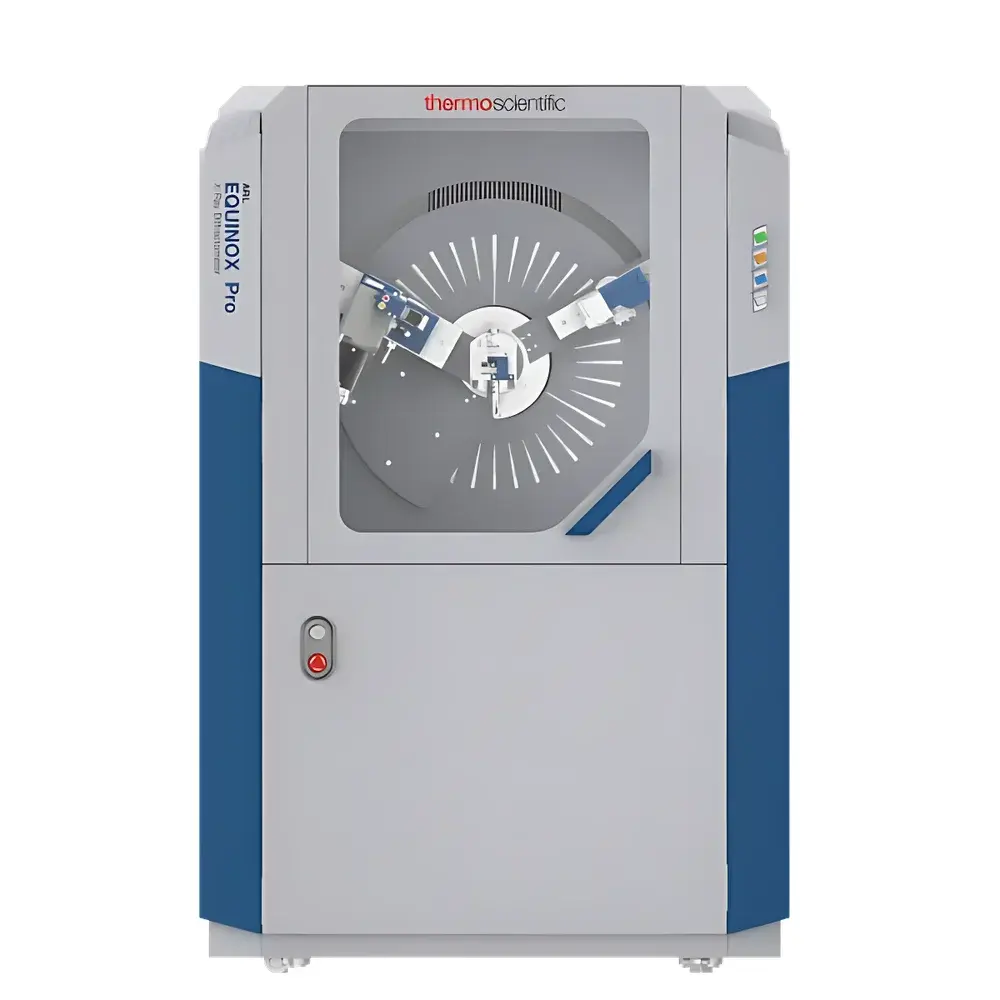
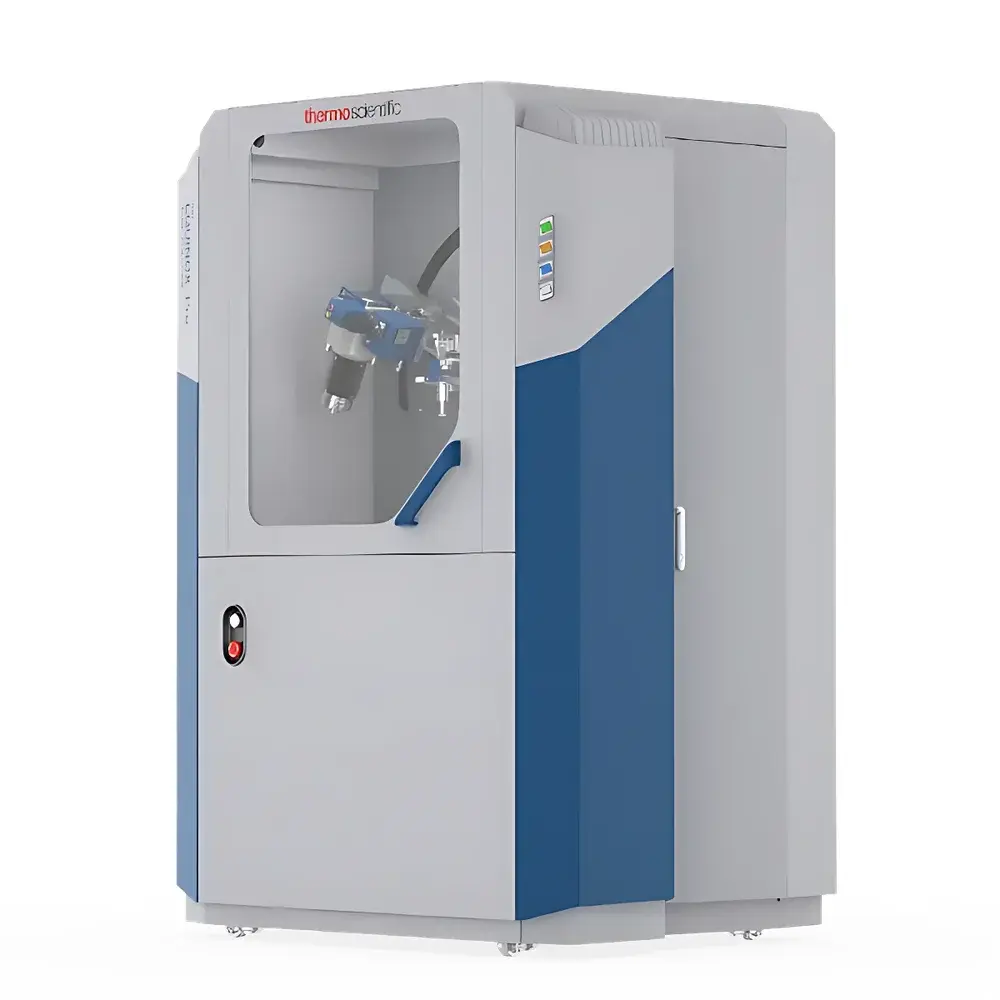
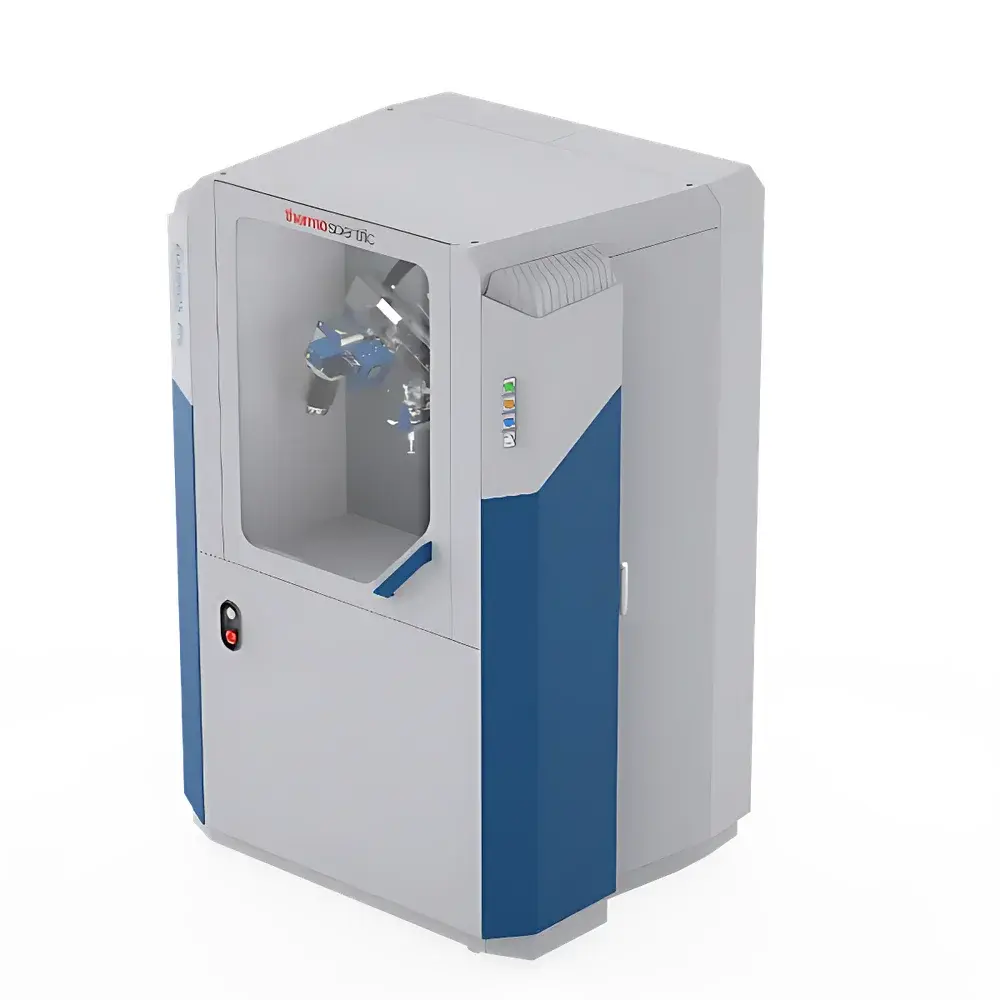
Thermo Scientific ARL EQUINOX Pro Vertical X-ray Diffractometer
| Brand | Thermo Fisher |
|---|---|
| Origin | Shanghai, China |
| Manufacturer Type | Original Equipment Manufacturer (OEM) |
| Product Category | Domestic |
| Model | ARL EQUINOX Pro |
| Instrument Type | Powder X-ray Diffractometer |
| Power Rating | 3000 W |
Overview
The Thermo Scientific™ ARL™ EQUINOX Pro Vertical X-ray Diffractometer is a high-precision, vertically oriented powder X-ray diffractometer engineered for rigorous crystalline phase analysis in industrial R&D and quality control laboratories. It operates on the θ/θ Bragg–Brentano geometry—a standard configuration for powder diffraction—where both the X-ray source and detector rotate about a fixed sample position, enabling optimal beam collimation, intensity stability, and angular resolution. Designed under the “system-wide optimization” philosophy, the ARL EQUINOX Pro integrates synchronized mechanical, optical, and electronic subsystems to ensure long-term measurement reproducibility, minimal operator intervention, and robust performance across diverse sample matrices—from inorganic oxides and pharmaceutical polymorphs to battery cathode materials and geological minerals.
Key Features
- θ/θ Bragg–Brentano Optics: Ensures precise angular alignment and high-intensity beam delivery, minimizing systematic peak shift and improving FWHM accuracy in quantitative phase analysis.
- Advanced Electro-Mechanical Goniometer: Incorporates miniaturized, distributed stepper motor control with real-time step-loss compensation—eliminating positional drift caused by motor stalling or overshoot during high-speed scanning.
- Pulse-Triggered Positional Counting (PTPC): Synchronizes detector gate activation with actual goniometer position via hardware-level pulse triggering, decoupling data acquisition timing from software latency and achieving sub-0.001° angular fidelity in count-position correlation.
- Modular Optical Cartridge System (“Magic Card”): A fully integrated, plug-and-play optical path architecture featuring pre-aligned X-ray tube mounts, variable divergence slits, anti-scatter plates, and detector modules—enabling rapid reconfiguration between Cu/Kα, Co/Kα, or Cr/Kα excitation without recalibration.
- Dynamic Mechanical Error Compensation: Real-time correction of mechanical tolerances—including tube height, goniometer tilt, slit elevation, and detector offset—via embedded calibration routines executed automatically during startup or mode switching.
- Vertical Sample Loading Architecture: Supports automated sample changers, temperature-controlled stages (up to 1200 °C), and humidity-controlled chambers—compatible with ISO 17025-compliant workflows and GLP/GMP documentation requirements.
Sample Compatibility & Compliance
The ARL EQUINOX Pro accommodates standard 25 mm and 50 mm diameter powder holders, as well as custom-mounted solid samples, thin films, and layered composites. Its vertical geometry minimizes gravitational settling effects during long-duration scans and facilitates in situ measurements under controlled atmospheres. The system complies with IEC 61000-6-3 (EMC), IEC 61000-6-4 (immunity), and IEC 62471 (photobiological safety). Software operation supports audit trails, electronic signatures, and 21 CFR Part 11–compliant data integrity frameworks when deployed with Thermo Scientific™ OMNIC™ Enterprise or optional LIMS integration modules. All diffraction data formats adhere to the Crystallographic Information File (CIF) standard and are compatible with ICDD PDF-4+ database licensing.
Software & Data Management
Controlled by Thermo Scientific™ OMNIC™ Spectra software (v12.x or later), the ARL EQUINOX Pro provides full automation of acquisition, background subtraction, peak search, phase identification (via ICDD Search/Match), Rietveld refinement (with GSAS-II export support), and crystallite size/strain analysis. Raw data are stored in vendor-neutral .UDF (Universal Diffraction Format) containers, preserving metadata including voltage/current settings, goniometer zero offsets, detector dead time, and environmental sensor logs. Data archiving supports hierarchical folder structures, SHA-256 checksum validation, and encrypted network backup to NAS or cloud repositories meeting ISO/IEC 27001 security protocols.
Applications
- Quantitative phase analysis (QPA) of cement clinkers per ASTM C1365 and ISO 29581-2
- Polymorph screening and stability assessment in solid-state pharmaceutical development (ICH Q5A, Q6A)
- Crystallinity index determination in polymer nanocomposites (ASTM D7906)
- In-line raw material verification for battery electrode manufacturing (UL 1642, GB/T 30484)
- Residual stress mapping in metal additive manufacturing powders (ASTM E915, EN 15305)
- Mineralogical quantification in mining and metallurgical process streams (ASTM D517)
FAQ
What X-ray tube anode materials are supported?
The ARL EQUINOX Pro supports interchangeable sealed-tube anodes: Cu (Kα = 1.5418 Å), Co (Kα = 1.7889 Å), and Cr (Kα = 2.2897 Å), each optimized for specific absorption edges and lattice parameter ranges.
Is the instrument compliant with FDA 21 CFR Part 11?
Yes—when configured with OMNIC Enterprise v12.5+ and validated user access controls, electronic signature workflows, and immutable audit trail logging, the system meets Part 11 requirements for regulated environments.
Can the system perform in situ heating experiments?
Yes—through optional Anton Paar HTK 1200N or Linkam TS1500 stages, enabling continuous diffraction monitoring from ambient to 1200 °C under inert or reactive gas flow.
What maintenance intervals are recommended for the X-ray tube?
Under typical usage (≤8 h/day, 3000 W operation), Thermo Fisher recommends preventive replacement every 18–24 months; tube life is extended at 4000 W only with active cooling and duty-cycle management.
Does the Magic Card system require recalibration after changing optical configurations?
No—pre-characterized optical cartridges retain factory-traceable alignment parameters; system-level recalibration is performed automatically during initialization using built-in reference patterns.





