
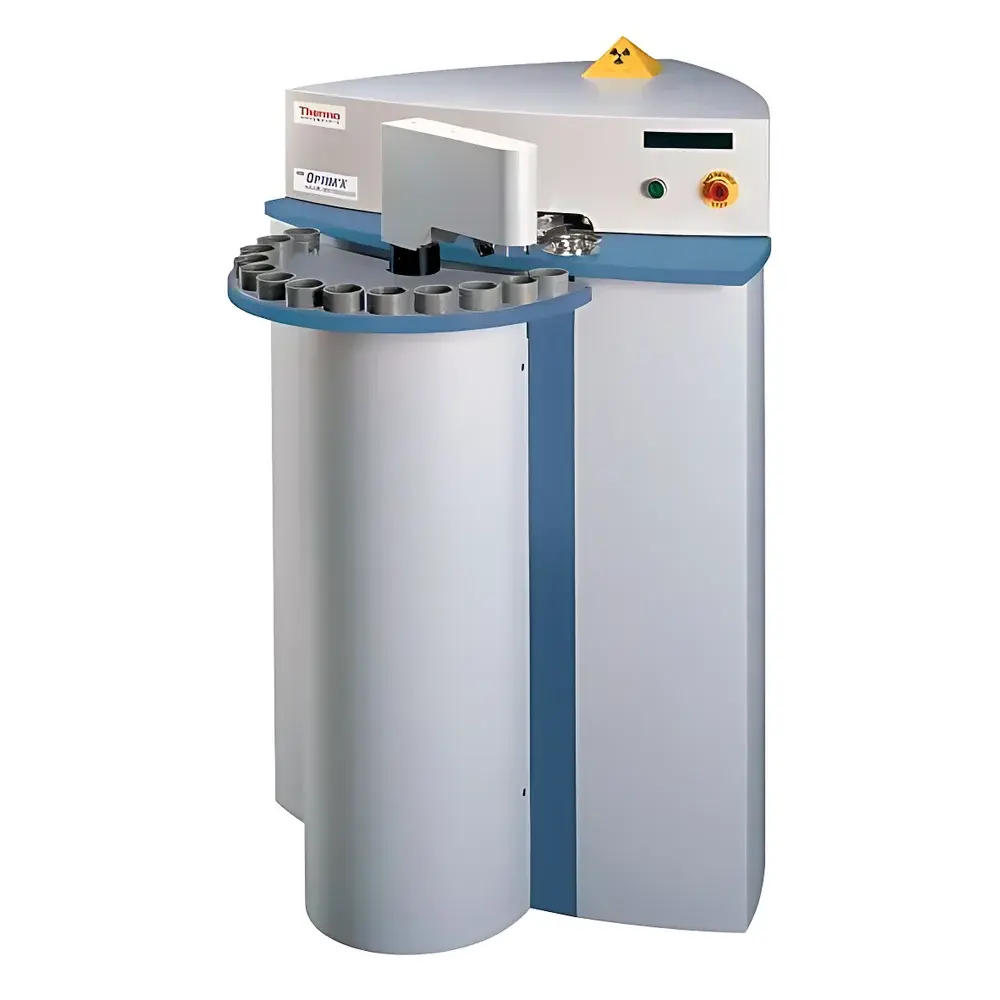
Thermo Scientific ARL Optim’X Wavelength Dispersive X-Ray Fluorescence Spectrometer
| Brand | Thermo Fisher |
|---|---|
| Origin | Switzerland |
| Manufacturer | Thermo Fisher Scientific |
| Origin Category | Imported |
| Model | ARL Optim’X |
| Instrument Type | Floor-standing |
| X-ray Tube Power | 50 W / 200 W (equivalent via UCCO™ technology) |
| Elemental Range | F to U (73 elements) |
| Analysis Mode | Simultaneous (fixed-channel) and Sequential (scanning) |
| Cooling | Air-cooled, no external water circulation required |
| Sample Handling | Standard 1-position manual loader |
| Software | Thermo Scientific OXSAS with OptiQuant™ quantitative package |
| Compliance | Designed to meet ASTM E1361, ISO 2936, ISO 8258, and GLP/GMP data integrity requirements (21 CFR Part 11-ready audit trail) |
Overview
The Thermo Scientific ARL Optim’X is a high-performance, floor-standing wavelength dispersive X-ray fluorescence (WDXRF) spectrometer engineered for precision elemental analysis across diverse industrial and central laboratory environments. Leveraging Bragg diffraction principles, the instrument separates characteristic X-ray emissions by wavelength using analyzing crystals—enabling high spectral resolution, low background noise, and exceptional peak-to-background ratios. Its core architecture integrates a patented Ultra-Short Distance Coupling Optics (UCCO™) system, which optimizes photon transfer efficiency between the X-ray tube and detector, effectively delivering 200 W-class excitation performance from a compact 50 W end-window X-ray tube with a 75 µm beryllium window. This design ensures superior sensitivity for light elements—including fluorine (F)—while maintaining long-term stability without reliance on external water cooling. The spectrometer operates under vacuum-controlled, thermally stabilized conditions: both the optical chamber and crystal stage feature independent temperature regulation to minimize thermal drift, ensuring compliance with ASTM E1361 (Standard Practice for WDXRF Analysis of Metals) and ISO 2936 (XRF — Calibration and Verification Procedures).
Key Features
- UCCO™ (Ultra-Short Distance Coupling Optics) technology enabling high-intensity excitation at reduced power consumption and thermal load
- Dual-mode analytical capability: configurable combination of fixed-channel detectors for routine elements (e.g., S in fuels, Ca/Si/Al/Fe in cement) and sequential scanning for full-element coverage (F–U)
- Vacuum-stabilized, thermostatically controlled spectrometer chamber and crystal mount for sub-0.001° angular stability over extended operation
- Air-cooled design eliminating dependency on external chillers or tap water—reducing infrastructure requirements and operational downtime
- Modular sample handling: standard manual single-position loader; field-upgradable to a 13-position automated sample changer with programmable tray alignment and auto-calibration routines
- Integrated OXSAS software platform supporting method development, calibration management, statistical process control (SPC), and full audit-trail logging per FDA 21 CFR Part 11 guidelines
Sample Compatibility & Compliance
The ARL Optim’X accommodates solid discs (32 mm, 40 mm), fused beads, powders (pressed pellets), and thin-film standards—compatible with conductive and non-conductive matrices including metals, slags, clinkers, ceramics, glasses, polymers, and food-grade powders (e.g., milk powder, cereal flour). Its robust excitation geometry supports direct analysis of irregular or heterogeneous samples when paired with OptiQuant™ fundamental parameters algorithms. Regulatory alignment includes traceability to NIST SRMs, adherence to ISO/IEC 17025 quality management systems, and built-in support for GLP/GMP workflows—particularly critical for cement QA/QC (ASTM C114), petroleum sulfur testing (ASTM D2622, D7039), and metallurgical slag certification (ISO 12677). All firmware and software revisions are documented with version-controlled release notes and validation packages available upon request.
Software & Data Management
OXSAS is a modular, Windows-based application suite providing intuitive instrument control, real-time spectrum visualization, and multivariate quantification. Core modules include QuickCal™ for rapid calibration transfer, MatrixMatch™ for inter-laboratory method harmonization, and OptiQuant™—a physics-based, standardless quantification engine capable of delivering accurate results for up to 73 elements (F–U) without certified reference materials. Data export supports CSV, XML, and LIMS-compatible formats (ASTM E1382-compliant). Audit trails record all user actions, parameter changes, and result modifications with timestamped, non-erasable entries. Electronic signatures, role-based access control, and secure database encryption ensure compliance with FDA 21 CFR Part 11 and EU Annex 11 requirements for regulated environments.
Applications
- Petroleum & refining: Ultra-low sulfur analysis (ppm-level) in diesel, gasoline, and marine fuels using dedicated fixed-channel configuration
- Cement & building materials: Quantitative determination of major oxides (CaO, SiO₂, Al₂O₃, Fe₂O₃) and minor constituents (MgO, SO₃, Na₂O, K₂O, Cl⁻) in raw meals, clinker, and finished cement
- Metallurgy: Slag composition monitoring (CaO/SiO₂ ratio, MgO, MnO, P₂O₅) for blast furnace and steelmaking process control
- Advanced materials: Oxide stoichiometry verification in functional ceramics, refractories, and battery cathode precursors
- Food safety & nutrition: Multi-element profiling of macro- and micronutrients (Ca, P, K, Fe, Zn, I) in fortified dairy and grain products
FAQ
Does the ARL Optim’X require liquid nitrogen or external water cooling?
No—the instrument uses an air-cooled X-ray tube and thermoelectrically stabilized optics, eliminating cryogenic or recirculating water dependencies.
Can it analyze light elements such as carbon, nitrogen, or oxygen?
Yes, with appropriate crystal selection (e.g., LDE1, PET, TAP) and vacuum-purged optical path; carbon analysis requires optional fixed-channel configuration.
Is method transfer possible between different ARL Optim’X units?
Yes—OXSAS supports cross-instrument calibration portability via QuickCal™ and standardized spectral libraries traceable to NIST SRMs.
What is the typical detection limit for sulfur in fuel matrices?
Under optimized conditions (vacuum, LiF(200) crystal, 1000 s counting time), LOD is ≤0.5 ppm (1σ) for diesel and marine gas oil.
How does OptiQuant™ achieve accuracy without certified standards?
It applies fundamental parameter modeling incorporating matrix absorption, secondary fluorescence, and instrumental response functions—validated against >200 CRM types across 12 material classes.
Related Products




