
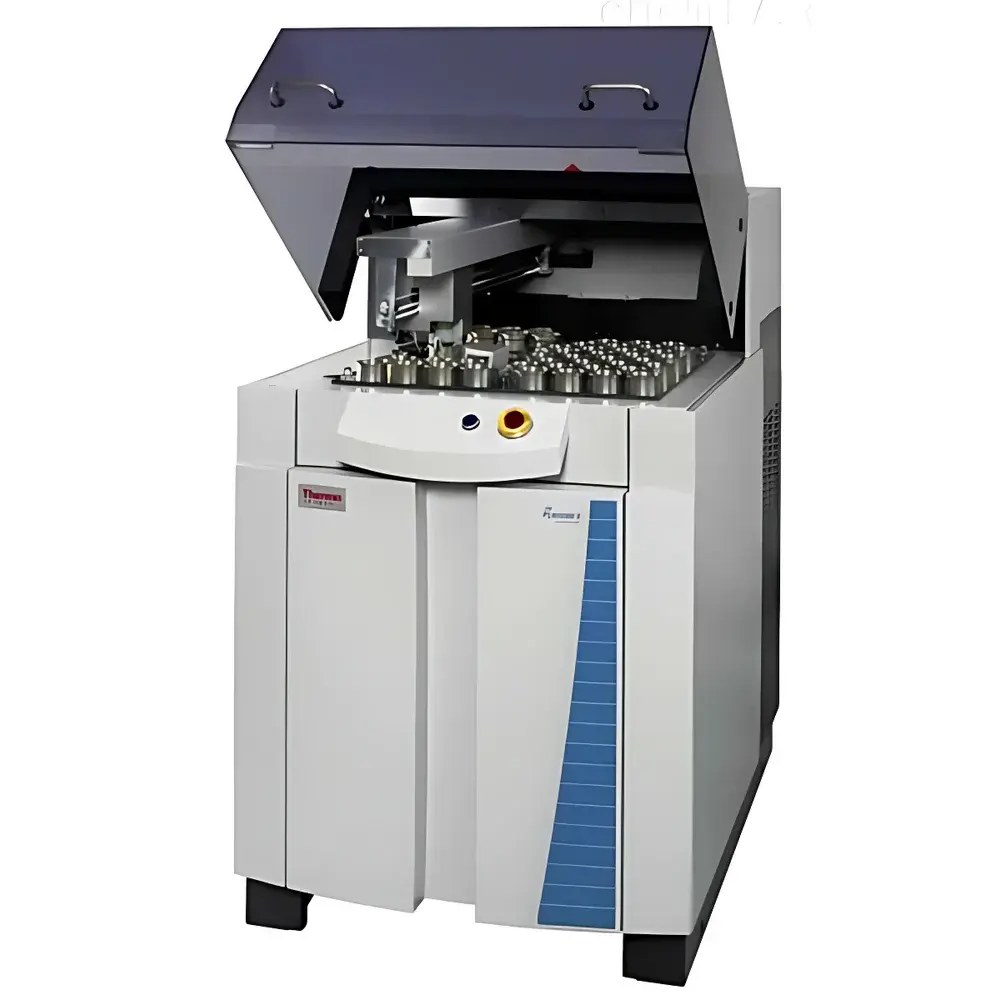
Thermo Scientific ARL PERFORM’X Sequential Wavelength Dispersive X-Ray Fluorescence Spectrometer
| Brand | Thermo Fisher |
|---|---|
| Origin | USA |
| Manufacturer Type | Authorized Distributor |
| Origin Category | Imported |
| Model | ARL PERFORM'X Sequential |
| Price Range | USD 135,000–205,000 (FOB) |
| Instrument Type | Sequential WDXRF |
| X-ray Tube Power | 1.5 kW (ARL PERFORM'X 1500W), 2.5 kW (ARL PERFORM'X 2500W), 4.2 kW (ARL PERFORM'X 4200W) |
| Elemental Range | F (Z=9) to U (Z=92), plus C (Z=6) |
| Detection Limit | Sub-ppm for most elements in optimized matrices |
| Angular Positioning Accuracy | ≤0.0005° (Moiré fringe encoder-based goniometer) |
| Sample Form | Solids (pressed pellets, fused beads), Liquids (sealed cells), Powders, Coatings |
| Automation | Integrated XYZ sample changer with up to 120-position capacity |
Overview
The Thermo Scientific ARL PERFORM’X Sequential Wavelength Dispersive X-Ray Fluorescence (WDXRF) Spectrometer is an engineered analytical platform designed for high-precision, multi-element quantification across diverse solid and liquid matrices. Operating on the fundamental principle of wavelength-dispersive spectroscopy—where characteristic X-ray fluorescence emissions are resolved by diffraction through precisely aligned analyzing crystals—the system delivers superior spectral resolution, peak-to-background ratios, and long-term stability compared to energy-dispersive alternatives. Its sequential measurement architecture enables rigorous, element-by-element analysis with selectable spectrometers and variable counting times per line, ensuring optimal statistical precision for trace, minor, and major constituents within a single run. The instrument supports routine compliance with ASTM E1621, ISO 21043, and ISO 8258 for quality control, as well as method development under GLP and GMP frameworks where traceability and reproducibility are mandated.
Key Features
- Modular power configurations: 1.5 kW (air-cooled), 2.5 kW (air-cooled), and 4.2 kW (water-cooled) X-ray tube options—enabling scalability from routine QC to demanding research applications such as low-Z light element analysis or ultra-trace detection in refractory matrices.
- Digital Moiré fringe goniometer with gearless drive: Provides sub-arcsecond angular reproducibility (<0.0005°) and eliminates mechanical hysteresis, critical for accurate Bragg angle positioning across the full 2θ range (5°–145°).
- UCCO (Ultra-Close Coupled Optics) technology: Integrates collimators, analyzing crystals, and detectors in a thermally stabilized optical path, enhancing intensity and resolution for light elements (F–Na) and heavy elements (Ba–U) without hardware reconfiguration.
- Automated sample handling: Integrated XYZ robotic stage with 120-position capacity supports heterogeneous batches—including powders, fused beads, metals, filters, and liquid cells—with programmable alignment and autofocus routines.
- Small-spot analysis (down to 100 µm): Enabled by motorized capillary optics and high-resolution CCD imaging, facilitating micro-heterogeneity mapping, inclusion analysis, and localized contamination assessment.
- Liquid-handling safeguards: Patented sealed cell recognition and leak-detection algorithm prevent cross-contamination and protect optics during volatile or viscous sample analysis.
Sample Compatibility & Compliance
The ARL PERFORM’X accommodates a broad spectrum of sample forms without destructive preparation: pressed powder pellets (with binder), fused borate glasses, polished metal blocks, thin-film coatings, and sealed liquid cells (e.g., ASTM D7039-compliant fuel analysis). Its calibration architecture complies with ISO/IEC 17025 requirements for method validation, including linearity assessment (R² ≥ 0.9999 over 6 orders of magnitude), limit of detection (LOD) verification per IUPAC guidelines, and uncertainty budgeting per EURACHEM/CITAC. Pre-configured application packages—including PetroilQuant (ASTM D6443, D7039, D7220), CementQuant (ASTM C114), and GeoQuant (ISO 12787)—are validated against NIST SRMs and certified reference materials (CRMs) from USGS, BAM, and SARM series. Full audit trail logging, electronic signatures, and 21 CFR Part 11–compliant user access controls are embedded in OXSAS software for regulated environments.
Software & Data Management
OXSAS v7.x serves as the unified control, acquisition, and evaluation environment. It supports both fundamental parameter (FP) and empirical calibration workflows. QuantAS provides fully automated, standard-free quantification using physics-based matrix correction—ideal for unknown or complex samples where CRM availability is limited. UniQuant extends FP analysis to heterogeneous solids and layered structures via iterative layer modeling. All quantitative results include propagated uncertainty estimates, spectral deconvolution diagnostics, and residual maps. Raw data (intensity, background, peak shape) and processed reports are stored in vendor-neutral .csv and .xml formats, compatible with LIMS integration via ASTM E1482 or OPC UA protocols. Remote diagnostics via secure TLS-encrypted connection enable proactive service intervention and firmware updates without on-site visits.
Applications
- Geoscience & Environmental: Multi-element profiling (Li–U) in soils, sediments, ores, and airborne particulates; certified for EPA Method 6200 and ISO 13877.
- Petroleum & Lubricants: Sulfur, Ca, Zn, P, and wear metals in fuels and engine oils at sub-ppm levels per ASTM D2622 and D4294.
- Materials Science: Phase composition mapping in alloys, ceramics, and battery cathodes; coating thickness and interdiffusion analysis via depth profiling sequences.
- Cement & Building Materials: Major oxides (SiO₂, Al₂O₃, Fe₂O₃), alkalis (Na₂O, K₂O), and trace contaminants (Cr, Pb, As) per EN 196-2 and ASTM C114.
- Forensics & Polymers: Additive identification (Br, Cl, Sn), filler quantification (CaCO₃, TiO₂), and contaminant sourcing (Pb, Cd, Hg) in plastics and electronic waste.
FAQ
What is the difference between sequential and simultaneous WDXRF configurations?
Sequential systems like the ARL PERFORM’X measure elements one at a time using a single spectrometer, enabling flexible method optimization, extended dynamic range, and lower cost of ownership. Simultaneous instruments use multiple fixed spectrometers for real-time multi-element acquisition—ideal for high-throughput production lines but less adaptable to variable sample types.
Can the ARL PERFORM’X analyze light elements below sodium?
Yes—using vacuum or helium purge modes, Li (Z=3) through O (Z=8) can be measured with appropriate crystals (e.g., LDE1, PET) and detector configurations (flow-proportional counter or scintillation + gas-quench). Carbon (Z=6) analysis is routinely performed in geological carbonates and polymers.
Is fused bead preparation mandatory?
No—while fused beads deliver highest accuracy for heterogeneous silicates and ores, the system supports direct solid analysis (metals, ceramics), pressed pellets (soils, catalysts), and liquid cells—each with validated matrix correction protocols.
How is calibration maintained over time?
OXSAS includes automated drift correction using internal reference lines (e.g., Cu Kα), daily intensity stabilization routines, and scheduled recalibration against CRMs. IQ/OQ documentation kits support installation and operational qualification per ISO/IEC 17025 Annex A.
Does the system support regulatory reporting for pharmaceutical excipients?
Yes—through validated PetroilQuant and PharmaQuant modules, it meets ICH Q2(R2) requirements for elemental impurity testing (USP <232>/<233>, EP 2.4.20), including As, Cd, Hg, Pb, and Ir in APIs and carriers.




