
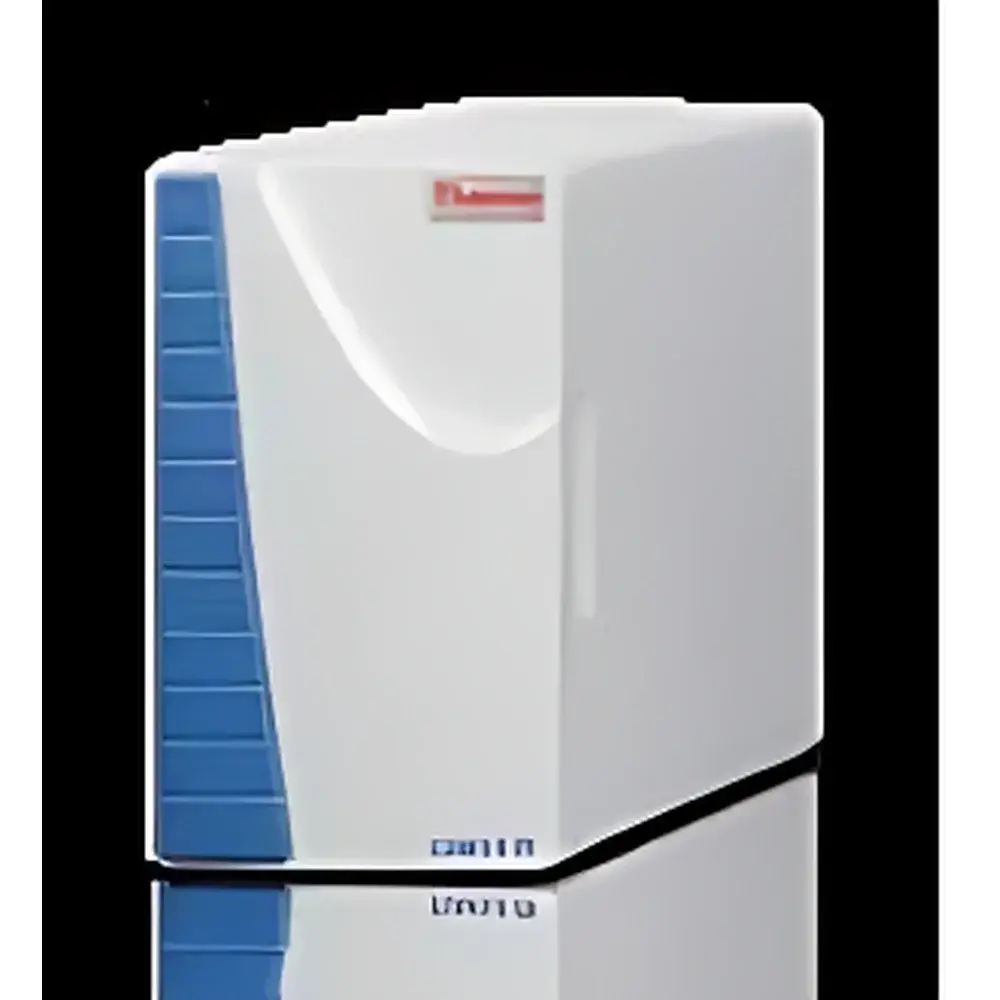
Thermo Scientific ConFlo IV Universal Interface for Isotope Ratio Mass Spectrometry
| Brand | Thermo Fisher |
|---|---|
| Origin | Germany |
| Manufacturer Type | Original Equipment Manufacturer (OEM) |
| Import Status | Imported |
| Model | ConFlo IV |
| Instrument Type | Continuous-Flow Interface for Stable Gas Isotope Ratio Mass Spectrometry |
| Measurement Precision | High-Precision Isotopic Ratio Detection |
| Reference Gas Compatibility | CO₂, N₂, CO, H₂, SO₂ (≥5 independent reference gas lines) |
| Automation Features | Auto-switching between external analyzers and working gases, real-time H₃⁺ factor monitoring and correction, fully automated gas dilution (1–100% range, extendable) |
Overview
The Thermo Scientific ConFlo IV Universal Interface is a high-precision, modular continuous-flow interface engineered specifically for stable isotope ratio mass spectrometry (IRMS) systems. It serves as the critical pneumatic and control bridge between IRMS instruments—such as the Delta V or 253 Plus—and upstream sample introduction devices, including elemental analyzers (EA), gas chromatographs (GC), laser absorption spectrometers, and offline preparation systems. Operating on the principle of continuous helium carrier gas flow with precise pressure and flow regulation, the ConFlo IV enables real-time isotopic analysis of light stable isotopes (e.g., δ¹³C, δ¹⁵N, δ¹⁸O, δ²H, δ³⁴S) in gaseous analytes. Its design adheres to the fundamental requirements of IRMS metrology: minimal memory effects, sub-nanoliter dead volume, thermal stability across all flow paths, and trace-level inertness to reactive species such as SO₂ and CO.
Key Features
- Multi-source compatibility: Simultaneous integration of up to five independent reference gas lines (CO₂, N₂, CO, H₂, SO₂) with individual pressure regulation and leak-tight stainless-steel pathways.
- Intelligent source switching: Fully automated, software-controlled valve sequencing enables seamless transition between EA, GC, and calibration gas inputs without manual intervention or system venting.
- H₃⁺ factor management: Integrated Faraday cup and electron multiplier monitoring allows real-time calculation and dynamic correction of the H₃⁺/H⁺ ratio—a critical parameter for accurate δ²H measurement in hydrogen-bearing compounds.
- Programmable gas dilution: Onboard mass flow controllers support fully automated, reproducible dilution of sample or reference gases from 1% to 100% (v/v) in 0.1% increments; extended dilution ranges achievable via custom configuration.
- Robust architecture: Constructed with electropolished 316 stainless steel and metal-sealed diaphragm valves; compliant with UHV-compatible cleaning protocols and bake-out up to 80 °C.
- Embedded diagnostics: Real-time monitoring of inlet pressures, flow rates, valve positions, and detector signal stability via Ethernet-connected firmware (Thermo Scientific Qtegra ISM platform).
Sample Compatibility & Compliance
The ConFlo IV supports gaseous analytes generated from solid, liquid, or gas samples processed through standardized IRMS sample preparation workflows—including flash combustion (EA), pyrolysis (TC/EA), gas chromatographic separation (GC-IRMS), and cryogenic trapping. It meets ISO 17025 requirements for method validation in accredited environmental, geochemical, and forensic laboratories. The interface’s gas handling architecture complies with ASTM D7924 (δ¹³C in natural gas), ASTM D6869 (δ¹⁵N in nitrogenous fertilizers), and USP guidelines for analytical instrument qualification. All firmware and control logic are designed to support 21 CFR Part 11-compliant audit trails when operated within Thermo’s Qtegra ISM software environment under GLP/GMP conditions.
Software & Data Management
Controlled exclusively via Thermo Scientific Qtegra Intelligent Scientific Data Solution (ISM) software, the ConFlo IV integrates natively into IRMS acquisition workflows. Qtegra provides synchronized timing for valve actuation, detector stabilization, peak integration, and H₃⁺ correction—ensuring full traceability of every analytical event. Raw data (ion currents, flow parameters, valve states) are stored in vendor-neutral .raw format with embedded metadata (sample ID, operator, timestamp, calibration history). Batch processing supports automated drift correction using multi-point reference gas bracketing, and uncertainty propagation follows GUM-compliant models per ISO/IEC Guide 98-3. Export options include CSV, ASCII, and direct LIMS integration via ODBC or Thermo’s Laboratory Informatics Gateway.
Applications
- Environmental forensics: Source attribution of methane emissions (δ¹³C-CH₄, δ²H-CH₄) from wetlands, landfills, and fossil fuel infrastructure.
- Food authenticity: Detection of adulteration in honey, wine, olive oil, and vanilla via compound-specific δ¹³C, δ¹⁸O, and δ²H signatures.
- Geochemistry: High-resolution carbon and sulfur isotope stratigraphy in sedimentary carbonate and sulfate minerals.
- Pharmaceutical metabolism studies: Position-specific isotope enrichment tracking (PSIE) in ¹³C-labeled drug metabolites using GC-IRMS coupling.
- Climate science: Triple-oxygen isotope analysis (¹⁶O, ¹⁷O, ¹⁸O) of atmospheric CO₂ and O₂ for paleoatmospheric reconstruction.
FAQ
What external instruments can be connected to the ConFlo IV simultaneously?
Up to three primary sample sources (e.g., EA, GC, TC/EA) plus five independent reference gas lines can be active in a single configuration; physical connection is managed via standardized Swagelok® 1/8″ VCR fittings.
Is the ConFlo IV compatible with non-Thermo IRMS systems?
Yes—when interfaced via analog/digital I/O and custom pressure/flow protocol mapping; however, full H₃⁺ correction and Qtegra synchronization require native Thermo IRMS hardware integration.
Does the ConFlo IV support reactive gases like SO₂ or NO?
Yes—its passivated stainless-steel manifold and chemically inert internal surfaces ensure long-term stability with SO₂, NO, CO, and Cl₂ at concentrations ≤1000 ppm; optional gold-plated components available for enhanced corrosion resistance.
How is calibration traceability maintained?
Each reference gas line is individually calibrated using NIST-traceable standard gases; calibration certificates and pressure decay test logs are archived automatically in Qtegra’s instrument history database.
Can dilution ratios be programmed per-sample in batch mode?
Yes—Qtegra ISM supports method-based dilution profiles, enabling variable 1–100% dilution settings across sample sequences without manual reconfiguration.




