
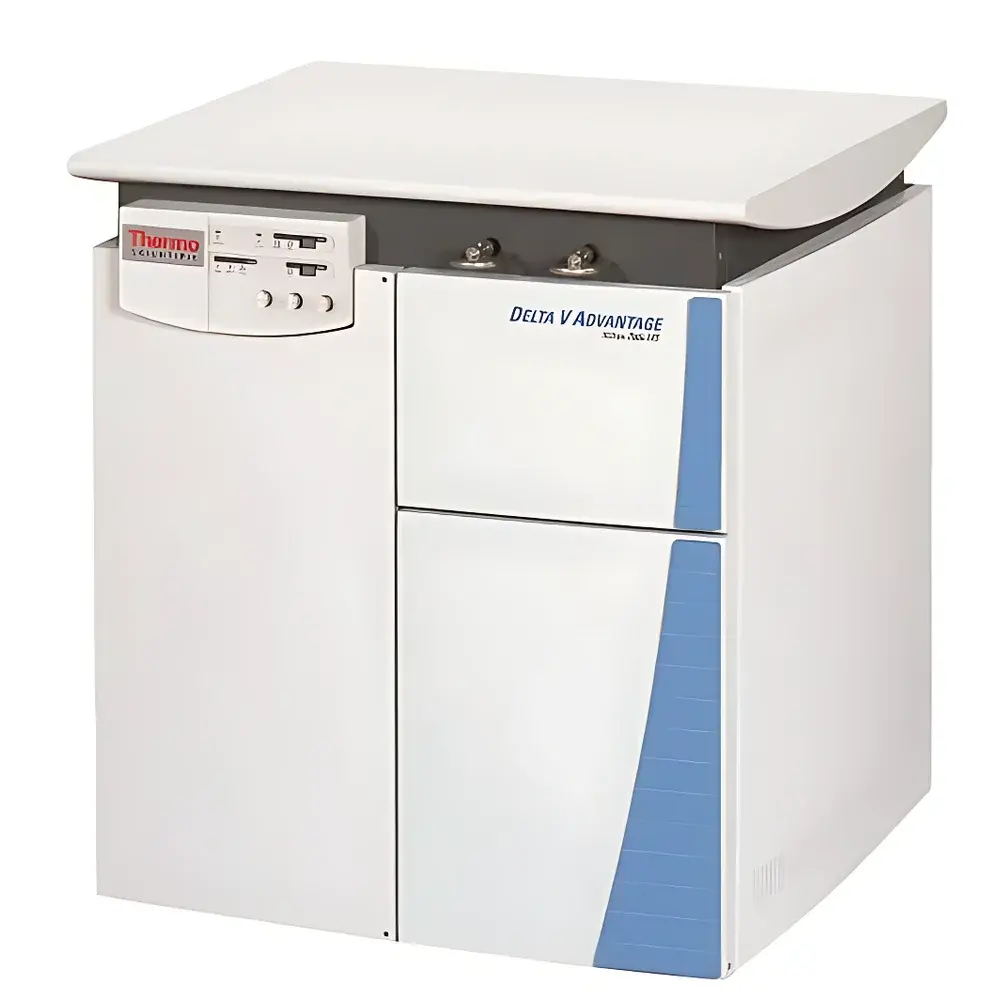
Thermo Scientific DELTA V Advantage Isotope Ratio Mass Spectrometer
| Brand | Thermo Fisher |
|---|---|
| Origin | Germany |
| Manufacturer Type | Original Equipment Manufacturer (OEM) |
| Origin Category | Imported |
| Model | DELTA V Advantage |
| Instrument Type | Stable Gas-Source Isotope Ratio Mass Spectrometer |
| Measurement Precision | High Precision |
| Price Range | USD 260,000 – 390,000 (based on configuration and regional duties) |
Overview
The Thermo Scientific DELTA V Advantage is a high-performance stable isotope ratio mass spectrometer (IRMS) engineered for precise, reproducible measurement of isotopic ratios in light elements—including carbon (¹³C/¹²C), nitrogen (¹⁵N/¹⁴N), sulfur (³⁴S/³²S), hydrogen (²H/¹H), and oxygen (¹⁸O/¹⁶O)—in gaseous analytes. Operating on the principle of magnetic sector mass spectrometry with Faraday cup and multi-collector detection, the DELTA V Advantage achieves high mass resolution and exceptional signal stability through its dual-inlet design, optimized ion optics, and ultra-stable vacuum architecture. Unlike quadrupole or time-of-flight systems, this magnetic sector IRMS delivers long-term instrumental drift < 0.05‰ per 24 hours under routine operation—critical for compliance with ISO 17025-accredited laboratories and longitudinal isotopic monitoring studies. Its gas-source configuration requires conversion of solid or liquid samples into pure, dry gases (e.g., CO₂, N₂, SO₂, H₂, CO, O₂) via offline or online preparation modules—ensuring compatibility with rigorous sample introduction protocols mandated in geochemical, environmental, and forensic applications.
Key Features
- High-resolution magnetic sector mass analyzer with 10–100 eV electron impact ionization and adjustable accelerating voltage for optimal peak shape and mass separation.
- Dual-inlet system with automated, computer-controlled valve sequencing enabling rapid switching between reference and sample gases—minimizing memory effects and maximizing throughput.
- Multi-collector array comprising up to nine Faraday cups (including configurable high-gain amplifiers) for simultaneous detection of multiple isotopes, supporting internal normalization and real-time δ-value calculation.
- Compact, modular chassis designed for laboratory integration—engineered for vibration resistance and thermal stability; operates continuously at ambient lab temperatures without external chiller dependency.
- Integrated vacuum architecture featuring turbomolecular pumps and cryo-trapping stages to maintain base pressure < 5 × 10⁻⁹ mbar—essential for low-background isotope measurements and minimizing interferences from residual air species.
- Robust electronics with digital signal processing (DSP) and lock-in amplification for enhanced signal-to-noise ratio, particularly critical for low-abundance isotopes such as ¹⁵N or ¹⁸O in trace-level samples.
Sample Compatibility & Compliance
The DELTA V Advantage interfaces seamlessly with a range of Thermo Scientific and third-party sample preparation systems—including EA IsoLink™ elemental analyzers (for C/N/S/H/O in solids), GasBench II™ (for carbonate δ¹⁸O/δ¹³C and water δ²H/δ¹⁸O), GC IsoLink™ (for compound-specific δ¹³C analysis), and LC IsoLink™ (for δ²H in non-volatile organics). All configurations support full traceability per ISO/IEC 17025:2017 requirements, including audit-ready electronic logs, calibration certificate management, and instrument performance verification (IPV) routines. The system complies with ASTM D7921 (isotopic analysis of biofuels), ASTM D6866 (radiocarbon-free content), and USP for method validation in pharmaceutical authenticity testing. Data integrity adheres to FDA 21 CFR Part 11 guidelines when paired with Thermo Scientific Qtegra ISM software configured for electronic signatures and audit trails.
Software & Data Management
Controlled exclusively via Thermo Scientific Qtegra ISM (Intelligent Scientific Management) software, the DELTA V Advantage supports fully automated acquisition, real-time data reduction, and compliant reporting workflows. Qtegra ISM implements GLP/GMP-compliant features including user role-based access control, electronic signature capture, change history logging, and secure database archiving (SQL Server or Oracle). Isotopic ratio calculations follow IUPAC-recommended conventions (δ-notation relative to international standards such as VPDB, AIR-N₂, VSMOW), with built-in correction algorithms for linearity, mass fractionation, and instrumental bias. Batch processing enables unattended overnight runs across hundreds of samples, while raw data (.raw) and processed results (.csv, .xlsx) are exportable for secondary statistical analysis (e.g., PCA, SIMCA) in R or Python environments.
Applications
- Food Authenticity & Traceability: Detection of adulteration in honey, olive oil, wine, and dairy products via multi-element isotopic fingerprinting (δ¹³C, δ¹⁵N, δ¹⁸O, δ²H).
- Environmental Forensics: Source apportionment of nitrate pollution (δ¹⁵N–NO₃⁻, δ¹⁸O–NO₃⁻), methane emissions (δ¹³C–CH₄), and pesticide degradation pathways.
- Geochemistry & Paleoclimatology: High-precision δ¹⁸O and δ¹³C analysis in foraminifera, speleothems, and ice-core CO₂ for reconstructing past temperature and atmospheric composition.
- Agricultural Research: Nitrogen use efficiency studies (¹⁵N tracer experiments), soil organic matter turnover modeling, and fertilizer origin tracing.
- Pharmaceutical & Clinical Research: Metabolic flux analysis using ¹³C-labeled tracers, isotopic dilution assays, and stable isotope-labeled internal standard quantification.
FAQ
What sample forms are compatible with the DELTA V Advantage?
Solid, liquid, or dissolved samples must first be converted to pure, dry gases (e.g., CO₂, N₂, SO₂, H₂, CO, O₂) using dedicated preparation systems—no direct injection of complex matrices is supported.
Does the system support compound-specific isotope analysis (CSIA)?
Yes—when coupled with GC IsoLink™ or LC IsoLink™ interfaces, it enables δ¹³C, δ²H, or δ¹⁵N measurement at the molecular level for individual compounds in complex mixtures.
How is calibration and long-term stability maintained?
Calibration uses certified reference materials (e.g., USGS40, IAEA-CH-7, NBS-19) in dual-inlet mode; daily standard bracketing and periodic linearity checks ensure δ-value accuracy within ±0.03‰ (1σ) for carbon and nitrogen.
Is remote monitoring or troubleshooting supported?
Qtegra ISM includes secure remote desktop capability for diagnostic support; all communication adheres to TLS 1.2 encryption and enterprise firewall policies.
Can the instrument be upgraded for additional elements or configurations?
Yes—the modular design supports field-installable upgrades including extended collector arrays, alternative ion sources (e.g., MC-ICP-MS interface kits), and enhanced vacuum packages for ultra-low background applications.
Related Products





