
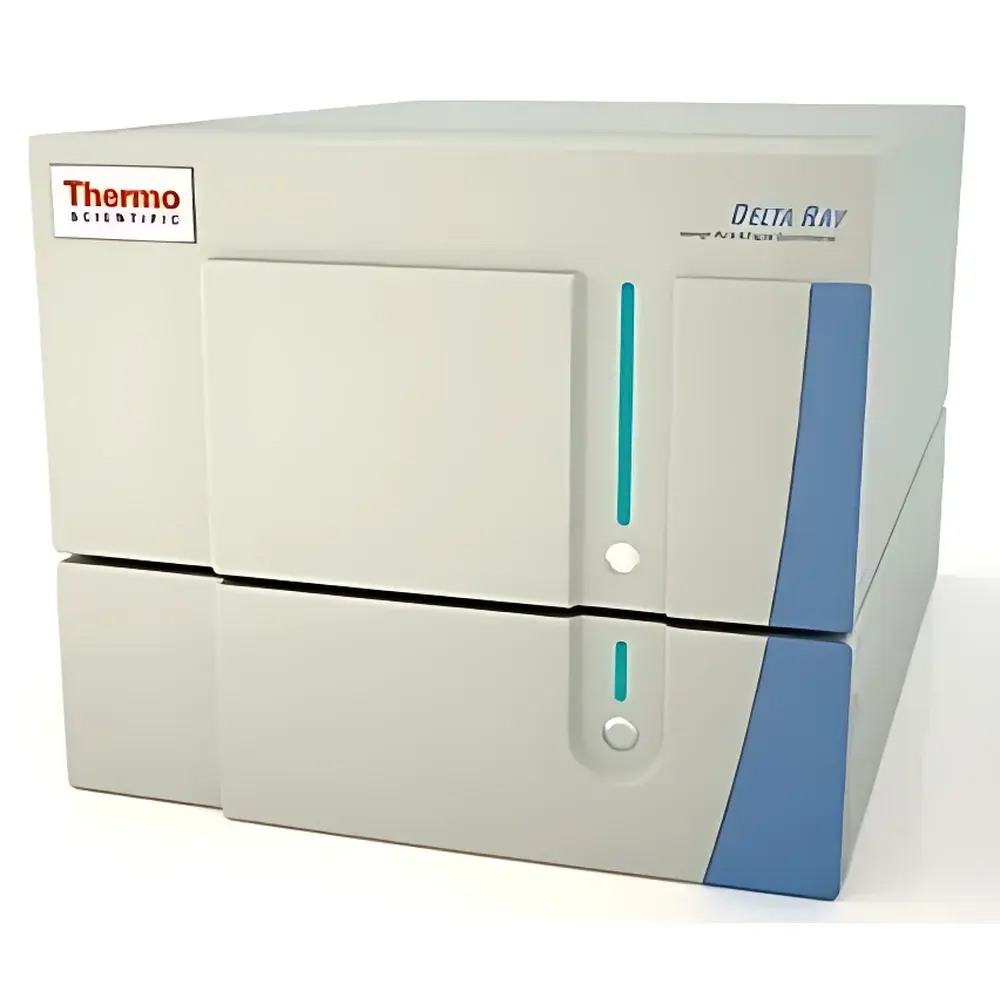
Thermo Scientific Delta Ray Isotope Ratio Infrared Spectrometer
| Brand | Thermo Fisher |
|---|---|
| Origin | Germany |
| Manufacturer | Thermo Fisher Scientific |
| Instrument Type | Stable Gas Isotope Ratio Analyzer |
| Model | Delta Ray |
| Measurement Targets | δ¹³C and δ¹⁸O in CO₂ |
| Precision | < 0.05‰ (1σ) for both δ¹³C and δ¹⁸O |
| Dynamic Range | 200 ppm to 100% CO₂ |
| Calibration Interface | Universal Reference Inlet (URI) with automated reference gas delivery and real-time calibration |
| Compliance | Designed for GLP/GMP-aligned workflows |
Overview
The Thermo Scientific Delta Ray Isotope Ratio Infrared Spectrometer is a high-performance, field-deployable analyzer engineered for precise, simultaneous measurement of carbon-13 and oxygen-18 isotope ratios (δ¹³C and δ¹⁸O) in carbon dioxide. Unlike traditional isotope ratio mass spectrometry (IRMS), the Delta Ray employs quantum cascade laser absorption spectroscopy (QCLAS) in the mid-infrared region—specifically targeting rovibrational transitions of CO₂ isotopologues at ~4.3 µm. This optical detection principle eliminates ion source degradation, vacuum system maintenance, and mass discrimination corrections inherent to IRMS, delivering inherently stable, drift-free isotope ratio measurements with minimal operator intervention. The instrument is optimized for continuous, unattended operation in both laboratory and remote environmental monitoring settings, including eddy covariance towers, volcanic observatories, forest canopy stations, and controlled-environment growth chambers.
Key Features
- Simultaneous dual-isotope analysis: Real-time, co-measured δ¹³C and δ¹⁸O values from a single CO₂ sample stream, each with precision better than 0.05‰ (1σ) over 1-hour averaging periods.
- Full dynamic range capability: Accurate quantification across CO₂ concentrations from 200 ppm to 100%—enabling direct analysis of ambient air, headspace gases, incubation effluents, and pure standard gases without manual dilution.
- Universal Reference Inlet (URI): An integrated, software-controlled interface that automates switching between sample and certified reference gases (e.g., NBS-19, IAEA-CO-1, USGS24), enabling on-the-fly bracketing calibration and long-term ratio stability tracking.
- Compact, modular architecture: Dimensions of 48.3 × 49.5 × 47.0 cm (19″ rack-mountable); total mass < 35 kg. Designed for low power consumption (< 200 W) and passive thermal stabilization—no external chillers or compressed air required.
- Ruggedized field readiness: IP54-rated enclosure with internal humidity and temperature compensation algorithms; validated for continuous operation at ambient temperatures from −10 °C to +40 °C and relative humidity up to 90% non-condensing.
Sample Compatibility & Compliance
The Delta Ray accepts gaseous CO₂ samples delivered via standard 1/8″ Swagelok fittings, compatible with common gas handling systems—including cryogenic traps, catalytic scrubbers, and continuous-flow interfaces from elemental analyzers (e.g., TC/EA, Flash EA). It meets essential regulatory and methodological frameworks for environmental and food authenticity applications: compliant with ASTM D7926–19 for stable isotope analysis of CO₂ in atmospheric studies; aligned with ISO 18351:2016 for isotopic characterization of greenhouse gases; and supports traceability to international isotope reference materials maintained by IAEA and NIST. Data integrity is ensured through time-stamped, checksum-verified raw absorbance spectra storage and configurable audit trails meeting FDA 21 CFR Part 11 and EU Annex 11 requirements.
Software & Data Management
Delta Ray is operated via Thermo Scientific Qtegra ISDS software—a platform built for regulated and research-grade laboratories. The software provides real-time spectral visualization, automated peak fitting using Voigt line profiles, multi-point calibration curve generation, and delta-value calculation against user-defined reference scales. All raw interferograms and processed results are stored in vendor-neutral HDF5 format with embedded metadata (instrument configuration, gas flow rates, pressure/temperature logs). Export options include CSV, Excel, and direct integration with LIMS via ODBC. Software validation packages (IQ/OQ/PQ documentation) and electronic signature support are available for GxP environments.
Applications
- Atmospheric & ecosystem science: Long-term δ¹³C and δ¹⁸O monitoring of atmospheric CO₂ at flux towers, ice core air extraction labs, and urban background sites to constrain biospheric and fossil fuel contributions.
- Plant physiology & paleoclimatology: High-temporal-resolution analysis of leaf-respired CO₂, soil respiration, and tree-ring cellulose-derived CO₂ for carbon assimilation pathway discrimination and drought stress response modeling.
- Vulcanology & geothermal monitoring: Field-deployed detection of magmatic CO₂ signatures via δ¹³C shifts preceding eruptive activity; integration with multi-gas sensors for fumarole gas screening.
- Food authenticity & traceability: Rapid verification of origin and processing history in beverages (wine, coffee, fruit juices), dairy products, and honey via CO₂ liberated from carbonates or organic acids—without derivatization or offline preparation.
- Carbon capture & storage (CCS): Quantitative tracking of injected CO₂ plume migration and reservoir integrity using isotopic fingerprinting of leakage gases at wellheads and near-surface soils.
FAQ
Does the Delta Ray require carrier gas or vacuum pumps?
No. As an optical spectrometer, it operates at ambient pressure and requires only a clean, dry sample gas stream—eliminating the need for helium, nitrogen, or mechanical vacuum systems.
Can it be interfaced with an elemental analyzer for solid sample analysis?
Yes. It is fully compatible with Thermo Scientific TC/EA and Flash EA systems via standard CO₂ transfer lines and optional heated transfer tubing kits for quantitative coupling.
How is data traceability maintained during extended unattended deployments?
Each measurement includes embedded timestamps, instrument ID, calibration event logs, and raw spectral hashes. Qtegra ISDS enforces role-based access control and immutable audit trails compliant with GLP and 21 CFR Part 11.
Is routine maintenance required beyond daily zero/span checks?
No scheduled consumables or periodic recalibration are needed. Laser wavelength stability is monitored continuously; optical alignment remains fixed for the instrument lifetime under normal operating conditions.
What reference materials are supported for δ¹³C and δ¹⁸O calibration?
Certified standards including NBS-19, IAEA-CO-1, USGS24, and LSVEC are natively supported via URI-driven bracketing protocols, with customizable scale normalization to VPDB or VSMOW.



